Category Archives: Jessie Buckley

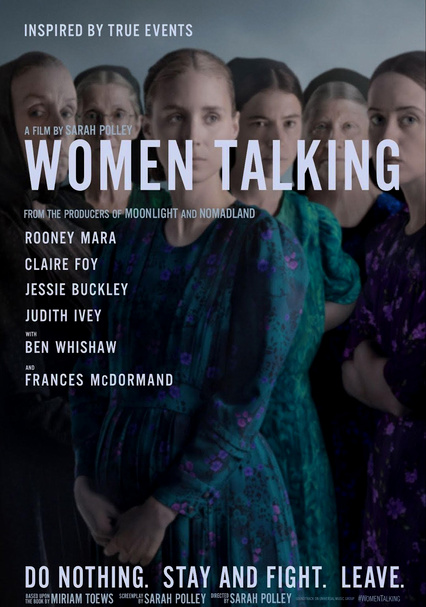
Women Talking-2022

Women Talking-2022

Director Sarah Polley

Starring Rooney Mara, Claire Foy, Jessie Buckley

Scott’s Review #1,341

Reviewed February 7, 2023

Grade: B+

Women Talking (2022) is a quiet film faithful to its title because it is about a group of women, well, talking. But, instead of idle gossip, these women have something powerful to say. They debate and discuss their fates throughout the film’s one hour and forty-four-minute running time.

It is written and directed by Sarah Polley, a former actress, and adapted from the recent 2018 novel of the same name written by Miriam Toews.

Shockingly, the film is inspired by actual events that took place in the ultraconservative Manitoba colony in Bolivia.

For years, the women of a rural colony have been drugged and raped nightly by demons punishing them for their sins. They have, until recently, acquiesced.

But when the women discover that these “demons” are the men of their community, they boldly decide to take a vote to determine what action to take.

The year is 2010, but the woman’s dress makes it seem like it’s the 1800s. I wasn’t sure of the year going in, save for a 1960s pop tune bursting from the speakers of a pushup truck, so the viewer can easily be misled or unclear.

A male rapist is caught and imprisoned, which leads the men to conveniently be out of town while the women have two days to make a decision. They will either stay and do nothing, stay and fight, or leave.

One male remains with the females; the kind teacher, August, played by Ben Whishaw. There also exists a transgender man who has been raped by men and no longer speaks to adults.

While the film is a slow one, it has something intelligent and interesting to offer. Despite the women being repressed and abused a feminist overtone is readily apparent which uplifts the dire tone.

Hollywood heavyweights like Frances McDormand and Brad Pitt executive-produced and produced, respectively, so Women Talking has big-time backing, deservedly so.

Comparisons to a female version of the classic play, Twelve Angry Men, cannot be overlooked by the astute viewer. The women are divided and not in agreement or harmony…..at first. The lone juror would be most similar to Ona (Rooney Mara), a sensible woman who reasons and weighs the pros and cons.

McDormand also appears in a small role as the grizzled and beaten-down ‘Scarface’ Janz, who has accepted her lot in life.

Mara, Claire Foy, and Jessie Buckley are the standouts; the latter two characters are fueled with anger at the revelations and mistrust of the men.

Liberties must be taken.

It’s mentioned that the women are not taught to read or write, but the characters are wise, cagey, and well-spoken. The ambiguity of what’s to become of the women slightly let me down. A decision has been reached, but what’s next?

Polley has directed a gem and garnered considerable notice for her project, and the kudos can’t come loudly enough. I thought it wise that, besides August, the male characters are either not seen or seen only from a long distance. Some are blurred entirely.

This adds to the mystique and grotesqueness of their actions.

An accurate ensemble picture that could easily be shaped into a stage play, Women Talking (2022), led by Polley and backers, produces a compelling narrative.

The point is well-intentioned and well-received that repression and victimization are alive and well.

Oscar Nominations: 1 win-Best Picture, Best Adapted Screenplay (won)

Independent Spirit Award Nominations: 1 win-Best Feature, Best Director-Sarah Polley, Best Screenplay, Robert Altman Award (won)

The Lost Daughter-2021

The Lost Daughter-2021

Director Maggie Gyllenhaal

Starring Olivia Colman, Dakota Johnson

Scott’s Review #1,232

Reviewed February 21, 2022

Grade: A

Throughout The Lost Daughter (2021), there is a constant feeling of dread that may result in viewer anxiety. We know that bad things are coming, but we do not know how or when. This makes for good drama done exceptionally well by director Maggie Gyllenhaal in her astounding debut.

She has acted for years and has made the transition to writer/director.

Gyllenhaal adapts her film from a novel written by Italian author Elena Ferrante. The experience is extremely female-centered, and having a female pen both book and film makes it a rich and authentic project.

The result is a brilliant depiction of motherhood and choices, making it essential for everyone to see and appreciate this film.

However, the film is not for everyone, nor will it please those seeking a conventional work about mother and daughter love and moments of happily skipping through the field of daisies. It has feel-good moments, but it’s much darker than some might expect.

For me, those aspects are what make The Lost Daughter so damned amazing.

We meet middle-aged Leda (Olivia Colman) when the woman embarks on a seaside vacation in Greece. She begins to observe a young mother, Nina, played by Dakota Johnson, and her daughter, Elena, on the beach and becomes obsessed with them.

Leda unwisely butts heads with the mother’s menacing extended family, who may be mafia-related.

Leda begins to have memories of her early motherhood when she struggled to raise two young girls while balancing her career as a professor. When she spontaneously steals Elena’s doll, she becomes increasingly obsessive, battling moments of rage and emotion.

Colman is a perfect choice for the central character. From the first moment she appears on the screen, we know there is conflict surrounding her. She is consumed by anger and either guilt or tension.

The actress is outstanding at portraying Leda’s complexities through her eyes and facial expressions. Many shots of Leda quietly observing events or sitting on the beach, deep in thought, are powerful.

Though a quiet film, The Lost Daughter never drags or lags, thanks to Gyllenhaal’s perfect portrayal of a doleful atmosphere. I was dying to know Leda’s secrets, and the interspersing flashbacks to a young Leda, wonderfully played by Jessie Buckley, finally provide resolution.

But that’s just the beginning of the fun. Once Leda’s backstory is revealed, and Gyllenhaal makes us wait quite a while for the reveal, there are more places for the film to go, like what about the stolen doll?

The viewer will not only wonder why Leda stole the doll but also why she won’t return it, especially when it’s known how desperately the family wants it back. Will they kill her when they find out she has it?

Beneath all the drama, a lingering question is posed to the viewers. Do I want to be a parent? The film is not only for women, but men can certainly ask themselves the same question.

The inclusion of a male character played by Ed Harris is evidence of this. In his youth, he struggled with being a father.

The film has a sense of purpose and meaning that many films lack. A film that poses questions and makes the viewer squirm a bit is top-notch for me. The basic story of a lone woman on vacation evolves into a tale of intensity and psychological warfare within oneself and one’s feelings.

The Lost Daughter (2021) is a complicated watch, but it offers a lesson in outstanding acting, directing, writing, and how atmosphere and mood can enhance a story layered with intrigue.

As shocking and unsettling as moments are, I was left feeling satisfied that I had seen something of worth and merit.

I can’t wait to see what Gyllenhaal does next.

Oscar Nominations: Best Actress-Olivia Colman, Best Supporting Actress-Jessie Buckley, Best Adapted Screenplay

Independent Spirit Award Nominations: 3 wins-Best Feature (won), Best Director-Maggie Gyllenhaal (won), Best Screenplay (won), Best Supporting Female-Jessie Buckley

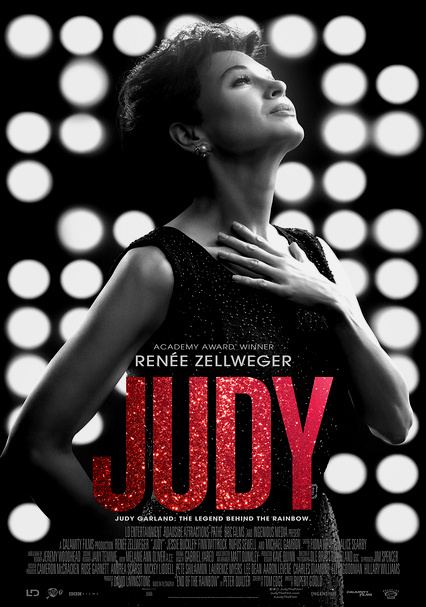
Judy-2019

Judy-2019

Director Rupert Goold

Starring Renee Zellweger

Scott’s Review #946

Reviewed October 14, 2019

Grade: A

Creating a film about an iconic figure like Judy Garland is undoubtedly a challenging task. Casting the role is even tougher.

Both points come together with perfect symmetry as director Rupert Goold provides Judy (2019) with heart, hope, and a sense of sadness. Rene Zellweger is astounding in the title role as she embodies the character.

The film is excellent and an accurate telling of the real-life person.

The period is 1967, and we meet the adult Judy Garland (Zellwegger) well after midnight, having performed with her two young children in tow. Haggard, they are informed by the Los Angeles hotel staff that their room has been given up due to non-payment.

The American singer and actress is broke due to bad marriages, drugs, and alcohol. The star is forced to return to her ex-husband for shelter—the two quarrel about the children.

The film does not focus solely on the late 1960s and the final years of Garland’s life, but also delves back to her debut as Dorothy in The Wizard of Oz (1939).

The pressures put upon the aspiring actress to perform, lose weight, and maintain her energy are shown in savage fury, so that the audience realizes how the young girl has turned into a boozy, unreliable middle-aged woman.

Hollywood ruined her innocence.

Zellweger is beyond brilliant. Having disappeared from the spotlight for several years, the actress is back with a vengeance, having something to prove. Prove she does as she becomes Judy Garland.

From her small but expressive eyes to her nervous movements and pursed lips, she delivers a flawless performance and has been rewarded with praise across the board.

It is a remarkable portrayal that should be remembered in history.

Much of the film takes place in London as Garland is forced, for financial reasons, to agree to a series of concerts to bring in cash. This necessitates leaving her children behind.

A poignant scene unfolds in a phone booth as Judy reaches the heartbreaking conclusion that her children would prefer the stability of living with their father. Though she understands, the star crumbles in sadness and loneliness.

A treat is the showcasing of Garland’s compassion for others deemed outcasts, as she also was. Gravitating towards gay men, she spots one gay couple in the audience night after night and befriends them as they eagerly await her exit from the theater one night.

She suggests dinner, and the dumbfounded couple clumsily searches for a restaurant open that late, finally offering to make her scrambled eggs at their flat.

Things go awry, but it hardly matters in a heartfelt scene that exposes the prejudices same-sex couples faced as recently as the 1960s and the champion Garland was to the LGBTQ community.

The iconic “Over the Rainbow” is featured late in the film and perfectly placed. Judy ends her touring engagement due to hecklers but returns for a final night on stage, where she asks to perform one last song.

She breaks down while singing “Over the Rainbow,” but recovers with the encouragement of supportive fans and can complete the performance.

Judy asks, “You won’t forget me, will you?” She does not live long thereafter and dies in the summer of 1969. The scene is painful, and not a dry eye is left in the house.

Judy (2019) is a wonderful tribute to the life and times of a Hollywood legend. The film is neither a complete downer nor cheerful.

What the filmmakers do is make it clear that Garland always had hope for a better life and for the happiness that eluded her. She was kind to most and loved her children beyond measure.

Zellweger will likely eat up a plethora of awards throughout the season, as she should.

Oscar Nominations: 1 win-Best Actress-Renee Zellweger (won), Best Makeup and Hairstyling

Independent Spirit Award Nominations: 1 win-Best Female Lead-Renee Zellweger (won)