Tag Archives: Merritt Wever

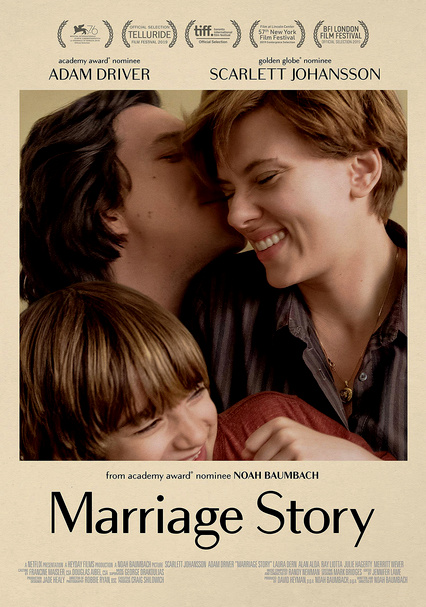
Marriage Story-2019

Marriage Story-2019

Director Noah Baumbach

Starring Adam Driver, Scarlett Johansson

Scott’s Review #959
Reviewed November 14, 2019

Grade: A

Marriage Story (2019) is a film that could have been generic, melodramatic, or contrived. Before its release, it was described as an excellent” version of Kramer vs. Kramer (1979) or Terms of Endearment (1983).

Those are excellent films, but marginally sappy and overwrought. Marriage Story excels at being a brilliant, powerful, and realistic portrayal of a marriage disintegrating, painting a picture of how good people can turn ugly under certain circumstances.

Believe the hype of how good this film is.

Taking place in both New York City and Los Angeles, we meet Charlie and Nicole Barber (Adam Driver and Scarlett Johansson), a theater director and his wife, an actress who stars in his plays.

They fill notebook paper with what they love most about each other, and the list is lengthy.

Appearing to be madly in love, the audience soon realizes that the couple is amid an amicable separation, the writings a result of an assignment by a “separations counselor”, hired to make things easier.

Charlie and Nicole share an eight-year-old son named Henry. Nicole returns to Los Angeles to resume her acting career and spend time with her mother (Julie Hagerty) and sister (Merritt Wever). Adam, successful in New York City, plans to stay and reside with his son.

Nicole hires a tough lawyer, Nora (Laura Dern), while Charlie begrudgingly hires semi-retired attorney Bert Spitz (Alan Alda), and later Jay (Ray Liotta). Nicole and Charlie are sensible, planning to work things out on their own, only needing representation for formalities, or so they think.

The situation escalates, spinning out of control as their divorce becomes increasingly hostile, as custody of their young son ups the ante. Qualities they once loved about each other become hate-filled arguments as the couple fights and feuds, as their attorneys scramble for a leg up.

Can the couple save themselves as secrets bubble to the surface, and situations be used against each other?

The film is a lengthy two hours and sixteen minutes, so the plot takes time to capture its viewer. When it eventually takes hold, it never lets go, forcefully enrapturing the watcher.

We care for both Charlie and Nicole, and while sympathizing with each other at different times, both characters are written as benevolent.

There is no villain except the divorce itself.

The key to success is in the writing. Director, Noah Baumbach, known for The Squid and the Whale (2005), and Frances Ha (2012) knows how to craft witty and clever dialogue, weaving comedy and drama intricately together.

He can make the viewer laugh and cry within the same scene.

The screenplay is the best part of the film because it is laden with crackling words and interesting situations.

Marriage Story reminds me of a Woody Allen film. Feeling improvised, unsure if any of the dialogue is, the characters speak lengthy soliloquies and engage in endless chatter with each other or themselves.

This results in a powerful medium of self-expression and a “talkie” movie.

The banter between characters is not drivel nor gibberish but contains significant, emotionally rich meaning and flavor.

The film belongs to Driver and Johansson, each delivering a home run. Driver is the stronger of the two, but not by much, and this is only because his emotional scenes feel rawer than hers do.

When the actors engage in a knock-down, drag-out fight, the scene is lengthy and exceptionally well-acted, with each taking turns verbally attacking the other. Vicious rage and emotional fury come to the forefront.

This is the best scene in the film.

Dern, Alda, and Liotta are terrific, bringing respect to the film. Each has been on the Hollywood scene for a long time, and each plays an attorney. While Dern’s and Liotta’s characters are sharks, Alda is a reasonable and realistic older man who has seen it all.

Burt lays down the facts for Charlie, making him realize how much is at stake. Dern shines as the sexy blonde attorney who wears revealing clothes and legs for miles. Grizzled Liotta plans to win at all costs. What a delight to see these veterans bring electricity to each scene.

Lastly, I adore the bi-coastal locales of New York City and Los Angeles. The big cities burst with meaning and are as different as day and night, as the film explains.

Charlie is a New Yorker, and Nicole is a California girl at heart. The numerous scenes shot on location in both cities lend the film richness and texture.

With Marriage Story (2019), Baumbach creates his best and most personal film.  Rumored to be partly autobiographical, he takes a subject matter that most assume has already been exhausted and spins the story in a different direction, making it feel fresh.

The aspects all come together in an experience that is emotional, powerful, and intelligent. The film is a treasure and a shining example to young filmmakers that good writing always prevails.

Oscar Nominations: 1 win-Best Picture, Best Actor-Adam Driver, Best Actress-Scarlett Johansson, Best Supporting Actress-Laura Dern (won), Best Original Screenplay, Best Original Score

Independent Spirit Award Nominations: 2 wins-Best Feature, Best Screenplay (won), Robert Altman Award (won)
Charlie Says-2019

Charlie Says-2019

Director Mary Harron

Starring Hannah Murray, Sosie Bacon

Scott’s Review #936

Reviewed August 28, 2019

Grade: B

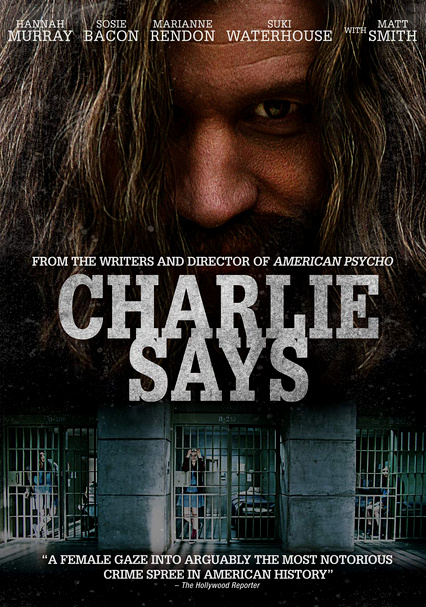
With the very high-profile release of Quentin Tarantino’s Once Upon a Time in Hollywood (2019) centering around the sadistic Manson murders of 1969, Charlie Says (2019) is another film that delves into the same story, though in a very different way.

The latter takes the perspective of the followers, victimizing them and examining the choices they made that affected the rest of their lives.

The angle is of interest, but the production never completely takes off, resulting in an uneven experience that requires more grit and substance.

Karlene (Merritt Wever), a female graduate student focused on women’s studies, takes an interest in three followers who were viciously killed in the name of their “god”, Charles Manson.

A few years after their arrests, they co-exist together in relative solitary confinement in a California penitentiary. They remain under the delusion that Manson is their leader and their deeds were all part of a grand cosmic plan until Karlene slowly brings them out of their haze of unreality with heartbreaking results.

The casting of the real-life figures is as follows: Charles Manson (Matt Smith), Leslie Van Houten (Hannah Murray), Patricia Krenwinkel (Sosie Bacon), and Susan Atkins (Marianne Rendon).

Each is a prominent character, with the central figure being Leslie “Lulu” and her complex relationship with Manson.

The newest to be recruited, the audience witnesses her hypnotic possession and her occasional uncertainty about the cult. For a fleeting moment, she is even tempted to leave, which the film hammers home to the audience.

Murray plays the character well, but does not resemble her enough for praise, though we read the conflict on her face very well. She is meant to be the thoughtful member of the Manson Family, whereas Patricia and Susan are more reactionary and temperamental, especially Susan.

Whether this is how things were is not known. Still, I always had a gnawing feeling throughout the running time that historical accuracy may have been secondary to the story points and dramatic effect.

Charlie Says is bothersome because of the realization that the girls were recruited and fed lies, falling for the deceit, hook, line, and sinker.

The followers were indeed brainwashed into Manson’s disturbing version of reality, and that fact is alarming, as the girls were not dumb people, only vulnerable young women.

Decades later, it is easy to think of other victims polarized by a central or controversial figure, whether it be in politics or another arena. The lesson learned is that people can be easily influenced.

The actual “murder night” and the death of Sharon Tate are featured, but up-close and personal gore is thankfully avoided. The actress, well known to have suffered a terrible fate, to say nothing of her unborn baby, is a small but crucial aspect of the film.

When one of the girls watches one of Tate’s films in her cell, another girl clamors for her to turn off the film, beginning to feel pangs of guilt and remorse.

The film questions the girl’s responsibilities for their actions, a fact that in real life many wrestled with, including the courts and parole boards. Were they merely duped in the cleverest of ways, or do they deserve their fates?

Spared of the electric chair due to a California law, a positive aspect of the film is a current update of the happenings of each girl, now over forty years later, as mature women. Lulu and Patricia remain incarcerated while Susan has died in prison.

After the film closed and a good measure of time was left to ponder the movie, I was left feeling slightly less than fulfilled and desiring a bit more.

Charlie Says (2019) feels safe and lacks enough grit or bombast, although it is well-intended. The film is clearly from a feminist point of view and is an interesting watch, though, given the subject matter, I had hoped for more substance.

Welcome to Marwen-2018

Welcome to Marwen-2018

Director Robert Zemeckis

Starring Steve Carell, Leslie Mann

Scott’s Review #892

Reviewed May 1, 2019

Grade: B

Welcome to Marwen (2018) is a feature film that flew under the radar at the time of release, suffering from mostly poor, if not scathing, reviews.

Having debuted in the last quarter of the year, the anticipation was assuredly for Oscar love, but this was not to be, as the film was a box office and critical disappointment.

Despite a marvelous and sympathetic portrayal by Steve Carell and bold creativity in the animation, the film lags and misfires in the storytelling, never completely coming together despite a heartfelt effort.

Based on a powerful true story chronicled much better in documentary form, the film follows Mark Hogancamp (Carell), a man struggling with post-traumatic stress syndrome after being physically assaulted.

He creates a fictional village to deal with his violent trauma as a form of escapism. Mark teeters between fantasy and reality as his various action figures mirror both himself and other people in his life, from the benevolent – his pretty new next-door neighbor, Nicol (Leslie Mann) – to the malicious – his attackers.

Director Zemeckis is no stranger to cool and innovative visual effects. Having created films like Back to the Future (1985), Death Becomes Her (1992), and Forrest Gump (1994), his track record is proven.

Though far from a masterpiece, Welcome to Marwen’s most outstanding achievement is its look, with stunning and realistic figurines coming to life with splendid effect.

The modified fashion dolls are morphed into action heroes, livening up the film and making it a spectacle compared to the morose everyday life that Mark lives in.

As Mark frequently escapes into his soothing, self-created fantasy world, named Marwen, the mostly female characters are strong, resilient, and protective of him. He even embarks on a fantasy romance with Nicol and faces both sweet moments with her as well as a peril from Nazis.

The negative to the fantasy sequences is in the climax, as Zemeckis teeters too broadly towards a full-fledged action film with over-the-top segments and an overly lengthy battle scene.

The real-life scenes don’t work as well, as Mark’s small-town residence is gloomy and depressing, offering little interest. Presumed to be two hours outside of New York City, the reason Nicol moves to the town is never explained, and her true intentions remain mysterious.

The presence of her aggressive ex-boyfriend seems forced, and Mark’s romantic interest in her becomes awkward. The main drawback is a lack of romantic chemistry between Carell and Mann, which results in little reason to root for the pair to be together.

The film contains an admirable progressive slant as Mark, while straight in his sexuality, is enamored with women’s shoes and collects hundreds of sensible and erotic pairs.

The key to his attack as briefly shown via flashback is his boasting to redneck types while inebriated, his love of the shoes. This plot point is essential to the film, yet not fleshed out well. What do we know about his attackers? Did they assume Mark was gay, prompting the attack?

Since the attack is deemed a hate crime, we can only assume the answer is yes, but I had hoped for a bit more depth and more about Mark’s backstory.

Based on the 2010 documentary Marwencol, Welcome to Marwen (2018) is a production that asks the viewer to revel in a wonderful fantasy world and marvel at the resulting creativity, escaping into a life-like adventure zone.

The story remains uneven with a bandied-about romance that never comes together, uneven storytelling, and a mediocre conclusion. While I admire Welcome to Marwen’s intentions, the film ultimately falls short of delivering.

Birdman-2014

Birdman-2014

Director Alejandro G. Iñárritu

Starring Michael Keaton, Edward Norton, Emma Stone

Scott’s Review #190

80000643

Reviewed November 6, 2014

Grade: A

Birdman (2014) is a unique art film that, happily, has garnered major exposure and publicity because a movie like this runs the risk of receiving praise and notice only from the art-house crowd itself.

The film’s star, Michael Keaton, portrays Riggan Thomson, a former action hero superstar from the 1990s, who was made famous for the “Birdman” character he created.

Having made sequels to the film, his career has since dried up and he hopes to establish credibility and prove himself a real actor by writing, directing, and starring in his play.

The film is set in and around the Broadway theater in New York City.

As opening night approaches, he struggles to pull everything together and emit a successful production while faced with an injured terrible actor, a difficult actor, his insecurities, and a miserable theatre critic destined to ruin his big chance.

To make matters worse, his daughter Sam, played by Emma Stone is a recovering drug addict who hangs around the theatre distracting actors with her charm and good looks.

Naomi Watts and Edward Norton play Leslie and Mike, other cast members in the production. Watts is sympathetic as the emotional actress with a heart of gold who finally has her dream of performing on Broadway realized.

Norton, outstanding as Mike, is blunt yet socially awkward and can only perform truthfully on stage.

Keaton is simply a marvel as he plays a dark and vulnerable man. He hates and wishes to shed his ridiculous movie persona of yesteryear and secretly cringes when recognized by fans. He uses it with a voice inside his head when he played “Birdman” years earlier.

The uniqueness of the film is the use of what seems like one long take as the action rarely stops and is ongoing. The film belongs to Keaton, who wonderfully relays vulnerability, pain, and fear within with an outward persona of bravery and masculinity.

Throughout the film I wondered, is Riggan suicidal? What is real and what is imagined? Are certain scenes foreshadowing later events?

The film has much depth.

One marvels at how art imitates life, is Keaton portraying himself? He was the original Batman in the successful superhero franchise beginning in 1989 and his career tanked shortly after.

Birdman is a comeback film for him and he is devastatingly good.

Norton’s character Mike impressed me. He is blunt flawed, scared, and addicted to the stage.

Stone has one particularly brilliant scene as she lambasts her father and with regret, later on, tells him that the world has moved on without him and that he is irrelevant just like everyone else. It is a powerful scene.

In another, Riggan is locked outside the theater during the performance, clad only in his underwear. How on earth will he return to the stage and complete the show? The quick slights at current Hollywood superstars playing superheroes, specifically Robert Downey Jr. are deliciously naughty.

It is impossible to predict what will come next and the film is very New York theater style. Keaton’s run-in with a theater critic in a cocktail bar is the best scene in the film as the critic’s vicious critique of “You’re a celebrity, not an actor” resonates with both pain and tremendous anger for Riggan.

Riggan is a sensitive, struggling man and Keaton so wonderfully shows his vulnerability in every scene.

Oscar Nominations: 4 wins-Best Picture (won), Best Director-Alejandro G. Iñárritu (won), Best Actor-Michael Keaton, Best Supporting Actor-Edward Norton, Best Supporting Actress-Emma Stone, Best Original Screenplay (won), Best Sound Editing, Best Sound Mixing, Best Cinematography (won)

Independent Spirit Award Nominations: 3 wins-Best Feature (won), Best Director-Alejandro G. Inarritu, Best Male Lead-Michael Keaton (won), Best Supporting Male-Edward Norton, Best Supporting Female-Emma Stone, Best Cinematography (won)