Tag Archives: Mark O’Brien

Ready or Not-2019

Ready or Not-2019

Director Tyler Gillett, Matt Bettinelli-Olpin

Starring Samara Weaving, Adam Brody

Scott’s Review #1,040

Reviewed July 16, 2020

Grade: B+

A hybrid of dark comedy, horror, and whodunit, Ready or Not (2019) is a splatter of a good time.

Witty and macabre, the film is patterned after Knives Out (2019), Clue (1985), and the television series Riverdale, with a dash of Kill Bill Volume 1 and 2 (2003-2004) peppered in for good measure.

The results are fantastic, gory, and fun, and the pacing is on point. The best aspect is the unpredictability factor, as the conclusion cannot be drawn, and the audience willingly plunges along for a thrilling ride, eager to see what happens next.

The film begins with a mysterious flashback.

A young boy living in a vast mansion is confronted by an injured man begging for help. The boy cries out for his family, who shoots the man dead.

Decades later, happier events transpire as Alex (Mark O’Brien) and Grace (Samara Weaving) enjoy a lavish wedding at the Le Domas family estate.

Alex’s family is extremely wealthy, and he asks Grace if she is certain she wants to join the family. Why wouldn’t she welcome a life of pampering and all the money she can imagine? She readily tells Alex that, yes, she is sure she wants to marry him.

After the wedding, Alex and Grace are summoned by the family to partake in a game, a family tradition. Grace will choose a card, and everyone will play that game.

When Grace chooses the Hide-and-Seek card, the reactions are morose. When she gleefully trots off at midnight to hide, she assumes it is an innocent game.

She quickly realizes that the family is determined to kill her as part of an ancient legend involving a deal to keep the family money secure. Grace spends the night being pursued by members of the family while the household staff is accidentally killed off.

Being a horror film, the rosy start to the movie (the wedding) is delicious and short-lived, as any fan of the horror genre knows that dreary events are soon in store. The fun is waiting for the other shoe to drop and the body count to begin rising.

Ready or Not succeeds most when Grace is being pursued, and when she emerges from the dumb waiter, thinking she will give up the game and enjoy a good night’s sleep, the scenes are spectacular. A house-nanny is shot by a doltish family member who mistakes her for Grace, cowering behind a bed.

At that moment the bride realizes she is screwed.

The final thirty minutes of Ready or Not take a different turn as victimized Grace turns into revenge-seeking Grace. Think Carrie White at the prom after being soaked with pig blood.

As Grace lumbers through the mansion in her blood-streaked white gown, happy to kill any one of the filthy rich family members, she has the most fun pummeling Alex’s mother, Becky Le Domas (Andie MacDowell), to death with a box, which he gets to witness.

Revenge Grace is like Uma Thurman’s The Bride in the Kill Bill double-feature.

Released the same year as Knives Out (2019), both films portray the wealthy characters similarly, rendering them as shallow and unlikable as humanly possible. Insipid, money-hungry, and impolite, they treat each other as badly as those considered beneath them.

Daniel (Adam Brody), may turn out to be Grace’s knight in shining armor but can he be trusted? Can Alex?

Snippets of the 1985 comedy Clue emerge as secret passageways are revealed, and one death is reminiscent of the singing telegram girl’s death, as the character leaps into the room only to be instantly killed. It’s a fun scene and not too seriously intended, which makes it enjoyable.

The gothic nature of the series Riverdale also comes into play with the modern trimmings and dark ambiance.

Ready or Not (2019) successfully produces what it intends to—an entertaining, cleverly written horror yarn. With a clear feminist stance and oozing with wealth and glamour, the rich people are horrible and ultimately get what they deserve.

This is satisfying to the viewer despite the silly motivations of the family.

Played for laughs, the film doesn’t take itself too seriously despite a subdued lesson in overindulgence and entitlement—a crackling, fun late-night offering.
Marriage Story-2019

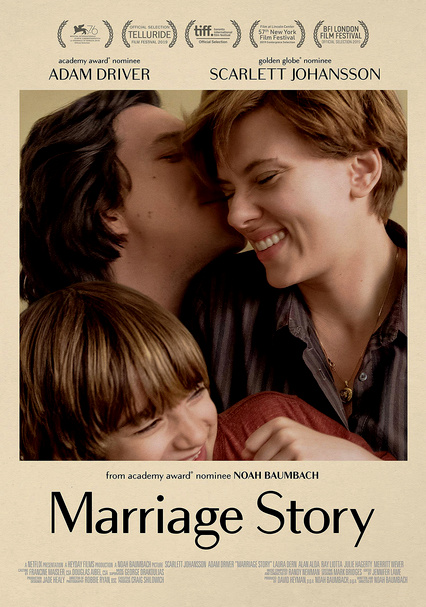
Marriage Story-2019

Director Noah Baumbach

Starring Adam Driver, Scarlett Johansson

Scott’s Review #959

Reviewed November 14, 2019

Grade: A

Marriage Story (2019) is a film that could have been generic, melodramatic, or contrived. Before its release, it was described as an excellent” version of Kramer vs. Kramer (1979) or Terms of Endearment (1983).

Those are excellent films, but marginally sappy and overwrought. Marriage Story excels at being a brilliant, powerful, and realistic portrayal of a marriage disintegrating, painting a picture of how good people can turn ugly under certain circumstances.

Believe the hype of how good this film is.

Taking place in both New York City and Los Angeles, we meet Charlie and Nicole Barber (Adam Driver and Scarlett Johansson), a theater director and his wife, an actress who stars in his plays.

They fill notebook paper with what they love most about each other, and the list is lengthy.

Appearing to be madly in love, the audience soon realizes that the couple is amid an amicable separation, the writings a result of an assignment by a “separations counselor”, hired to make things easier.

Charlie and Nicole share an eight-year-old son named Henry. Nicole returns to Los Angeles to resume her acting career and spend time with her mother (Julie Hagerty) and sister (Merritt Wever). Adam, successful in New York City, plans to stay and reside with his son.

Nicole hires a tough lawyer, Nora (Laura Dern), while Charlie begrudgingly hires semi-retired attorney Bert Spitz (Alan Alda), and later Jay (Ray Liotta). Nicole and Charlie are sensible, planning to work things out on their own, only needing representation for formalities, or so they think.

The situation escalates, spinning out of control as their divorce becomes increasingly hostile, as custody of their young son ups the ante. Qualities they once loved about each other become hate-filled arguments as the couple fights and feuds, as their attorneys scramble for a leg up.

Can the couple save themselves as secrets bubble to the surface, and situations be used against each other?

The film is a lengthy two hours and sixteen minutes, so the plot takes time to capture its viewer. When it eventually takes hold, it never lets go, forcefully enrapturing the watcher.

We care for both Charlie and Nicole, and while sympathizing with each other at different times, both characters are written as benevolent.

There is no villain except the divorce itself.

The key to success is in the writing. Director, Noah Baumbach, known for The Squid and the Whale (2005), and Frances Ha (2012) knows how to craft witty and clever dialogue, weaving comedy and drama intricately together.

He can make the viewer laugh and cry within the same scene.

The screenplay is the best part of the film because it is laden with crackling words and interesting situations.

Marriage Story reminds me of a Woody Allen film. Feeling improvised, unsure if any of the dialogue is, the characters speak lengthy soliloquies and engage in endless chatter with each other or themselves.

This results in a powerful medium of self-expression and a “talkie” movie.

The banter between characters is not drivel nor gibberish but contains significant, emotionally rich meaning and flavor.

The film belongs to Driver and Johansson, each delivering a home run. Driver is the stronger of the two, but not by much, and this is only because his emotional scenes feel rawer than hers do.

When the actors engage in a knock-down, drag-out fight, the scene is lengthy and exceptionally well-acted, with each taking turns verbally attacking the other. Vicious rage and emotional fury come to the forefront.

This is the best scene in the film.

Dern, Alda, and Liotta are terrific, bringing respect to the film. Each has been on the Hollywood scene for a long time, and each plays an attorney. While Dern’s and Liotta’s characters are sharks, Alda is a reasonable and realistic older man who has seen it all.

Burt lays down the facts for Charlie, making him realize how much is at stake. Dern shines as the sexy blonde attorney who wears revealing clothes and legs for miles. Grizzled Liotta plans to win at all costs. What a delight to see these veterans bring electricity to each scene.

Lastly, I adore the bi-coastal locales of New York City and Los Angeles. The big cities burst with meaning and are as different as day and night, as the film explains.

Charlie is a New Yorker, and Nicole is a California girl at heart. The numerous scenes shot on location in both cities lend the film richness and texture.

With Marriage Story (2019), Baumbach creates his best and most personal film.  Rumored to be partly autobiographical, he takes a subject matter that most assume has already been exhausted and spins the story in a different direction, making it feel fresh.

The aspects all come together in an experience that is emotional, powerful, and intelligent. The film is a treasure and a shining example to young filmmakers that good writing always prevails.

Oscar Nominations: 1 win-Best Picture, Best Actor-Adam Driver, Best Actress-Scarlett Johansson, Best Supporting Actress-Laura Dern (won), Best Original Screenplay, Best Original Score

Independent Spirit Award Nominations: 2 wins-Best Feature, Best Screenplay (won), Robert Altman Award (won)

Bad Times at the El Royale-2018

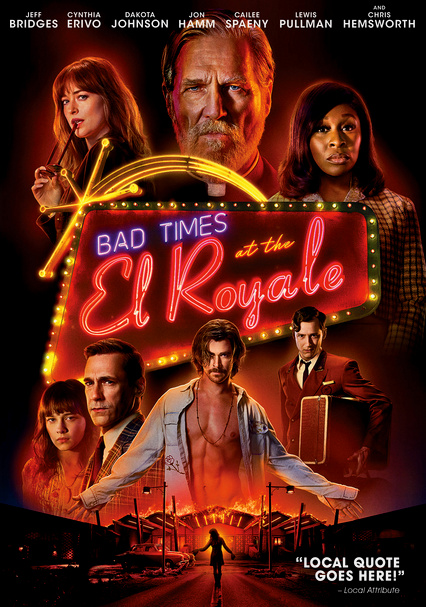
Bad Times at the El Royale-2018

Director Drew Goddard

Starring Jeff Bridges, Cynthia Erivo, Dakota Johnson

Scott’s Review #919

Reviewed July 10, 2019

Grade: A-

Bad Times at the El Royale (2018), directed by Drew Goddard, known for crafting the horror film The Cabin in the Woods (2012), is a gem that crosses multiple genres with sound results.

With Bad Times, he assumes writing and production duties for the thriller and steals a page from the Quentin Tarantino playbook, most notably from The Hateful Eight (2015).

The resulting feature is clever, perverse, and mysterious. It is a fantastic, edge-of-your-seat experience and a must-see for Tarantino fans.

Set in 1969, the film focuses on seven strangers of different backgrounds who go to a seedy and remote hotel on the California/Nevada border. Each harbors its share of dark secrets, culminating during a deadly macabre showdown one dark and stormy night.

In many ways, each character seeks redemption or forgiveness for a past indiscretion or is otherwise protecting someone or something else. A large sum of money is also in play for the greedier characters to tussle over.

The seven players are as follows: Jeff Bridges plays catholic priest Donald “Dock” O’Kelly, Cynthia Erivo plays struggling soul singer Darlene Sweet, and Dakota Johnson portrays Emily Summerspring, a hippie trying to save her younger sister, Rose, who is devoted to and mesmerized by sadistic cult leader Billy Lee (Chris Hemsworth).

Finally, Jon Hamm plays Dwight Broadbeck, a vacuum salesman who may have a secret identity, and hotel clerk Miles Miller (Lewis Pullman), who runs the hotel alone.

As events roll along, the complexities of the characters grow, which is my favorite aspect of the film. There are so many twists and turns involving the characters’ backstories and motivations that surprises are in store.

Some characters have strange connections to each other, while others meet for the first time and their lives intersect in interesting ways.

The dynamic between all the actors works tremendously well, with the standouts being Bridges and Erivo, who share tremendous chemistry and are the most interesting characters, to mention get the most screen time.

Their characters forge a bond during their lengthy scenes while never wholly trusting each other. Erivo, as Darlene, gets to showcase her wonderful singing voice. The highlight is the grand hotel room sequence as she belts out “This Old Heart of Mine (Is Weak for You).”

Old and burdened with memory loss, Bridges successfully grants more sympathy to his character than he deserves.

The film loses momentum towards the end when introducing the miscast Hemsworth, who is pretty but not the most remarkable acting talent. The actor overacts, playing Billy Lee as sinister and one-dimensional rather than infusing complexities into the character, which doesn’t work.

A better casting choice (and Tarantino mainstays) would have been Leonardo DiCaprio or Brad Pitt, and either actor would have assuredly brought more depth to the role.

Comparisons must be made to The Hateful Eight and the comedy Clue (1985). Godard divides the film into chapters like the former, mostly entitled as the hotel room numbers. With each subsequent room, the events going on in that room and its inhabitants are explored.

As in both films, he brings several mysterious characters with connections together. In Clue, secret passageways that lead to various parts of a building are featured, offering layers of possibilities.

The hotel itself is styled and dressed brilliantly, nearly a character with glossy decals and shiny trimmings but with a solemn and melancholy gloominess. The establishment has seen its share of heartbreak, schemes, and even death. Clever is the division of the hotel into either the sunny and cheerful “California” section or the less posh “Nevada” section, purple and costing one dollar less.

The viewer is sucked into its web within the first sequence when a man is shown hiding money under the floorboards and then subsequently shot to death.

Despite being labeled a Tarantino rip-off, this does not bother me as I was enthralled with the characters, the details, and the vast nuances offered.

Unfortunately, the film was a box-office disappointment, suffering from a lack of awards buzz and a lofty running time. Bad Times at El Royale (2018) will entertain, intrigue, and keep one guessing until the credits roll.

Be prepared for a bloody good time!

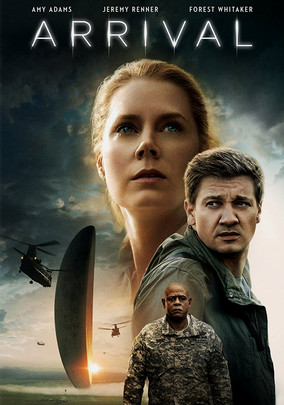
Arrival-2016

Arrival-2016

Director Denis Villeneuve

Starring Amy Adams, Jeremy Renner, Forest Whitaker

Scott’s Review #642

Reviewed May 9, 2017

Grade: B-

Arrival (2016) is the latest in a recent trend of science fiction-themed films garnering Academy Award praise, either for technical achievements or, in the case of Arrival, a surprising Best Picture nomination in addition to the more traditional awards notice for categories like sound effects and editing.

Traditionally, science fiction gets little or no recognition in significant categories; this makes the inclusion of films in the under-the-radar style with the big guns all the more surprising.

Similar in style to recent films such as Interstellar (2014) and Gravity (2013), Arrival ultimately proves a disappointment as a complete film, succeeding only in specific avenues like its musical score and a sort of surprise twist ending that the film presents, but at times is downright to say nothing of its tedious moments.

Needless to say, I wholeheartedly disagree with its Best Picture nomination.

I am not claiming to be the world’s greatest science fiction fan. At times, Arrival does have glimmers of success (mainly in the first act) and some high points in the vein of 2001: A Space Odyssey (1968), the greatest of the greats in the genre. However, the good moments ultimately fade as the story lumbers on, only to show a brief resurgence in the final act.

Sadly, the rest of the film is rather middling.

In a role seemingly written just for her, Amy Adams stars as Louise Banks, a linguist professor living and teaching in Massachusetts.

One day, a series of twelve extraterrestrial aircraft appeared across the world. Louise is summoned by an Army Colonel (Forest Whitaker) to travel to a remote area of Montana where one aircraft has taken up residence and assist a physicist, Ian Donnelly (Jeremy Renner), in communicating with the aliens.

Their goal is to determine why they have come to planet Earth.

Interspersed with the main story are strange flashbacks of a life Louise briefly spent with her daughter, who appears to have died of cancer as a teenager.

The film’s premise is reminiscent of another film named Contact, made in 1997, starring Jodie Foster.

The film seems to borrow aspects from several other famous science fiction films, such as the creepy, ominous score that harkens back to 2001: A Space Odyssey in its mysteriousness to the oddity of The Day the Earth Stood Still (1951).

So much so that the film reminds me too much of other films, it, therefore, has little identity, especially throughout the film’s mid-section.

Other than Louise’s character, there is no character development, and this is glaring among the male cast of top talents like Whitaker and Renner. The roles are glorified throwaway roles.

Except for Renner’s limited involvement in the film’s climactic “twist,” which admittedly barely raises the movie above mediocrity, neither character serves many purposes and could be played by any actor.

Whitaker’s G.T. Weber has little motivation other than convincing Louise to participate in the mission. The film also seems unsure whether to fully explore a romantic entanglement between Louise and Renner’s Ian.

Indeed, a flirtation exists on the surface, but the film never hits a home run with it. Couldn’t a meatier story be created for these two storied actors?

The unique extraterrestrial, a hybrid of tentacles, fingers, and funny eyes appearing as a pair humorously nicknamed Abbott and Costello, is impressive from an artistic perspective, and this does help the film.

The characters’ unsureness about whether Abbott and Costello are friends or foes is also slightly intriguing. However, the film’s main negative is that nothing much happens other than Louise’s repeated attempts to communicate, whimsically staring into the camera in wonderment and ultimately figuring out the alien’s messages and purpose.

Worthy of mention is a fantastic and ominous musical score that gives the film some climactic and dark elements that feel like its highlights. It adds chilling, practical elements, bringing the movie up a notch from complete blandness.

The film’s best part is its ending, which sent a chill down my spine. The unique and inspired big reveal made me a bit shiver.

This way, Arrival saves itself from being completely lackluster, but too little, too late. I would have preferred the film to balance the emotions, surprises, and thrills more rather than exist mainly as a tedious, uninteresting film.

Overall, the outcome of Arrival (2016) is more of a retread than anything new or original.

Oscar Nominations: 1 win-Best Picture, Best Director-Denis Villeneuve, Best Adapted Screenplay, Best Sound Editing (won), Best Sound Mixing, Best Production Design, Best Cinematography, Best Film Editing