Arrival-2016
Director Denis Villeneuve
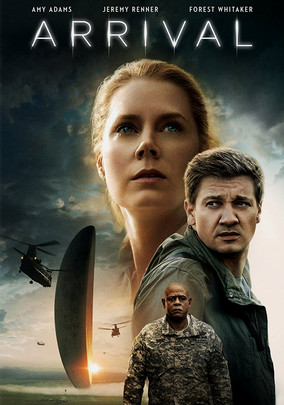
Starring Amy Adams, Jeremy Renner, Forest Whitaker
Scott’s Review #642
Reviewed May 9, 2017
Grade: B-
Arrival (2016) is the latest in a recent trend of science fiction-themed films garnering Academy Award praise, either for technical achievements or, in the case of Arrival, a surprising Best Picture nomination in addition to the more traditional awards notice for categories like sound effects and editing.
Traditionally, science fiction gets little or no recognition in significant categories; this makes the inclusion of films in the under-the-radar style with the big guns all the more surprising.
Similar in style to recent films such as Interstellar (2014) and Gravity (2013), Arrival ultimately proves a disappointment as a complete film, succeeding only in specific avenues like its musical score and a sort of surprise twist ending that the film presents, but at times is downright to say nothing of its tedious moments.
Needless to say, I wholeheartedly disagree with its Best Picture nomination.
I am not claiming to be the world’s greatest science fiction fan. At times, Arrival does have glimmers of success (mainly in the first act) and some high points in the vein of 2001: A Space Odyssey (1968), the greatest of the greats in the genre. However, the good moments ultimately fade as the story lumbers on, only to show a brief resurgence in the final act.
Sadly, the rest of the film is rather middling.
In a role seemingly written just for her, Amy Adams stars as Louise Banks, a linguist professor living and teaching in Massachusetts.
One day, a series of twelve extraterrestrial aircraft appeared across the world. Louise is summoned by an Army Colonel (Forest Whitaker) to travel to a remote area of Montana where one aircraft has taken up residence and assist a physicist, Ian Donnelly (Jeremy Renner), in communicating with the aliens.
Their goal is to determine why they have come to planet Earth.
Interspersed with the main story are strange flashbacks of a life Louise briefly spent with her daughter, who appears to have died of cancer as a teenager.
The film’s premise is reminiscent of another film named Contact, made in 1997, starring Jodie Foster.
The film seems to borrow aspects from several other famous science fiction films, such as the creepy, ominous score that harkens back to 2001: A Space Odyssey in its mysteriousness to the oddity of The Day the Earth Stood Still (1951).
So much so that the film reminds me too much of other films, it, therefore, has little identity, especially throughout the film’s mid-section.
Other than Louise’s character, there is no character development, and this is glaring among the male cast of top talents like Whitaker and Renner. The roles are glorified throwaway roles.
Except for Renner’s limited involvement in the film’s climactic “twist,” which admittedly barely raises the movie above mediocrity, neither character serves many purposes and could be played by any actor.
Whitaker’s G.T. Weber has little motivation other than convincing Louise to participate in the mission. The film also seems unsure whether to fully explore a romantic entanglement between Louise and Renner’s Ian.
Indeed, a flirtation exists on the surface, but the film never hits a home run with it. Couldn’t a meatier story be created for these two storied actors?
The unique extraterrestrial, a hybrid of tentacles, fingers, and funny eyes appearing as a pair humorously nicknamed Abbott and Costello, is impressive from an artistic perspective, and this does help the film.
The characters’ unsureness about whether Abbott and Costello are friends or foes is also slightly intriguing. However, the film’s main negative is that nothing much happens other than Louise’s repeated attempts to communicate, whimsically staring into the camera in wonderment and ultimately figuring out the alien’s messages and purpose.
Worthy of mention is a fantastic and ominous musical score that gives the film some climactic and dark elements that feel like its highlights. It adds chilling, practical elements, bringing the movie up a notch from complete blandness.
The film’s best part is its ending, which sent a chill down my spine. The unique and inspired big reveal made me a bit shiver.
This way, Arrival saves itself from being completely lackluster, but too little, too late. I would have preferred the film to balance the emotions, surprises, and thrills more rather than exist mainly as a tedious, uninteresting film.
Overall, the outcome of Arrival (2016) is more of a retread than anything new or original.
Oscar Nominations: 1 win-Best Picture, Best Director-Denis Villeneuve, Best Adapted Screenplay, Best Sound Editing (won), Best Sound Mixing, Best Production Design, Best Cinematography, Best Film Editing