Category Archives: Tzi Ma

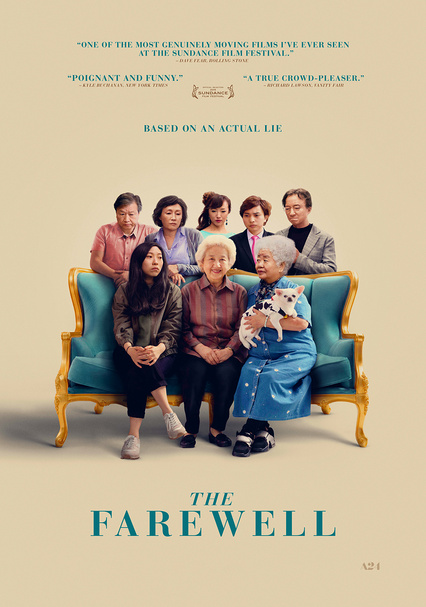
The Farewell-2019

The Farewell-2019

Director Lulu Wang

Starring  Awkwafina, Tzi Ma

Scott’s Review #927
Reviewed August 6, 2019

Grade: A-

Any film with a dark premise, such as The Farewell (2019), runs the risk of resulting in a bleak and depressing outcome, but the film is anything but a downer.

Surprisingly, to many, the film is classified as both a drama and a comedy, with snippets of humor and sadness prevalent throughout.

Met with widespread critical acclaim, the film successfully furthers the much-needed presence of quality Asian representation in modern cinema well into the twenty-first century.

Young upstart/comedienne Awkwafina, memorable for her humorous turn in Crazy Rich Asians (2018), returns to the big screen in a more subdued role, crafting a passionate and dramatic character that strongly leads the charge in an ensemble project exploring the family dynamic.

The film succeeds remarkably as a multi-generational glimpse into humanity, although it occasionally suffers from a slow pace.

A thirty-something struggling writer, Billi (Awkwafina), lives in New York City near her parents, all of whom are ex-pats from China. Billi is particularly close with her grandmother, Nai Nai (Zhao Shuzhen), who still resides in her birth land as they speak regularly via telephone.

When Billi is informed that her grandmother has terminal lung cancer and has weeks to live, the entire family reunites and decides to hold a mock wedding as an excuse to be all together.

The family makes the decision not to tell Nai Nai she is dying, preferring to let her live out her days in happiness rather than fear.

Awkwafina is the main draw of the film, and much of the action is told from her point of view.

One wonders if perhaps director Lulu Wang drew from personal experience when she wrote the screenplay. The audience is not aware of Billi’s sexuality, nor is it relevant to the film, but the vagueness was noticeable.

She does not date, nor does she look particularly interested in men. She does her laundry at her parents’ apartment and attempts, but fails, to secure a prestigious writing scholarship.

The supporting characters add tremendous depth, making the film more than just Billi’s story, and provide unique perspectives from her mother, father, and aunt, each of whom holds a distinct viewpoint about Nai Nai’s illness.

I adore this technique in rich storytelling, as it not only fleshed out secondary characters but also provides interesting ideas.  Nai Nai is not written as a doting old lady nor a victim; she is strong, witty, and full of life.

Shuzhen, unknown to me before viewing this film, brings tremendous poise to a crucial role, portraying it perfectly.

The Farewell is a quiet film that combines both comic and dramatic elements, often within the same scene, thereby providing relief from the dour subject matter.

Wang strikes the balance just right, ensuring the film does not become too heavy.

A hysterical bowing marathon ensues as the entourage decides to visit the grandfather’s grave, preparing the essentials to comfort him during the afterlife.

In stark contrast to the physical comedy, not a dry eye can be found when Billi and her parents depart China by taxi for the airport. Nai Nai tearfully waves goodbye to them, not knowing that it will undoubtedly be her final goodbye.

Any audience member with an elderly relative whom they seldom see will be deeply moved by this poignant scene. Questions such as “Would you keep a loved one unaware of a terminal disease?” will gnaw at the viewer, the central theme of the story.

Influenced by the buzz and word of mouth surrounding the film, I yearned for a single, powerful, emotional scene, but one clearly defined, bombastic moment never materialized.

Instead, the film offers small tidbits, careful not to overpower the audience or risk making the movie too sentimental or overwrought. I still think a pivotal teary scene might have been added for good measure.

A scene where Billi breaks down in front of her parents was adequate, but never catapulted the film over the top.

The Farewell (2019) is a fantastic film rich with emotion and importance.

Like Black Panther (2017), which brought Black characters to the forefront of the mainstream film genre, this film provides exposure to the Asian population, typically relegated to stereotypical roles such as doctors or Chinese takeout owners.

Wang delights with an independent film steamrolling itself across Middle America.

Independent Spirit Award Nominations: 2 wins-Best Feature (won), Best Supporting Female- Zhao Shu-zhen (won)
Arrival-2016

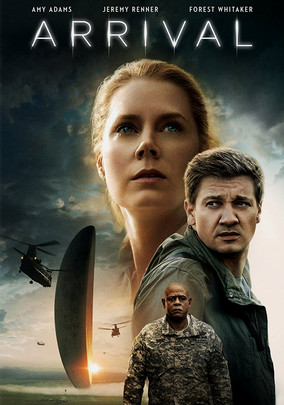
Arrival-2016

Director Denis Villeneuve

Starring Amy Adams, Jeremy Renner, Forest Whitaker

Scott’s Review #642

Reviewed May 9, 2017

Grade: B-

Arrival (2016) is the latest in a recent trend of science fiction-themed films garnering Academy Award praise, either for technical achievements or, in the case of Arrival, a surprising Best Picture nomination in addition to the more traditional awards notice for categories like sound effects and editing.

Traditionally, science fiction gets little or no recognition in significant categories; this makes the inclusion of films in the under-the-radar style with the big guns all the more surprising.

Similar in style to recent films such as Interstellar (2014) and Gravity (2013), Arrival ultimately proves a disappointment as a complete film, succeeding only in specific avenues like its musical score and a sort of surprise twist ending that the film presents, but at times is downright to say nothing of its tedious moments.

Needless to say, I wholeheartedly disagree with its Best Picture nomination.

I am not claiming to be the world’s greatest science fiction fan. At times, Arrival does have glimmers of success (mainly in the first act) and some high points in the vein of 2001: A Space Odyssey (1968), the greatest of the greats in the genre. However, the good moments ultimately fade as the story lumbers on, only to show a brief resurgence in the final act.

Sadly, the rest of the film is rather middling.

In a role seemingly written just for her, Amy Adams stars as Louise Banks, a linguist professor living and teaching in Massachusetts.

One day, a series of twelve extraterrestrial aircraft appeared across the world. Louise is summoned by an Army Colonel (Forest Whitaker) to travel to a remote area of Montana where one aircraft has taken up residence and assist a physicist, Ian Donnelly (Jeremy Renner), in communicating with the aliens.

Their goal is to determine why they have come to planet Earth.

Interspersed with the main story are strange flashbacks of a life Louise briefly spent with her daughter, who appears to have died of cancer as a teenager.

The film’s premise is reminiscent of another film named Contact, made in 1997, starring Jodie Foster.

The film seems to borrow aspects from several other famous science fiction films, such as the creepy, ominous score that harkens back to 2001: A Space Odyssey in its mysteriousness to the oddity of The Day the Earth Stood Still (1951).

So much so that the film reminds me too much of other films, it, therefore, has little identity, especially throughout the film’s mid-section.

Other than Louise’s character, there is no character development, and this is glaring among the male cast of top talents like Whitaker and Renner. The roles are glorified throwaway roles.

Except for Renner’s limited involvement in the film’s climactic “twist,” which admittedly barely raises the movie above mediocrity, neither character serves many purposes and could be played by any actor.

Whitaker’s G.T. Weber has little motivation other than convincing Louise to participate in the mission. The film also seems unsure whether to fully explore a romantic entanglement between Louise and Renner’s Ian.

Indeed, a flirtation exists on the surface, but the film never hits a home run with it. Couldn’t a meatier story be created for these two storied actors?

The unique extraterrestrial, a hybrid of tentacles, fingers, and funny eyes appearing as a pair humorously nicknamed Abbott and Costello, is impressive from an artistic perspective, and this does help the film.

The characters’ unsureness about whether Abbott and Costello are friends or foes is also slightly intriguing. However, the film’s main negative is that nothing much happens other than Louise’s repeated attempts to communicate, whimsically staring into the camera in wonderment and ultimately figuring out the alien’s messages and purpose.

Worthy of mention is a fantastic and ominous musical score that gives the film some climactic and dark elements that feel like its highlights. It adds chilling, practical elements, bringing the movie up a notch from complete blandness.

The film’s best part is its ending, which sent a chill down my spine. The unique and inspired big reveal made me a bit shiver.

This way, Arrival saves itself from being completely lackluster, but too little, too late. I would have preferred the film to balance the emotions, surprises, and thrills more rather than exist mainly as a tedious, uninteresting film.

Overall, the outcome of Arrival (2016) is more of a retread than anything new or original.

Oscar Nominations: 1 win-Best Picture, Best Director-Denis Villeneuve, Best Adapted Screenplay, Best Sound Editing (won), Best Sound Mixing, Best Production Design, Best Cinematography, Best Film Editing