Tag Archives: Gemma Jones

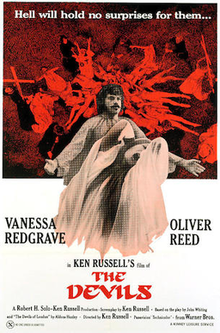
The Devils-1971

The Devils-1971

Director Ken Russell

Starring Oliver Reed, Vanessa Redgrave

Scott’s Review #1,403
Reviewed October 4, 2023

Grade: A

Ken Russell, most famous for directing the outstanding Women in Love (1970) and The Who’s Tommy (1975) creates a disturbing opus about perversion and scandal amid the Roman Catholic church during medieval times.

The film’s graphic portrayal of violence, sexuality, and religious blasphemy ignited shocked reactions from censors, and it originally received an X rating in both the United Kingdom and the United States. It was banned in several countries, and heavily edited for exhibition in others.

This alone will pique open-minded and curious viewer’s interests. It sure did mine.

The film is ironically entitled The Devils (1971) and stars Russell stalwart Oliver Reed who also appeared in the aforementioned films.  Reed leads the charge as a sexy, rugged man who beds many women and is the center of a convent full of nuns’ nasty and naughty thoughts.

Vanessa Redgrave also appears as a lustful and evil nun with a hunchback.

During the period of seventeenth-century France, Father Grandier (Reed) was a priest whose unorthodox views on sex and religion influenced a passionate following of nuns, including the sexually obsessed Sister Jeanne (Redgrave).

When the power-hungry Cardinal Richelieu (Christopher Logue) realizes he must eliminate Grandier to gain control of France, Richelieu vows to destroy the man. He portrays Grandier as a Satanist and spearheads a public outcry to destroy the once-loved priest’s reputation.

The Devils is outrageous and bizarre in only the best of possible ways. Who doesn’t love a healthy dose of nun orgies and simulating fellatio on a large candlestick? One nun violently masturbates as another looks on giggling sadistically.

The camera simply loves Reed and Redgrave who it’s interesting to note are not a couple in the film. These British actors were in their heyday in 1971 and both portray roles that must have challenged them tremendously.

Despite being British the film takes place in France getting off to a naughty start with a nearly nude dance performed by skinny Louis XIII (played with wacky delight by Graham Armitage). Rumored to be gay the king traipses around in colorful costumes and later shoots protestants dressed as gorillas for sport.

There are themes of exorcising and burning at the stake and mentions of the warring Catholics and Protestants so there is a seriousness amid the antics and shenanigans.

It took me a little while to become fully immersed in the chaotic land of Loudon, a town in western France where the film is set. In truth, a second viewing really helped me settle in and have a sense of what was going on.

The best films really are like fine wines.

Attempts by Russell to irritate and incite the overly religious are quite satisfying in a wicked way. As much as he mocks religion by making the traditionally sexually conservative filled with lust and animalistic sexual prowess there is much more going on.

Beneath the surface, he challenges the ridiculousness of religion which cinema lovers will embrace and delight in. There are history lessons to be had though and the film provides exceptional details of the political upheavals and tyranny that occurred.

The thunderous musical score by Peter Maxwell Davies is fabulous especially during The Devils final act when a major character endures a broiling on a wooden stake.

Those possessing the wonderful Blu-Ray version of the film can be treated to various outtakes, cast interviews, and behind-the-scenes information.

An added delight for knowledgeable film fans is the inclusion of character actor Murray Melvin, famous for playing Reverand Runt in the classic Barry Lyndon (1975). He plays Father Pierre Barre.

The Devils (1971) is a perverse and operatic extravaganza of lunacy. It’s caked with sex and nudity and blasphemy that I loved every bit of. The dangerous tone can be studied and thought about long after the film ends.
Rocketman-2019

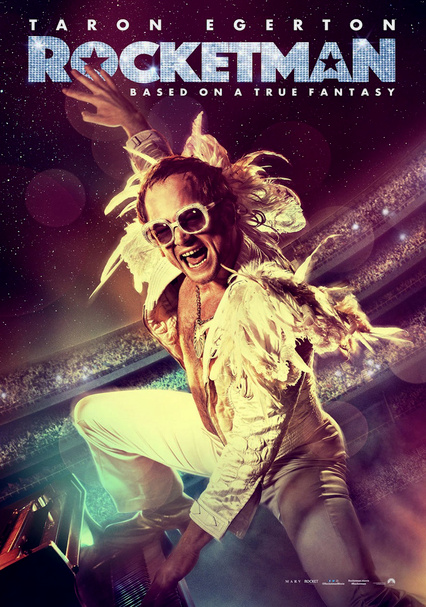
Rocketman-2019

Director Dexter Fletcher

Starring Taron Egerton, Jamie Bell

Scott’s Review #906

Reviewed June 5, 2019

Grade: A

Following the unexpected success of 2018’s rock biography Bohemian Rhapsody comes the similarly themed Rocketman (2019).

This time, the subject at hand is Elton John, rather than Freddie Mercury, but both storied figures share unquestionable comparisons, as their successes, failures, and struggles are well-documented.

Both films take their names from popular title songs, and both feature the same director, Dexter Fletcher.

Freddie Mercury and Elton John are both larger-than-life onstage personas, yet both reportedly suffered from shyness, creating characters to portray that helped ease their difficulties.

Rocketman gets the slight edge over Bohemian Rhapsody when comparing the two, with experimental and psychedelic sequences making the experience more left of center than the latter and lacking a hefty feel-good component.

I would venture to assess that Rocketman has darker overtones.

The film opens impressively as an adult, successful Elton John (Taron Egerton) attends a support group therapy session in rehab, begrudgingly. This scene will recur throughout the film as John slowly reveals more to the group about his childhood, rise to fame, and struggles with numerous demons.

This is key to the enjoyment of the film, as it frequently backtracks in time, allowing us to see John’s development both as a musician and on a personal level.

Many scenes unfold like a Broadway play, which is an ingenious approach, not only a treat for fans of John’s vast catalog of songs but also immensely creative from a cinematic perspective.

At the film’s high point, the scenes are not only showy but also propel the direction of the film, rather than slowing down the events.

Fantastic are the offerings of hit songs like “Tiny Dancer”, as shown during John’s first trip to Los Angeles, where he is forced to witness the then-crush, Bernie Taupin (Jamie Bell), take up with a supermodel at an LSD-infused Hollywood party.

The musical numbers offer glimpses into the mind and heart of Elton and other characters through song. A teary number occurs early on when a pained, boyish Elton is learning to play the piano, facing struggles at home.

When the song begins, it is Elton’s tune to carry, but then his father sings a few lines, followed by his mother and then his grandmother. Each person offers their perspective based on the lyrics they are singing.

The beauty of this scene is powerful and sets the tone for the scenes to follow.

Rocketman is an emotionally charged film, evoking laughter and tears throughout its duration. Thanks to Egerton, who carries the film, the audience cares for him as a human being instead of a larger-than-life rock star.

We feel his pain, cry his tears, and smile during rare moments when he is content. He faces insecurity, sex addiction, drug and alcohol addiction, and an eating disorder. Through Egerton, we face the battles alongside him.

Elton John serves as Executive Producer of the film, providing a measure of truth and honesty in storytelling, something Bohemian Rhapsody was accused of not containing. John’s parents are portrayed accurately and decidedly, and both mother and father are dastardly, nearly ruining Elton’s self-esteem for life.

Dallas Bryce-Howard, as his mother, is happy to capitalize financially on his fame, but sticks a dagger in his heart when she professes he will never be loved since he is a gay man.

His father is nearly as bad. Abandoning his loveless marriage to Elton’s mother, he eventually finds happiness with another woman and produces two boys. He can never love his eldest son, despite Elton’s efforts to reconnect.

To add insult to injury, his father asks him to cross out the words “to Dad” on an album autograph, instead requesting that it be given to a colleague. Elton is devastated.

Events are not all dire and dreary, as with his parents and a major suicide attempt. Happier times are shown, and his grandmother (wonderfully played by Gemma Jones) remains an ardent supporter.

His relationship with Taupin is one of the most benevolent and life-long causes of trust and respect, and once his act is cleaned up, Elton can appreciate the finer things in life more completely.

Egerton performs beautifully in both acting and singing capabilities, but lacks the singing chops that Elton John has. The decision was made not to have Egerton lip-sync, which deserves its measure of praise.

It’s interesting to wonder what the opposite choice would have resulted in. Like with Bohemian Rhapsody, we are left with a brilliant portrayal of John by Egerton.

Watched in tandem with Bohemian Rhapsody, a great idea given the back-to-back releases, is one recommendation for comparison’s sake.

Offering a more creative experience, again, the musical numbers are superb. Both switching through the back and forth timelines, Rocketman (2019) squeaks out the victory for me, and doesn’t the victor get the spoils?

If Rami Malek won the coveted Best Actor Oscar statuette, what would that mean for the tremendous turn that Egerton gives?

Oscar Nominations: 1 win-Best Original Song-“(I’m Gonna) Love Me Again (won)

God’s Own Country-2017

God’s Own Country-2017

Director Francis Lee

Starring Josh O’Connor, Alec Secareanu

Scott’s Review #773

Reviewed June 13, 2018

Grade: B+

God’s Own Country (2017) is a British, romantic, LGBT-themed drama directed by Francis Lee, making his directorial film debut.

The setting is farming land in the Yorkshire (northern England) territory, making the film quite lovely to watch, and the pace is slow. Lee does not rush the story’s pace either, so it mirrors the slow life that farmers must endure.

The film is somewhat autobiographical of Lee’s own life.

The connection and chemistry between the two leads are palpable, and the love story is endearing. It is awe-inspiring to see two cultures come together and merge as one.

The film is a nice watch and an above-average story, making it worthy of LGBT audiences worldwide. Those who believe in true love and find their soulmate will be deeply satisfied.

Twenty-something Johnny (Josh O’Connor) lives a dull existence on his father’s farm in remote Yorkshire, England. His grandmother (Gemma Jones) also lives there, and due to his father’s recent stroke, the farm’s success is in question. Johnny is depressed, drinking regularly, and engaging in sexual encounters with men.

Romanian migrant worker Gheorghe (Alec Secareanu) is hired to help, and the two young men eventually fall in love. After some ups and downs in their relationship, they decide to live on the farm together and presumably live happily ever after.

God’s Own Country is a rich story of romance, and the only real obstacles that Johnny and Gheorghe face are internal struggles.

In a unique fashion for LGBT films, neither of the men are necessarily unhappy with their sexual identities, nor do they face hurdles by other characters because of their sexuality. Gheorghe faces harassment because he is Romanian and deemed an “outsider”.

Besides Johnny’s grandmother and perhaps his father, no characters seem aware that the men are a couple.

The cinematography is gorgeous and a perfect backdrop for the love story. The farm is lush with spacious green rolling hills for miles and miles.

The family raises lamb and cattle, and more than one scene features a beautiful birth and the nuzzling of the parent to the newborn baby. Sadly, one birth is also a breach, which is tough to watch.

The themes of life and birth perhaps mirror the feelings and emotions that Gheorghe and Johnny experience- new love.

Throughout God’s Own Country, I frequently drew comparisons to arguably the most mainstream and revolutionary film in LGBT history- that of 2005’s Brokeback Mountain.

Both films feature similar elements of animals, farming, and the outdoors. Additionally, commonalities like loneliness and loss are heavily featured. Finally, the rough-and-tumble, machismo-fueled wrestling scenes that result in rough sex between the men are used in both Brokeback Mountain and God’s Own Country.

Both films could be companion pieces.

The film does not delve too much into the back story of the main characters; at least, I did not catch many mentions. Admittedly, viewing the movie on DVD with no closed captioning or subtitle capability made capturing all of the dialogue difficult.

Especially with English and cockney accents, this was made doubly challenging. Regardless, both men are lonely, even despondent, but why? What happened to Johnny’s mother? Where are Gheorghe’s parents or his family?

Upstart Francis Lee carves a quiet, thoughtful, yet compelling story of unexpected love that develops between two lonely men in a remote area of the United Kingdom.

God’s Own Country (2017) paints a nearly perfect experience, slow, yes, but featuring exceptional acting from both leads and the two supporting turns.

The film is recommended for those seeking a poignant and fulfilling love story.