Category Archives: Max Adrian

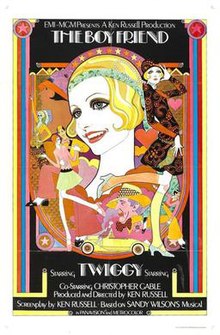
The Boy Friend-1971

The Boy Friend-1971

Director Ken Russell

Starring Twiggy, Christopher Gable

Scott’s Review #1,407
Reviewed October 27, 2023

Grade: B+

With each Ken Russell film, I expect something wacky, and I sit back for a schizophrenic roller coaster ride.

His finest efforts, such as Women in Love (1970), The Devils (1971), and Tommy (1975), offer bombast and weirdness in their own way.

The British director decided to take on The Boy Friend (1971), a reworking of a 1953 traditional musical of the same name by Sandy Wilson, and turn it upside down on its ass. Those expecting a conventional affair with cheery sing-along numbers in perfect symmetry will be disappointed.

The messy project has its ups and downs and meanders off course on more than one occasion. With jagged storytelling and dragging sequences, it makes up for ground with sizzling visuals and costumes. It offers the audience a glimpse of theatrical drama and shenanigans both onstage and offstage.

On its own merits and given that the director is Russell, it gets a marginal thumbs-up, but it is nowhere near as fantastic as his other works.

The plot is a bit confusing, divided into three levels. Level one tells the main story: in the 1920s, in the south of England, a struggling theatrical troupe is performing a musical about romantic intrigues at a finishing school for young women in the south of France.

The cast awkwardly strives to impress a visiting, famous movie director, hoping for fame and fortune. They giggle, improvise, and scheme to get noticed, risking upstaging the other cast members.

Next, there is the musical itself. Four of the girls at the school are very forward and have boyfriends, but Polly, played by 1960s supermodel Twiggy, is shy and has no one to take her to the carnival masked ball that night.

Tony (Christopher Gable), a messenger boy from a dress shop, brings her a costume, and they fall in love.

Finally, the film features extensive fantasy sequences in which the characters’ dreams and hopes are enacted through music and dance, without dialogue.

Glenda Jackson, who won an Oscar for Russell’s Women in Love, returns in an uncredited appearance as the theatre star whom Polly must fill in for when she breaks her leg.

The crux of the film is the romance between Polly and Tony. While there is some chemistry between the duo, they never fully take off as the centerpiece.

The cleverness lies in the reveal of the twist on stage, cementing the pair’s connection as characters in the play.

Nonetheless, there are too many other things going on to care about the lovebirds for very long.

The musical numbers got my attention, especially towards the end of the film. My personal favorite, ‘It’s Nicer in Nice’, kicks off with high-caliber energy and shout-outs to other cities compared to Nice, France. It’s a fun regional experience with great culture and an upbeat rhythm.

The chirpy ‘It’s Never Too Late to Fall in Love’ follows soon after, offering a gleeful ending.

The fantasy sequences waste the story’s potential and offer no plot direction, yet are fun to watch anyway. Dripping with colors and razzle-dazzle, the chaotic events are dreamlike and foot-stomping.

Twiggy, with little to no prior film experience, is quite impressive in the lead role. Her voice is strong, and her acting skills are more than adequate. What might have been a disaster is not, thanks to her talents.

Although other Ken Russell films are tighter and more linear, The Boy Friend (1971) is worth watching, especially for his die-hard fans.

Oscar Nominations: Best Music, Adaptation, and Original Song Score
The Devils-1971

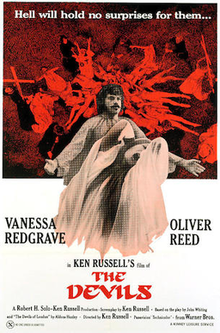
The Devils-1971

Director Ken Russell

Starring Oliver Reed, Vanessa Redgrave

Scott’s Review #1,403

Reviewed October 4, 2023

Grade: A

Ken Russell, best known for directing the outstanding Women in Love (1970) and The Who’s Tommy (1975), creates a disturbing opus about perversion and scandal within the Roman Catholic Church in medieval times.

The film’s graphic portrayal of violence, sexuality, and religious blasphemy ignited shocked reactions from censors, and it initially received an X rating in both the United Kingdom and the United States. It was banned in several countries and heavily edited for exhibition in others.

This alone will pique the interest of open-minded, curious viewers. It sure did mine.

The film is ironically entitled The Devils (1971) and stars Russell Stalwart Oliver Reed, who also appeared in the aforementioned films.  Reed leads the charge as a sexy, rugged man who beds many women and is the center of a convent full of nuns’ nasty and naughty thoughts.

Vanessa Redgrave also appears as a lustful and evil nun with a hunchback.

During the period of seventeenth-century France, Father Grandier (Reed) was a priest whose unorthodox views on sex and religion influenced a passionate following of nuns, including the sexually obsessed Sister Jeanne (Redgrave).

When the power-hungry Cardinal Richelieu (Christopher Logue) realizes he must eliminate Grandier to gain control of France, Richelieu vows to destroy the man. He portrays Grandier as a Satanist and spearheads a public outcry to destroy the once-loved priest’s reputation.

The Devils is outrageous and bizarre in only the best of possible ways. Who doesn’t love a healthy dose of nun orgies and simulating fellatio on a large candlestick? One nun violently masturbates as another looks on, giggling sadistically.

The camera loves Reed and Redgrave, who, interestingly, are not a couple in the film. These British actors were at the height of their careers in 1971, and both portrayed roles that must have been tremendously challenging.

Despite being set in France, the film opens in a naughty way with a nearly nude dance performed by skinny Louis XIII (played with wacky delight by Graham Armitage). Rumored to be gay, the king traipses around in colorful costumes and later shoots protestants dressed as gorillas for sport.

There are themes of exorcising and burning at the stake, and mentions of the warring Catholics and Protestants, so there is a seriousness amid the antics and shenanigans.

It took me a little while to become fully immersed in the chaotic land of Loudon, a town in western France where the film is set. In truth, a second viewing really helped me settle in and have a sense of what was going on.

The best films really are like fine wines.

Russell’s attempts to irritate and incite the overly religious are quite satisfying in a wicked way. As much as he mocks religion by making the traditionally sexually conservative filled with lust and animalistic sexual prowess, there is much more going on.

Beneath the surface, he challenges the ridiculousness of religion, which cinema lovers will embrace and delight in. There are history lessons to be had, though, and the film provides exceptional details of the political upheavals and tyranny that occurred.

The thunderous musical score by Peter Maxwell Davies is fabulous, especially during The Devil’s final act, when a central character endures a broiling on a wooden stake.

Those who own the wonderful Blu-Ray version of the film can enjoy various outtakes, cast interviews, and behind-the-scenes information.

An added delight for knowledgeable film fans is the inclusion of character actor Murray Melvin, famous for playing Reverend Runt in the classic Barry Lyndon (1975). He plays Father Pierre Barre.

The Devils (1971) is a perverse and operatic extravaganza of lunacy. It’s caked with sex and nudity and blasphemy that I loved every bit of. The dangerous tone can be studied and thought about long after the film ends.