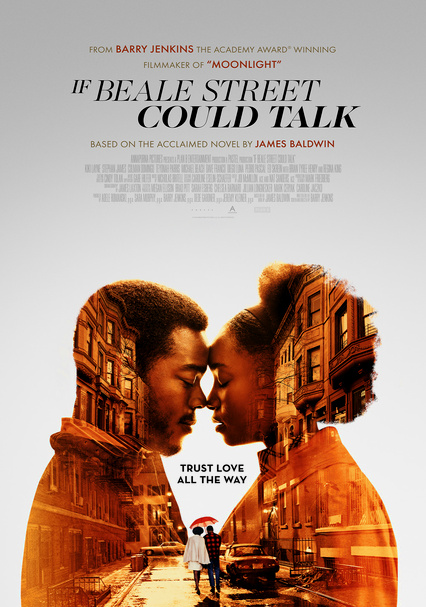
If Beale Street Could Talk- 2018
Director Barry Jenkins
Starring Kiki Layne, Stephan James
Scott’s Review #854
Reviewed January 8, 2019
Grade: A
2018 proved to be a year where filmmakers of color prided themselves in telling stories of diversity, inclusion, social injustice, and the never-ending challenges of minorities.
One of the year’s best films is If Beale Street Could Talk (2018), a lovely piece of storytelling by director Barry Jenkins. His other major work, Moonlight (2016), is a similarly poignant and melancholy experience.
The film is based on a novel by James Baldwin.
The title is explained in the first dialogue of the film. Beale Street exists in New Orleans, but thousands of streets exist in other cities. It is a metaphor for discrimination and unnecessary struggles that black folks continue to endure.
Right away, the audience knows that an important story is to be told.
The wonderful part of If Beale Street Could Talk is the combined elements that lead to brilliance.
Tish Rivers (Kiki Layne) and Fonny Hunt (Stephan James) have known each other since childhood. Growing up in a Harlem neighborhood, their families are interconnected and community-centered.
Events begin in 1973 when Tish realizes she is pregnant. Ordinarily, a happy occasion, this situation presents a major challenge because Fonny is imprisoned for a crime he did not commit.
A woman has accused him of rape and a corrupt policeman has positively identified Fonny as the rapist despite this being a logistical impossibility. Tish is determined to prove his innocence before the baby arrives with the assistance of her family.
The story is non-linear. Jenkins begins the film in the present day with Tish breaking the news of her pregnancy to him and then notifying her family.
As the film progresses, more of Fonny and Tish’s love story is explored. The couple falls in love, has romantic dinners, and nervously makes love for the first time. In this way, the film becomes a tender story of young love.
The social injustice and family drama are carefully mixed amid the central romance.
The film impresses with warm touches, ingenious cinematography, and a musical score that left me resounding with pleasure at the intricate and intimate details. The frequent use of jazz music over dinner or as the Rivers family sips celebratory wine adds sophistication to many scenes.
The film’s texture is muted and warm, giving it a subdued look that is genuine to the quiet and timeless nature of the production.
A plume of cigarette smoke can be seen in nearly every scene, as most of the characters smoke. Since the period is the 1970s, the authenticity is there, and a glamorous image is portrayed.
Smoking enhances the sophistication of the characters and adds to the tremendous cinematography.
Several scenes of simple dialogue crackle with authenticity and passion. In one of the best scenes, Fonny’s friend Daniel, a recent parolee, stays for dinner, and the friends talk while consuming beer and cigarettes.
The lengthy scene is poignant and tremendous with meaning. Daniel recounts his experience in prison and how black men are victims of the whims of white men and the terror involved in that. The scene is powerful in its thoughtfulness and a foreshadowing of Fonny’s impending trauma.
The supporting characters are stellar and add to the bravura acting troupe.
Regina King as Sharon Rivers gives an excellent performance when she bravely travels to Puerto Rico and confronts Fonny’s accuser, hoping to get her to modify her story. The scene is laden with emotion and honest dialogue.
The other notable actors are Colman Domingo and Teyonah Parris, who play Tish’s father and sister, respectively. Both do wonders in fleshing out the Rivers family as strong and kind people.
Jenkins is careful to add benevolent white characters to offset the other dastardly white characters. An example is the kindly old woman who comes to the rescue of Fonny and Tish and berates the cop.
The Jewish landlord who agrees to rent a flat to the pair is portrayed as decent and helpful, and finally, the young lawyer who takes Fonny’s case is earnest and understanding.
If Beale Street Could Talk (2018) continues talented director Barry Jenkins’s plunge into the depths of being one of the modern greats. With a beautifully visual and narrative film, he creates an experience sure to win more fans.
The ending is moving yet unsatisfying, as there are so many more miles to go in the race for prison justice. Adapting an important story of race and repression based on skin color is a powerful and detailed affair.
I cannot wait to see what Jenkins comes up with next.
Oscar Nominations: 1 win- Best Supporting Actress- Regina King (won), Best Adapted Screenplay, Best Original Score
Independent Spirit Award Nominations: 3 wins- Best Feature (won), Best Director- Barry Jenkins (won), Best Supporting Female- Regina King (won)