Tag Archives: Xavier Samuel

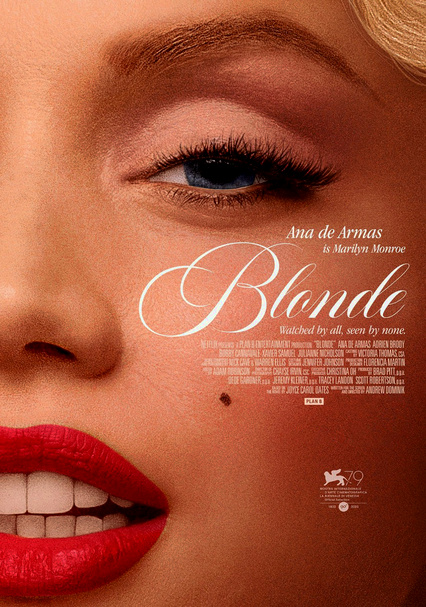
Blonde-2022

Blonde-2022

Director Andrew Dominik

Starring Ana de Armas, Adrien Brody, Bobby Cannavale

Scott’s Review #1,305
Reviewed October 7, 2022

Grade: A

Blonde (2022) is not the kind of film that I expected.

When I became aware that a new film vehicle showcasing the legendary film icon Marilyn Monroe was in the works, I assumed it would be a biographical-style effort. After all, this is hardly the first time the star’s life has been explored.

Throw in bits about her struggles, her love life, her famous screen roles, and her rise to fame, and there you’d have it.

My only real thought was who would be playing her?

Films about Marilyn have been made before, including the most recent effort I can recall, My Week With Marilyn (2011), starring Michelle Williams, a superior film but hardly groundbreaking or well remembered ten years later.

Released via the Netflix streaming service, director Andrew Dominik kicks the shit out of any preconceived notions about glamorous, happy, and prosperous Marilyn.

He creates a story focused on the dark side of the star: her failures, her insecurities, her forced abortions, and her humiliations. The result is a film that is both tragic and profound, and it should be well remembered.

Blonde delves into facts and some of the more profound thoughts of the legend herself, creating a muddy and dreamlike quality that makes the viewer apprehensive about what’s going on.

Since it’s based on Joyce Carol Oates’ 2000 fictional memoir, which is her interpretation of events, it makes truth and imagination all the muddier.

It’s not happy days watching Blonde, which left me wondering if Marilyn had a happy day in her life. From her abortions to sexual harassment, drug addiction, and physical abuse by her husband, she excitedly scampers off to a date with President Kennedy, only to be forced to give him oral sex.

Ana de Armas, known for Knives Out (2019) and No Time to Die (2021), is brilliant as Marilyn. Her mannerisms, speech patterns, and facial expressions reveal a genuine, layered portrayal rather than a carbon copy imitation of her.

Blonde boldly reimagines the life of one of Hollywood’s most enduring icons in two hours and forty-seven minutes of storytelling. It is advisable not to watch the film in one sitting, but instead spread it over three nights to let the story unfold.

Events begin with her volatile childhood as Norma Jeane, marked by an abusive mother and an absent father, and her rise to stardom and romantic entanglements. Blonde blurs the lines of fact and fiction to explore the widening split between her public and private selves.

In a way, Marilyn suffered from a split personality, longing to be Norma Jeane and despising Marilyn.

Enhancing the ambiguity, Dominik elects to use cinematography that is sometimes blurry as if in a sleepy haze, and sprinkles color with the primarily black and white filming. He even films one abortion scene from the perspective of Marilyn’s vagina.

These creative details lead me to classify Blonde as an art film and a highly interpretive one.

While not a crowd-pleaser, Blonde is not all doom and gloom either.

Tidbits about her most famous films, Gentlemen Prefer Blondes (1953) and Some Like It Hot (1959) are featured, showcasing one or two neat camera tricks, so it appears that de Armas is acting opposite Tony Curtis.

I worry that poor reviews for Blonde may hinder de Armas’s chances of receiving an Academy Award nomination. Positive reviews usually help secure Oscar recognition.

Thankfully, despite many critics and viewers having issues with the film, de Armas has received worldwide acclaim.

Bobby Cannavale and Adrien Brody are excellent as Marilyn’s husbands, controlling Joe DiMaggio and insecure artist Arthur Miller. Both actors combine effective acting with distinguished portrayals, allowing the audience to appreciate the appeal of both men.

Other interesting subplots involve Monroe’s ‘throuple’ romance with bisexual actors Cass and Eddy, and a haunting exposure of the abuse suffered by Marilyn at the hands of her mother, Gladys, wonderfully played by Julianne Nicholson.

There is little doubt that Blonde (2022) is an unconventional film that may not appeal to everyone. However, it’s the down-and-dirty texture and tour-de-force portrayal of Monroe that won me over.

It chilled me to the bone in the best possible way.

Oscar Nominations: Best Actress-Ana de Armas
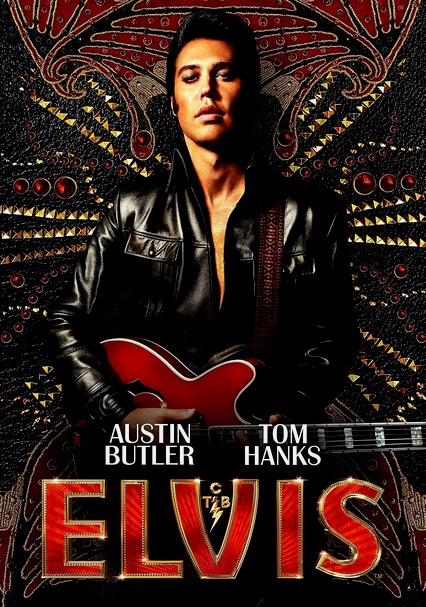
Elvis-2022

Elvis-2022

Director Baz Luhrmann

Starring Austin Butler, Tom Hanks

Scott’s Review #1,299

Reviewed September 16, 2022

Grade: B+

Once I knew that Australia’s own Baz Luhrmann was directing the new film Elvis (2022), I immediately formulated an expectation of what the film-watching experience would be like.

I anticipated a specific type of filmmaking, where an auteur artist merges fast-paced music videos with a dramatic biopic into a cohesive film.

Other Luhrmann offerings, such as Moulin Rouge (2001) and The Great Gatsby (2013), incorporate contemporary musical elements and are highly visual and stylistic. I knew what I was going to get and was prepared for it.

Elvis is no different, and Luhrmann’s style is an unconventional risk not for everybody.

I mostly enjoyed the film, but I didn’t quite love it either, seeing both the good and the not-so-good aspects.

At two hours and thirty-nine minutes, it goes on way too long.

Perhaps contradicting this point is that Elvis does improve as it progresses, initially feeling jarring, overwhelming, and disjointed due to rapid editing and rapid camera work.

A Dramamine is suggested until one is comfortable with the sudden bursts of turbulence. I semi-joke, but there is a period of sinking into Luhrmann’s style that is necessary, especially if you have never seen one of them.

The film explores the life and music of Elvis Presley (Austin Butler), and his complicated relationship with his opportunist manager, Colonel Tom Parker (Tom Hanks), and his wife, Priscilla (Oliva De Jonge).

The story delves into the singer’s rise to fame and the evolving cultural landscape in the United States during the 1950s and 1960s.

Like many films, the events start much later than the main story, in this case, 1997. Parker is on his deathbed, ruminating about how he first met Elvis and helped make him a legendary icon.

Much of the film takes place in glitzy Las Vegas, where Elvis had a long-term residency. However, it’s worth noting that the star’s working-class roots and impoverished upbringing in a predominantly black neighborhood had a tremendous influence on his music.

The Vegas setting applies a sparkling veneer, mixed with a sense of isolation, especially in scenes that show Elvis’s million-dollar penthouse view of Sin City. The star frequently pulls all the black curtains to reside in solitude.

Butler starts slow but ends up doing a fabulous job of portraying the iconic star, no easy feat. At first, I had difficulty buying the actor as Elvis, but as time went on, he became more immersed in the role.

The best scenes, hands down, occur during the performances. The sheer rawness of his act and the famous wiggle that left fans dizzy with eroticism are compelling and authentic, to say nothing of titillating.

The young actor exudes charisma just as the real-life star does, and this is most evident on stage. The dramatic scenes don’t work as well, and Luhrmann strangely skims over the controversial weight gain years, the 1970s, that Elvis experienced.

I expected Butler to don a fat suit, but there was none of this.

This miss can almost be forgiven when a heart-wrenching final performance of ‘Unchained Melody’ by the honest Elvis is showcased. The number is fraught with emotion and tenderness, leaving me feeling sympathy.

Hanks is good as the slimy and curmudgeonly manager, but I never felt sympathy for the character. If the film can be believed, he ruined Elvis as much as he brought him success, but Hanks never made me forgive the man. I also wasn’t interested in his backstory.

It will be hard-pressed ever to make me enjoy Hanks more than in his Oscar-winning back-to-back turns in Philadelphia (1993) and Forrest Gump (1994), his two best roles.

Elvis, the film, does better when it serves as a musical performance rather than a biography. Sure, the drug use and the disputes with family and manager are dramatic but it’s the performances of ‘All Shook Up, ‘Unchained Melody’, and ‘Can’t Help Falling Into Love’ that win me over.

In pure Luhrmann form, many of the familiar songs are done in different tempos and interpretations, but that’s part of the fun.

Comparisons to recent musical biographies, such as Bohemian Rhapsody (2018) and Rocketman (2019), are fair.

Elvis (2022) is not as good as those films, but it’s above average and succeeds when it entertains, showcasing how the star’s determination and grit prevailed despite outside influences.

Oscar Nominations: Best Picture, Best Actor-Austin Butler, Best Cinematography, Best Production Design, Best Film Editing, Best Sound, Best Costume Design, Best Makeup, and Hairstyling