Tag Archives: Austin Butler

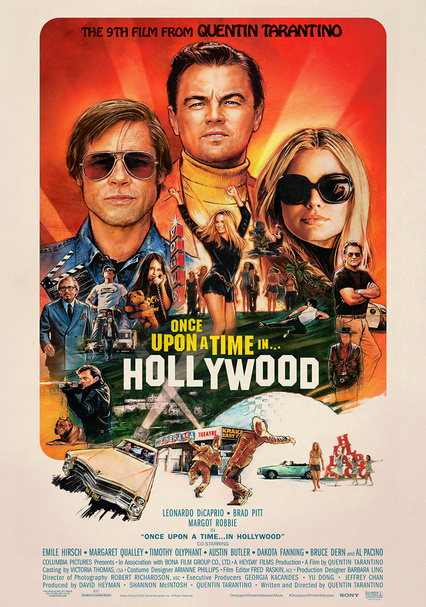
Once Upon a Time in Hollywood-2019

Once Upon a Time in Hollywood-2019

Director Quentin Tarantino

Starring Leonardo DiCaprio, Brad Pitt, Margot Robbie

Top 250 Films #84

Scott’s Review #926
Reviewed August 1, 2019

Grade: A

Once Upon a Time in Hollywood (2019) is another brilliant offering by one of the most (deservedly) respected directors of the modern film era.

This film may be his most personal as it includes many cinematic references and immerses itself in the Hollywood lifestyle. Toned down considerably from the violence standard in his other films, the first half lays the groundwork for a startlingly good second half with every detail of utmost importance.

A bevy of riches awaits any viewer enthusiastically feasting their eyes on this film.

The time is 1969, as actor Rick Dalton (Leonardo DiCaprio) struggles to reinvent himself and revitalize his career in Hollywood amid a changing cinematic landscape.

Famous for a popular western television series from the 1950s, Bounty Law, a pursued film career has not taken off, and he is reduced to guest appearances as the villain, then considered throwaway roles, in other episodic series.

His stunt double and best friend, Cliff Booth (Brad Pitt), accompanies him almost everywhere, serving as both sidekick and errand boy.

Meanwhile, famous director Roman Polanski and his wife, actress Sharon Tate (played by Argot Robbie), have moved into the house next door, which Dalton hopes will help him revitalize his career aspirations.

As Tate goes about her daily life of running errands and watching her movies in the theater, she is visited by Charles Manson one day, looking for the former resident of her house.

Historical viewers are familiar with the subsequent events that unfolded in real life, as Tarantino presents a fictional and tantalizing version of the events.

The film’s length is two hours and thirty-nine minutes, quite robust but typical for a Tarantino production. Some may complain about the bloated running time, but the film never drags; instead, the director lays out all the pieces carefully like a fine chess game.

By the mid-point, all hell breaks loose with one of the most suspenseful and edge-of-your-seat scenes in film history. When Cliff drives a flirtatious young hippy hitchhiker, Pussycat (Margaret Qualley) to a range populated by Manson followers, he is in for the adventure of his life…..if he survives.

Once Upon a Time in Hollywood is an orgy of cinematic tidbits, featuring a myriad of clips from forgotten films of the late 1960s and popular songs from that era.

This is just the tip of the iceberg in greatness as Tarantino perfectly immerses the viewer into the time with fury and zest. Every set piece, costume, hairstyle, or car is flawlessly placed. Kraft macaroni and cheese, Velveeta cheese, and popular dog food from the period are featured.

Tarantino is a fan of cinema and makes cinema lovers fall in love with cinema all over again.

The cast is humongous, but each character is necessary and perfectly represented in roles large and small.

The haunting troupe of Manson followers, specifically Tex Watson (Austin Butler), Squeaky Fromme (Dakota Fanning), and Susan Atkins (Mikey Madison), are all real-life figures. They are foreboding, dangerous, and crucial to the story.

Al Pacino shines in the small but pivotal role of Schwarz (not Schwartz), Dalton’s agent, while Steve McQueen’s look-alike, Damian Lewis, on-screen for merely seconds, is memorable.

The list of cameo performances goes on and on and on, and the fun is wondering who may appear next.

Despite the incorporation of big-name stars in important minor roles, the best performances belong to DiCaprio and Pitt. DiCaprio’s best scene takes place alone in his trailer as the washed-up star botches his lines thanks to a hangover, causing a delay in filming.

He abuses himself into nailing the scene, receiving kudos all around, while becoming teary-eyed after a compliment from a young actress.

Pitt has never given a better performance than he does as Cliff, sharing his best scenes with his adorable dog Brandi and with DiCaprio.

Who can ever forget his chest-baring rooftop scene?

Quentin Tarantino scores again with a bombastic and flawless picture, his ninth release. Rumored to retire after his tenth film, one can hardly fathom the reality of that statement. Hismovis can be watched and watched again, continuously absorbing new and noteworthy details of rich texture.

Once Upon a Time in Hollywood (2019) easily joins the ranks of great works, not just of the director’s catalog, but of all time.

Oscar Nominations: 2 wins-Best Picture, Best Director-Quentin Tarantino, Best Actor-Leonardo DiCaprio, Best Supporting Actor-Brad Pitt (won), Best Original Screenplay, Best Sound Editing, Best Sound Mixing, Best Production Design (won), Best Cinematography, Best Costume Design

The Bikeriders-2024

The Bikeriders-2024

Director Jeff Nichols

Starring Austin Butler, Jodie Comer, Tom Hardy

Scott’s Review #1,431

Reviewed July 1, 2024

Grade: A-

The Bikeriders (2024) immediately informs the audience of the time and place the film will be told. A dry and dusty midwestern USA between 1965-1973 is the window explored and the defiance of the characters drawn.

This period is the Vietnam War, Civil Rights, assassinations, Woodstock, and many other historical moments. Dangerous, the culture and people were changing and very rebellious.

Director Jeff Nichols, who also wrote the screenplay based on ‘The Bikeriders’ by Danny Lyon, wonderfully presents a time capsule of a group of bikers who forged their subculture away from the uncertainty of the rest of the world.

After a chance encounter at a local biker bar, strong-willed Kathy (Jodie Comer) is drawn to handsome and mysterious Benny (Austin Butler), the newest member of the Midwestern motorcycle club, the Vandals, led by the enigmatic Johnny (Tom Hardy).

Much like the country around it, the club changes with time, transforming from an essential gathering place for local outsiders into an underworld of violence. This forces Benny to choose between Kathy and his loyalty to the club.

The most vital parts of The Bikeriders are the beginning and end, with portions in the middle section, making it drag and lowering a potential ‘A’ rating to an ‘A-.’

But the other sections are so rich with characterization and events that they usurp the dull parts.

Nichols, who has also directed Take Shelter (2011), Mud (2012), and Loving (2016), likes to focus on the decade of the 1960s in America with conflicted characters. He likes to work with Michael Shannon, who has a small yet pivotal role as a man who ponders life.

We meet Benny in a bar, where he sips a drink. Two local thugs hastily tell him to remove his biker jacket. After a bloody fight in the parking lot, we realize how much the biker club means to him and what it symbolizes.

It’s a club where the vermin, weirdos, undesirables, and those cast aside by society find a place and are cared for by one another. That is until the years pass and things change by meaner and less loyal bikers.

The symbolism resonates with all because time never stands still, and good things always come to an end.

The Bikeriders is told from Kathy’s perspective through interviews with her friend Danny (Mike Faist). He is the real-life author of the book on which the film is based.

Comer is outstanding in the lead female role. She is strong and resilient, attracted to the dangerous lifestyle and the bikers, but only has eyes for Benny and will not be taken advantage of.

She chronicles specific events like fights, death, and rape in painful yet thoughtful detail, inviting the audience into her dark world.

Butler and Hardy are also terrific. Arguably co-leads, Butler’s Benny is childless and more accessible than Hardy’s Johnny, a family man. Johnny sees Benny as the next leader of the Vipers, but Benny wants none of that.

Comparisons to the club and life outside the club torture both men. During a long homoerotic scene, Johnny and Benny are dangerously close to kissing as Johnny discloses the reasons why Benny should lead the club.

The scene is smoldering as the unspoken connection can be felt in raw form. Nichols doesn’t dare to make the film into anything LGBTQ+ related, but the nuances and subtleties exist.

Besides the acting, the gritty environment oozes with richness. The soiled biker bars, sticky floors laden with blood, beer, and vomit, emit from the silver screen.

You can almost smell the environment.

The bad teeth, foul language, and tacky Midwestern accents all portray the loneliness of these characters and their clinging to the club for dear life.

Nichols and the author Lyon depict a fresh look into the world of motorcyclists and the culture they lived and died in for a brief time. The Bikeriders (2024) presents violence mixed with brotherhood and loyalty, which is fascinating to watch.

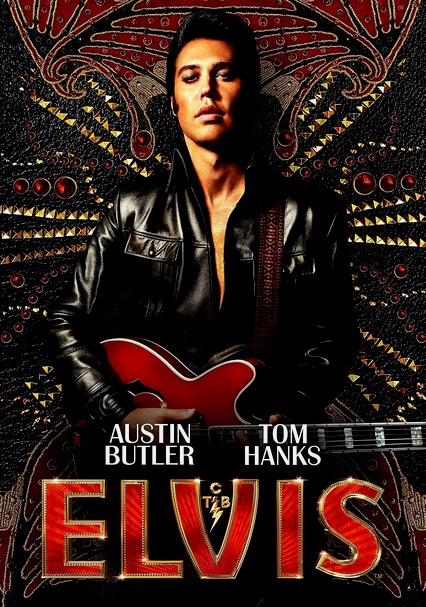
Elvis-2022

Elvis-2022

Director Baz Luhrmann

Starring Austin Butler, Tom Hanks

Scott’s Review #1,299

Reviewed September 16, 2022

Grade: B+

Once I knew that Australia’s own Baz Luhrmann was directing the new film Elvis (2022), I immediately formulated an expectation of what the film-watching experience would be like.

I anticipated a specific type of filmmaking, where an auteur artist merges fast-paced music videos with a dramatic biopic into a cohesive film.

Other Luhrmann offerings, such as Moulin Rouge (2001) and The Great Gatsby (2013), incorporate contemporary musical elements and are highly visual and stylistic. I knew what I was going to get and was prepared for it.

Elvis is no different, and Luhrmann’s style is an unconventional risk not for everybody.

I mostly enjoyed the film, but I didn’t quite love it either, seeing both the good and the not-so-good aspects.

At two hours and thirty-nine minutes, it goes on way too long.

Perhaps contradicting this point is that Elvis does improve as it progresses, initially feeling jarring, overwhelming, and disjointed due to rapid editing and rapid camera work.

A Dramamine is suggested until one is comfortable with the sudden bursts of turbulence. I semi-joke, but there is a period of sinking into Luhrmann’s style that is necessary, especially if you have never seen one of them.

The film explores the life and music of Elvis Presley (Austin Butler), and his complicated relationship with his opportunist manager, Colonel Tom Parker (Tom Hanks), and his wife, Priscilla (Oliva De Jonge).

The story delves into the singer’s rise to fame and the evolving cultural landscape in the United States during the 1950s and 1960s.

Like many films, the events start much later than the main story, in this case, 1997. Parker is on his deathbed, ruminating about how he first met Elvis and helped make him a legendary icon.

Much of the film takes place in glitzy Las Vegas, where Elvis had a long-term residency. However, it’s worth noting that the star’s working-class roots and impoverished upbringing in a predominantly black neighborhood had a tremendous influence on his music.

The Vegas setting applies a sparkling veneer, mixed with a sense of isolation, especially in scenes that show Elvis’s million-dollar penthouse view of Sin City. The star frequently pulls all the black curtains to reside in solitude.

Butler starts slow but ends up doing a fabulous job of portraying the iconic star, no easy feat. At first, I had difficulty buying the actor as Elvis, but as time went on, he became more immersed in the role.

The best scenes, hands down, occur during the performances. The sheer rawness of his act and the famous wiggle that left fans dizzy with eroticism are compelling and authentic, to say nothing of titillating.

The young actor exudes charisma just as the real-life star does, and this is most evident on stage. The dramatic scenes don’t work as well, and Luhrmann strangely skims over the controversial weight gain years, the 1970s, that Elvis experienced.

I expected Butler to don a fat suit, but there was none of this.

This miss can almost be forgiven when a heart-wrenching final performance of ‘Unchained Melody’ by the honest Elvis is showcased. The number is fraught with emotion and tenderness, leaving me feeling sympathy.

Hanks is good as the slimy and curmudgeonly manager, but I never felt sympathy for the character. If the film can be believed, he ruined Elvis as much as he brought him success, but Hanks never made me forgive the man. I also wasn’t interested in his backstory.

It will be hard-pressed ever to make me enjoy Hanks more than in his Oscar-winning back-to-back turns in Philadelphia (1993) and Forrest Gump (1994), his two best roles.

Elvis, the film, does better when it serves as a musical performance rather than a biography. Sure, the drug use and the disputes with family and manager are dramatic but it’s the performances of ‘All Shook Up, ‘Unchained Melody’, and ‘Can’t Help Falling Into Love’ that win me over.

In pure Luhrmann form, many of the familiar songs are done in different tempos and interpretations, but that’s part of the fun.

Comparisons to recent musical biographies, such as Bohemian Rhapsody (2018) and Rocketman (2019), are fair.

Elvis (2022) is not as good as those films, but it’s above average and succeeds when it entertains, showcasing how the star’s determination and grit prevailed despite outside influences.

Oscar Nominations: Best Picture, Best Actor-Austin Butler, Best Cinematography, Best Production Design, Best Film Editing, Best Sound, Best Costume Design, Best Makeup, and Hairstyling