Category Archives: Arthur Hiller

The Hospital-1971

The Hospital-1971

Director Arthur Hiller

Starring George C. Scott, Diana Rigg

Scott’s Review #1,369
Reviewed June 11, 2023

Grade: A

An example of the freedom to craft one’s vision allowed in cinematic works during the first half of the1970s, The Hospital (1971) is a testament to the creativity and exceptional writing and what can happen when studios and producers leave the creatives alone to make the film they want to make.

One can dismiss any preconceived notions of the classic medical dramas that flooded television networks during the 1970s and 1980s. The Hospital is not formulaic or contrived.

No, The Hospital is a dark work drooling with satirical examples of the politics and shenanigans within the medical community. Oftentimes, secondary activities come at the cost of good care and quality medicines.

Before you imagine a doctor and nurse cavorting in a janitor’s closet, it’s a deeper film than it appears on the surface despite the inclusion of witty comedy. A lax patient care, staff deaths, and the dismissal of nearby residents because of a new drug rehabilitation project are explored in this fascinating film.

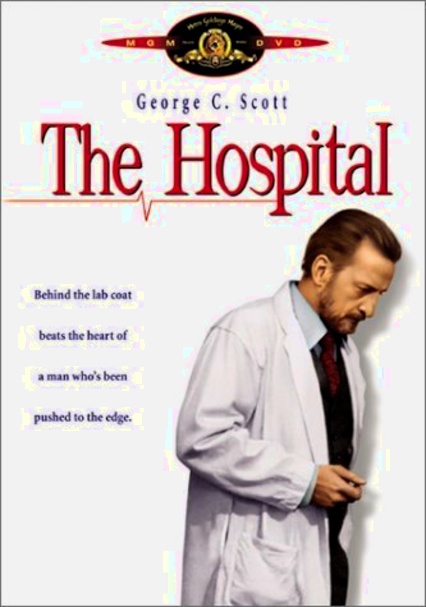
At a rundown Manhattan teaching hospital, chief of staff Herb Bock (George C. Scott) is riddled with multiple personal and professional problems after two doctors and one nurse are found dead almost simultaneously.

He assumes the rash of deaths is due to dimwitted staff who are overworked amid the chaos.

Suicidal, he meets the intelligent daughter of a patient who knocks him off his feet with her studious personality and reflections of the world. Barbara Drummond is played by Diana Rigg.

Immediately noticeable is the clever and well-paced screenplay while I was unknowledgeable of the fact that Paddy Chayefsky had won the Oscar for writing the film. Immediately, the chaos of a city hospital is exposed but not in a cliched way like a series like ER or Grey’s Anatomy might show.

Nobody is going into cardiac arrest on the operating table or having convulsions in the waiting room amid lame dramatic music.

The Hospital is more cerebral than that.

Unknown patients and little-known hospital staff go about their everyday business like clockwork until confusion with daily tasks causes events to go awry.

Like real-life.

The brilliance is how director Arthur Hiller casts regular-looking actors in almost all the roles. They look and act like everyday hospital staff so that the proper tone is set. This is even before we meet and get to know Herb and Barbara. They answer phones, walk around with charts, and hustle after emergencies.

Chayefsky and Hiller mirror director Robert Altman in many ways mostly in the dialogue and how seemingly unimportant scenes mean a whole lot.

In robust soliloquy-style scenes between Herb and Barbara the audience ‘gets them’. They are both desperate, wounded, and unhappy yet possess the sophistication and awareness to realize how similar they are.

They immediately connect, fall in love, and nearly run off together. It’s that simple. They are willing to flee their lives after meeting for five minutes. But will they ultimately take that plunge?

A key character is revealed to be Barbara’s father and a whodunit begins after it comes to light that the deaths are not accidents. Who is responsible and what their motivation is is the key to the story.

Scott does wonderful work with his character and rivals his excellent performance a year earlier in Patton (1970). Herb is more introspective with the world on his shoulders.

The Hospital has more than one daring scene. Herb, though impotent, basically throws Barbara down on the table and rapes her. The shocker is she makes light of it the next day and almost seems to have enjoyed it.

Barbara and Herb are both complex characters that the audience needs to ruminate over.

My favorite part of The Hospital (1971) is the setting. That Hiller puts you inside what a real urban hospital was like in 1971 is brilliance. The satire comes into play with the writing which questions decision-making and incompetence within the hospital walls.

Only, the result is a scathing look at hospital practices and will hit home to anyone terrified of entering a hospital only to never come out again.

Oscar Nominations: 1 win-Best Actor-George C. Scott, Best Original Screenplay (won)
Love Story-1970

Love Story-1970

Director Arthur Hiller

Starring Ryan O’Neal, Ali MacGraw

Scott’s Review #950

Reviewed October 23, 2019

Grade: B+

Love Story (1970) was an enormous blockbuster hit at the time of release, with two good-looking stars of the day immersed in a tragic romance. Almost fifty years later, the story feels contrived and watered down with a “been there, seen that” result.

While reviewing the film, one must be mindful of the period in which the film was made (before similar films hit the circuit), and the chemistry between the leads holds up quite well.

Perhaps the film works best when seen decades ago, as it now feels dated.

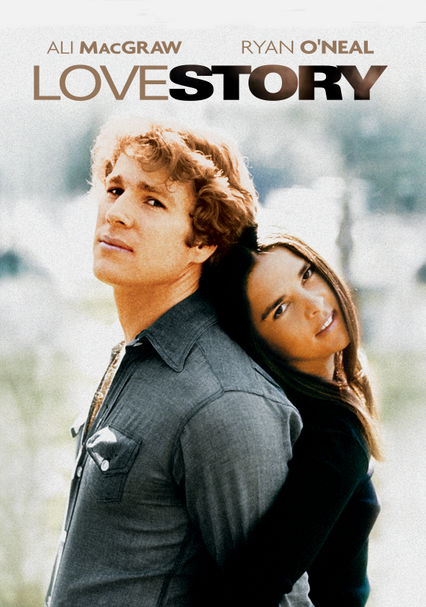
Handsome Oliver Barrett IV (Ryan O’Neal) is a star ice hockey player attending Harvard University in Cambridge, Massachusetts. He is heir to the wealthy Barrett family, led by father Oliver Barrett III (Ray Milland).

While at school, he meets the blue-collar Jenny Cavilleri (Ali MacGraw), who attends Radcliffe College, a neighboring college, and studies classical music. The couple falls madly in love and becomes inseparable.

Oliver is met with anger after he proposes to Jenny. She accepts, and they travel to the Barrett mansion so that she can meet Oliver’s parents. They are judgmental and unimpressed with her, thinking she is nice, but hardly a companion for their son.

Later, Oliver’s father tells him that he will cut off his financial support if he marries Jenny. After graduation, Oliver and Jenny marry nonetheless and begin a life of economic struggle, but filled with happiness. When they attempt to conceive, they learn that Jenny is terminally ill and has weeks to live.

The film’s primary appeal is the romance between Oliver and Jenny, which feels primal and honest. They are the cliched rich boy and poor girl equation, but in this film, the dynamic works.

O’Neal and MacGraw are good-looking and were on the cusp of Hollywood A-list classification, so the stars aligned in the casting. They ebb and flow at the beginning of the film with Jenny’s sarcasm and Oliver’s quiet arrogance, but there is never a doubt that the pair will fall madly in love, and we, the audience, are hooked from the start.

On an atmospheric level, the icy northeastern climate and the myriad of exterior scenes throughout Massachusetts give the film a proper ambiance.

For anyone who has studied at a university in this area or has an interest, the film succeeds, and it adds a robust flavor to the surrounding events. The youthful wonder and the promise of a bright future are of paramount importance to the story being told, and the foreshadowing is effective.

The film lacks guts in its pacing, though. Most of Love Story is spent focusing on the newness of Oliver and Jenny’s romance and their hurdles surrounding family members, and a brief nod to class and societal roles.

At a brief one hour and thirty-five minutes, there is very little time left for the shocking turn of events surrounding Jenny’s illness. Coming out of nowhere, the character is alive and well, has a brief fainting spell, and is then seen lying on a gurney before dying off-screen.

There is no bedside death scene, no suffering or deteriorating health, and the entire tragedy is glossed over. Hence the title, the focus is on the “love story,” but this seems like a scam.

So much is invested in the couple that the loss seems skimmed over. How can one die from leukemia (blood cancer) within a few days anyway?

The filmmaker’s clear attempts to play it safe come at the expense of the overall film experience.

Love Story (1970) deserves praise for being one of the first of its kind- the romantic tearjerker. The genre would soon be overrun with imitators so cliched that they bring the original down a notch, making it feel trite.

The ‘chick flick’ contains good acting and lovely scenery, but lacks the emotional depth I was hoping for. Melodramatic to a fault, the appeal of the leads surges the overall effort way more than it should.

Oscar Nominations: 1 win-Best Picture, Best Director-Arthur Hiller, Best Actor-Ryan O’Neal, Best Actress-Ali MacGraw, Best Supporting Actor-John Marley, Best Story or Screenplay Based on Factual Material or Material Not Previously Published or Produced, Best Original Score (won)

Outrageous Fortune-1987

Outrageous Fortune-1987

Director Arthur Hiller

Starring Bette Midler, Shelley Long

Scott’s Review #85

836062

Reviewed July 2, 2014

Grade: D

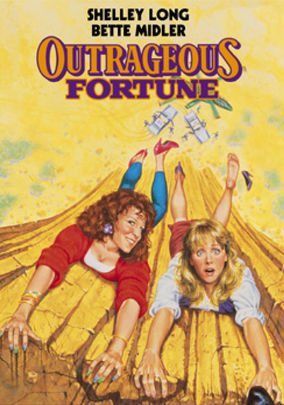
Outrageous Fortune (1987) is one of many silly plot-driven comedies to come out of the late 1980s.

It stars huge comedic actresses of the time (Bette Midler and Shelley Long) as opposites, Midler-brash, Long-refined, who are acting students and in love with the same man (Peter Coyote).

Of course, they meet and hate each other then become friends. This sets off a series of misunderstandings and standard comedy fare.

It’s a female buddy movie. I must say that I did enjoy the chemistry between Long and Midler as the on-screen chemistry is evident.

Besides the chemistry, the only other positive is the New York City location scenes and the acting/theater workshop setting.

Whose idea was it for Midler to use a horrible, phony New York accent??

It distracted throughout the entire film which is not very good, to begin with. Otherwise, this is a dud and is completely plot-driven and predictable.

It has a pure 1980s comedy feel to it (by that I mean overdone hairstyles, bad music, and a silly plot).

Shelley Long is the highlight of this film as she is great at comedic timing, but, unfortunately, her film-starring career was short-lived.