Tag Archives: Tony Randall

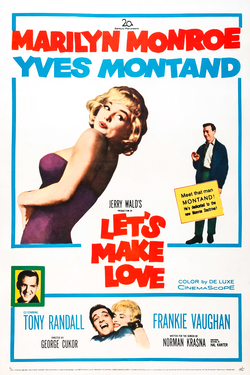
Let’s Make Love-1960

Let’s Make Love-1960

Director George Cukor

Starring Marilyn Monroe, Yves Montand, Frankie Vaughn

Scott’s Review #1,520

Reviewed February 22, 2026

Grade: C+

Let’s Make Love (1960) is a mediocre musical comedy starring Marilyn Monroe in one of her last film roles.  It would be her final musical film performance before she died in 1962.

Ironically, the iconic star plays a strong character, too frequently known for playing dimwits or money-hungry women. While refreshing, her role is almost a supporting turn for the star, playing a love interest to an uninteresting character portrayed by Yves Montand.

A very wealthy businessman, Jean-Marc Clement (Montand), has all the material possessions money can buy, but he has no love life. He seeks someone who loves him for who he is, not for his fortune.

One day, Clement learns that he is the subject of a satirical theater production and visits the set during a rehearsal. Unrecognized, the show’s unwitting producers offer him the part as himself, and he takes the gig to be close to the gorgeous yet down-to-earth actress Amanda Dell (Monroe).

This leads to a series of hijinks, misunderstandings, and, finally, an unfulfilling, predictable conclusion.

Monroe is terrific, of course, playing a character rich with honesty, integrity, and support for her theatre company. Amanda is not looking for a sugar daddy or a meal ticket and is content to while away the days doing what she loves on stage.

The film’s highlights occur when Monroe performs in showy outfits sparkling with glitter and color, oozing with sex appeal. Visually, she does not look as good as she did five years prior, appearing washed out and tired, but this can be attributed to knowing the personal turmoil she was in.

Numbers like the Cole Porter song “My Heart Belongs to Daddy,” and the title track, “Let’s Make Love,” are moderately memorable and, because Monroe performs them, are worth hearing.

It’s also cool to see exterior shots of New York City in the early 1960s grace the screen, and the backdrop of a low-key theatre is appealing.

I couldn’t help but find Clement’s character harshly unlikable and incapable of sympathy. We are asked to root for a rich man who wants a loving woman but doesn’t treat others very well.

When female staff who take dictation are called into his office, he isn’t particularly warm to them. His assistant, Alexander Kaufman, played by Tony Randall in a tepid performance, caters to Clement’s every whim but isn’t treated kindly in return.

In fact, the irritation is increased because the character of Tony Danton, Amanda’s boozy co-star, is very likable and a perfect match for Amanda.

Why the writers decided Clement and Amanda were better suited for each other is a mystery we’ll probably never figure out.

The biggest mistake is the lack of chemistry between Clement and Amanda, who have none. On the other hand, in the few scenes they share, Tony and Amanda have a tremendous connection.

What a missed opportunity.

Besides the main storyline, there is a silly side story about financing the production and a pissing match over who controls the theatre and its show. This was terribly unnecessary and would have been better if Amanda had been given her own side story, or better yet, a triangle between Amanda/Clement/Tony.

Troubles surrounded the production with various starts and stops, restarts, and proposed reshoots. This affects the film’s look and feel, and it’s apparent that the pacing is terribly uneven.

Even the incorporation of big stars like Milton Berle and cameos by Gene Kelly and Bing Crosby does nothing for the film.

It’s hard to believe that, aside from the outfits and musical numbers, George Cukor directed the film, since he would direct the sensational My Fair Lady in 1964.

Since I adore Marilyn Monroe, I desperately wanted to like Let’s Make Love (1960), but didn’t. The misplaced characters, the lukewarm pacing, and missed opportunities for a better story led to boredom and disappointment.

Oscar Nominations: Best Original Score

Saboteur-1942

Saboteur-1942

Director Alfred Hitchcock

Starring Robert Cummings, Priscilla Lake

Top 250 Films #236

Scott’s Review #98

60020559

Reviewed July 9, 2014

Grade: B+

Saboteur (1942) is a very early Alfred Hitchcock film that served as a blueprint for his masterpieces in the years to come.

The story follows a common theme among Hitchcock thrillers- the falsely accused man. An aircraft factory worker, Barry Kane, is falsely accused of an act of sabotage that kills his best friend.

Only Kane and the audience know the true culprit and set out on a quest for his innocence and to find and capture the real culprit.

The film then begins a tale of adventure, cross-country hijinks, romance, and political espionage, similar to the Hitchcock classic North by Northwest (1959), which followed years later.

This film contains some excellent scenes- the traveling Carnie train adventure, the blind man, and the climactic chase scene atop the Statue of Liberty are fantastic.

Saboteur (1942) is a bit raw, and the chemistry between the leads, Robert Cummings and Priscilla Lane, is poor, but an early Hitchcock film to be appreciated.

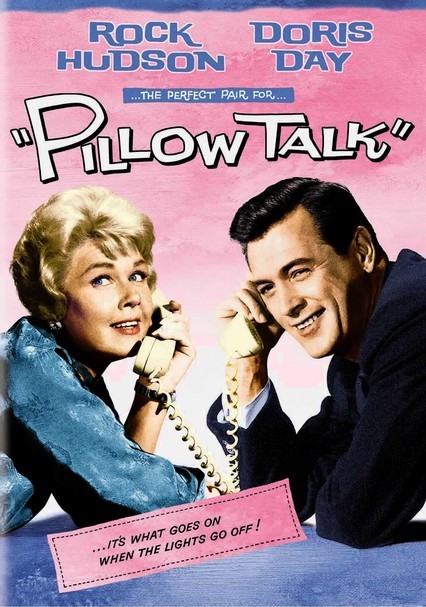
Pillow Talk-1959

Pillow Talk-1959

Director Michael Gordon

Starring Rock Hudson, Doris Day

Scott’s Review #907

Reviewed June 6, 2019

Grade: B+

Pillow Talk (1959) is the ultimate in romantic comedies from the age of innocence in cinema.

In 1959, pictures were still wholesome and safe, providing happy stories and charming characters. The film is a lovely and enchanting experience with intelligent characters and fantastic chemistry among its leads.

Combined with a good romance and comic elements, it makes for a fun watch that still feels fresh and bright decades later.

Doris Day and Rock Hudson smolder as singles living in Manhattan, New York City. Day plays Jan Morrow, a perky, independent interior decorator who dates frequently but has not yet found love. Hudson plays Brad Allen, a talented, creative Broadway composer and playboy who lives in a nearby apartment building.

Jan is frustrated by a party line that allows her to hear Brad’s endless phone conversations with the women in his life. He is annoyed by her prim and proper, holier-than-thou attitude. They bicker on the phone but have not met.

Through their mutual, yet unknown to them, acquaintance Jonathan Forbes (Tony Randall), Brad realizes who Jan is, which leads to hilarity as he fakes a Texan accent and invents a new persona: Rex Stetson, a wealthy Texas rancher.

He succeeds in wooing Jan, who falls madly in love with him while unaware of his identity. Events culminate in the inevitable big reveal when the couple vacations at Jonathan’s cabin in nearby Connecticut.

Rock Hudson oozes masculinity and charisma, and nearly every woman he meets falls madly in love with him. Hudson’s sexual preferences are hidden from the public but well-known within the film industry, so one wonders if a few comical situations were added as an inside joke.

One can speculate if these additions were made with or without the star’s knowledge; rumors abound that Hudson reportedly carried on an affair with actor Nick Adams (Tony) during filming.

A recurring theme involves Brad mistakenly walking into an obstetrician’s office (twice!) and the doctor and nurse assuming he may be the first man to become pregnant as they attempt to locate Brad when he continues to disappear.

Later, Brad attempts to trick Jan into believing Rex might be a homosexual because of his love for effeminate things.

The supporting players bring wit to Pillow Talk and are key to the film’s enjoyment. Randall, as Jonathan, is not quite the nice guy but not entirely the foil. As he has designs for Jan, he warns Brad to keep away.

His intention, which fails, is to woo her with money, but Jan seeks true love.

Thelma Ritter’s performance as Alma, Jan’s boozy housekeeper, is delicious. She adds necessary comic timing and sardonic humor. We crackle with delight when she ultimately finds love with the elevator operator.

The lavish set design is flawless. It brightens the film while adding the luxurious style and sophistication that only New York City apartment living can bring. The combined sets of Brad’s and Jan’s apartments are gorgeous.

With bright colors and 1950s-style furniture, one can easily imagine how beautiful it would be to live in an apartment of this brilliance—I know this viewer did!

A Doris Day film would not be complete without several songs that the singer/actress performs. “Pillow Talk” during the opening credits, “Roly Poly” in the piano bar with Blackwell and Hudson, and “Possess Me” on the drive up to Jonathan’s cabin.

Pillow Talk (1959) is an example of a rich romantic comedy with significant elements. It is a bit fantasy and silly but contains style, sophistication, and humor.

The film was an enormous success and was deemed “the feel-good film of the year” in many circles. Following the film, Hudson’s career was relaunched after a snag years earlier.

Oscar Nominations: 1 win-Best Actress-Doris Day, Best Supporting Actress-Thelma Ritter, Best Story and Screenplay Written Directly for the Screen (won), Best Scoring of a Dramatic or Comedy Picture, Best Art Direction, Color