Tag Archives: Harry Styles

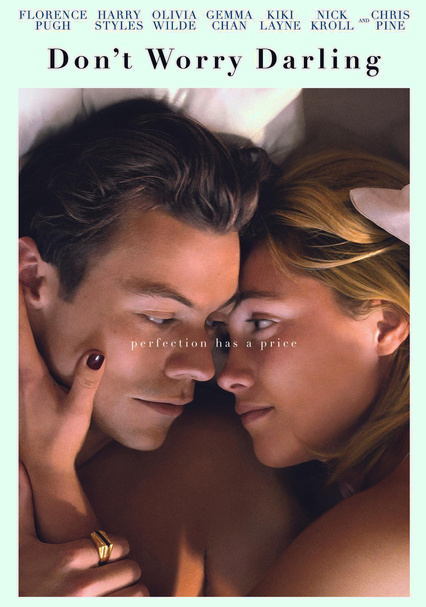
Don’t Worry Darling-2022

Don’t Worry Darling-2022

Director Olivia Wilde

Starring Florence Pugh, Harry Styles, Chris Pine

Scott’s Review #1,368
Reviewed June 9, 2023

Grade: B+

Don’t Worry Darling (2022) plays like a modern version of The Stepford Wives (1975) meets Pleasantville (1998) but with a supernatural spin and lots of much-needed modern diversity.

Not set in present times, the characters all feel very 2022 but are transplanted to a different period that only enhances an already unsettling feeling.

The sophisticated 1950s set design and art direction are a significant score, as well as the mysterious happenings that continue to shroud the central character and her surroundings.

The film never lags and, in fact, fascinates throughout. There is a continuous feeling of uncertainty, dread, and controlled chaos that assuredly will explode in the finale.

I’m not sure I quite got the conclusion right away until I read through the summary, and something about an alternate universe and different lives outside of the primary setting was revealed. Regardless, it felt unsatisfying, especially compared to the rest of the events.

But, small potatoes, I still enjoyed Don’t Worry Darling immensely.

The premise is thrilling from the start. A 1950s housewife named Alice, played by emerging star Florence Pugh, is living with her husband in a utopian experimental community. They mingle with neighbors, host lavish parties with delicious food and drink, and enjoy each gorgeous sunny day.

Daily, the men dutifully drive off to work in the distinguished Victory Headquarters while the wives cheerfully clean and scrub the windows and prepare a savory dinner, counting the minutes until their husbands return for a romp in the hay.

It all sounds too good to be true.

When a close friend Margaret (KiKi Layne) experiences a psychotic episode witnessed by Alice, she begins to worry that her husband’s glamorous company may be hiding disturbing secrets and that everything may not be as perfect as it seems.

I am becoming a big fan of Florence Pugh, who effortlessly carries the film. Impressive in both Midsommar and as Amy in Little Women, both in 2019, she possesses a specific ‘it’ factor showcased well in Don’t Worry Darling.

Pugh has many scenes with no dialogue. Ranging from a soak in the bathtub, a bizarre episode where she wraps her head in Saran Wrap, and witnessing her friend’s death, she does so much without speaking.

Successfully, the audience is taken along for the ride. We know as much as Alice does, which is nothing. It’s not that Alice hates her life; hell, she’s got it pretty good. A scrumptious roast and carrots alongside hot sex on her dining room table, the girl could do much worse.

But she knows something is off and is determined to find out what it is. Why are the women forbidden from seeing the Victory Headquarters? Why does a plane crash that only Alice sees? Why does Frank, the alpha male leader of Victory, wonderfully played by Chris Pine, keep eyeing Alice?

Impressive is the direction by Olivia Wilde, who also appears as Alice’s friend, Bunny. Along with the screenwriter, Katie Silberman, the duo crafts a piece of work with a feminist perspective turned topsy-turvy, and it’s a good angle.

Not to harp on the ending again, but the message of female empowerment, which I think is the intention of Wilde and Silberman, is unclear. A bolder message and a more finite ending would have helped cement the deal.

Still, in Wilde’s only second film, the first being the vastly different Booksmart (2019), she should only be proud of herself and the product she created.

If one is seeking an emboldened psychological thriller with twists and turns to savor, Don’t Worry Darling (2022) is a fine pick. It creeps along with appropriate plot points and a stylized visual canvas.
Dunkirk-2017

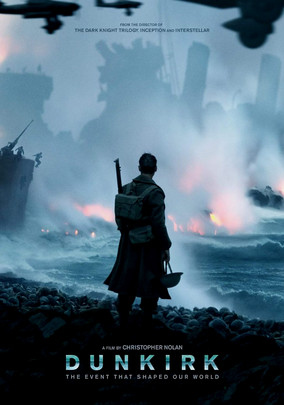
Dunkirk-2017

Director Christopher Nolan

Starring Fionn Whitehead, Tom Hardy

Scott’s Review #666

Reviewed July 24, 2017

Grade: A

Of the hundreds of war films made over the years, most have a similar style, with either a clear patriotic slant or a questioning/message-type nature.

Regardless, most have a certain blueprint—from the story to the visuals to the direction—and rarely stray from it.

The genre is not my favorite, as machismo is usually overdone, and too many films turn into standard “guy films” or “good guys versus the bad guys.”

Finally, along comes a film like Dunkirk (2017)that gives the stale genre a swift kick.

The story is both simple and historical.

In 1940, Nazi Germany, having successfully invaded France, pushed thousands of French and British soldiers to a seaside town named Dunkirk.

With slim hopes of rescue or survival, the soldiers are sitting ducks for the raid of German fighter planes, which drop bombs both on the soldiers and rescue ships.

In parallel stories, a kindly British civilian (Mark Rylance) and his son sail to Dunkirk to help rescue the soldiers, and two British fighter pilots chase the German fighter planes, attempting to thwart their deadly intentions.

One will immediately be struck by the film’s pacing, which is nonstop action from start to finish. The action, combined with very little dialogue and an eerie musical score, is what makes the film feel unique and fresh.

Directed by Christopher Nolan (The Dark Knight, 2008 and Inception, 2010), critics herald this film as his most remarkable work yet- I tend to agree.

Scenes involving such differing musical scores as screechy violins mixed with thunderous, heavy beats shake up the film and keep the audience on their toes as to what is coming next.

An interesting facet of the film, and certainly done on purpose, is that the characters’ backstories are not revealed- we know very little about them.  Do they have families? Are they married? This is a beautiful decision by the screenwriters and by Nolan.

For instance, the first scenes involve a disheveled private named Tommy (Fionn Whitehead).  Panicked, he runs through the streets in pursuit of the beach, where he meets a fellow soldier named Gibson, who is burying another soldier in the sand.

Together, they find a wounded soldier and carry him to a departing ship. The men never speak but communicate through their eyes and gestures—it is a powerful series of scenes.

Another positive to Dunkirk is the anonymity of the enemy. The German soldiers are never shown. We see many scenes of fighter planes overhead, pummeling the soldiers with bombs and pulsating gunfire in various scenes. Still, the mystique of the enemy troops is a constant throughout the film.

The faceless component of the villains adds terror and haunting uncertainty.  In this way, the film adds to the audience’s confusion about where the enemy may be at any given moment.

The visuals and the vastness of the oceanside beach are at the forefront throughout the entire film, which is one hour and forty-six minutes, relatively brief for a war film. It elicits both beauty and a terrible gloominess.

Scenes of the vastness of the beach peppered with thousands of cold and hungry men are both pathetic and powerful.

The best scenes occur on Mr. Dawson’s  (Rylance) mariner boat. Aided by his son Peter and Peter’s frightened schoolmate, the trio heads for dangerous Dunkirk to help rescue, but en route, he picks up a shell-shocked soldier determined to stay as far away from Dunkirk as possible.

This leads to compelling drama and deep characterization of all the central characters.

Many list 1998’s Saving Private Ryan as the best film in the modern war genre, but Dunkirk may very well rival that film in intensity and musical effectiveness. Dunkirk (2017) also contains shockingly little bloodshed or dismembered soldiers—it does not need this to tell a powerful story.

The film is sometimes emotional and intense, but it never lets go of its audience from the very first frame—it is a war film for the history books and a lesson in film creativity and thoughtfulness.

Oscar Nominations: 3 wins-Best Picture, Best Director-Christopher Nolan, Best Original Score, Best Sound Editing (won), Best Sound Mixing (won), Best Production Design, Best Cinematography, Best Film Editing (won)