Tag Archives: Gemma Chan

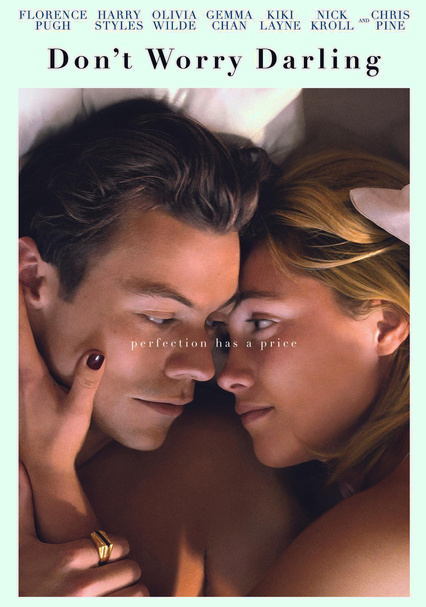
Don’t Worry Darling-2022

Don’t Worry Darling-2022

Director Olivia Wilde

Starring Florence Pugh, Harry Styles, Chris Pine

Scott’s Review #1,368
Reviewed June 9, 2023

Grade: B+

Don’t Worry Darling (2022) plays like a modern version of The Stepford Wives (1975) meets Pleasantville (1998) but with a supernatural spin and lots of much-needed modern diversity.

Not set in present times, the characters all feel very 2022 but are transplanted to a different period that only enhances an already unsettling feeling.

The sophisticated 1950s set design and art direction are a significant score, as well as the mysterious happenings that continue to shroud the central character and her surroundings.

The film never lags and, in fact, fascinates throughout. There is a continuous feeling of uncertainty, dread, and controlled chaos that assuredly will explode in the finale.

I’m not sure I quite got the conclusion right away until I read through the summary, and something about an alternate universe and different lives outside of the primary setting was revealed. Regardless, it felt unsatisfying, especially compared to the rest of the events.

But, small potatoes, I still enjoyed Don’t Worry Darling immensely.

The premise is thrilling from the start. A 1950s housewife named Alice, played by emerging star Florence Pugh, is living with her husband in a utopian experimental community. They mingle with neighbors, host lavish parties with delicious food and drink, and enjoy each gorgeous sunny day.

Daily, the men dutifully drive off to work in the distinguished Victory Headquarters while the wives cheerfully clean and scrub the windows and prepare a savory dinner, counting the minutes until their husbands return for a romp in the hay.

It all sounds too good to be true.

When a close friend Margaret (KiKi Layne) experiences a psychotic episode witnessed by Alice, she begins to worry that her husband’s glamorous company may be hiding disturbing secrets and that everything may not be as perfect as it seems.

I am becoming a big fan of Florence Pugh, who effortlessly carries the film. Impressive in both Midsommar and as Amy in Little Women, both in 2019, she possesses a specific ‘it’ factor showcased well in Don’t Worry Darling.

Pugh has many scenes with no dialogue. Ranging from a soak in the bathtub, a bizarre episode where she wraps her head in Saran Wrap, and witnessing her friend’s death, she does so much without speaking.

Successfully, the audience is taken along for the ride. We know as much as Alice does, which is nothing. It’s not that Alice hates her life; hell, she’s got it pretty good. A scrumptious roast and carrots alongside hot sex on her dining room table, the girl could do much worse.

But she knows something is off and is determined to find out what it is. Why are the women forbidden from seeing the Victory Headquarters? Why does a plane crash that only Alice sees? Why does Frank, the alpha male leader of Victory, wonderfully played by Chris Pine, keep eyeing Alice?

Impressive is the direction by Olivia Wilde, who also appears as Alice’s friend, Bunny. Along with the screenwriter, Katie Silberman, the duo crafts a piece of work with a feminist perspective turned topsy-turvy, and it’s a good angle.

Not to harp on the ending again, but the message of female empowerment, which I think is the intention of Wilde and Silberman, is unclear. A bolder message and a more finite ending would have helped cement the deal.

Still, in Wilde’s only second film, the first being the vastly different Booksmart (2019), she should only be proud of herself and the product she created.

If one is seeking an emboldened psychological thriller with twists and turns to savor, Don’t Worry Darling (2022) is a fine pick. It creeps along with appropriate plot points and a stylized visual canvas.
Crazy Rich Asians-2018

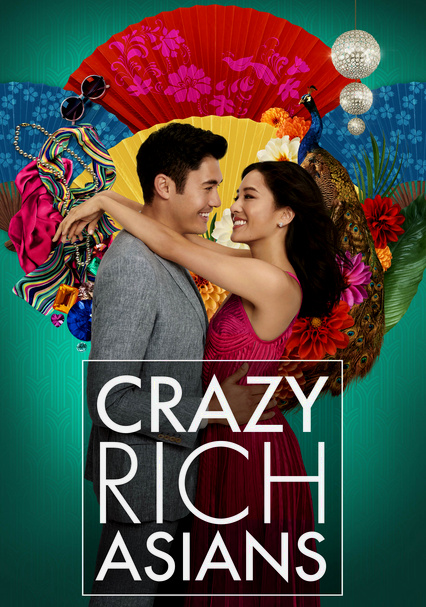
Crazy Rich Asians-2018

Director Jon M. Hu

Starring Constance Wu, Henry Golding

Scott’s Review #860

Reviewed January 26, 2019

Grade: B+

Crazy Rich Asians (2018), the romantic comedy smash of 2018, is a fun romp that is memorable because it centers on the Asian population, which is shamefully underrepresented in mainstream American cinema.

For this point alone, the film is recommended and worthy of praise, but otherwise, it is a standard genre film with gimmicks, stock characters galore, and a predictable conclusion.

The numerous cultural tidbits included must be mentioned, which raise the film above mediocrity.

Rachel Chu (Constance Wu) and Nick Young (Henry Golding) are a happily dating New York City couple; she is a New York University college professor, and he is an entrepreneur.

They fly to Singapore to attend Nick’s best friend’s wedding, which results in antics and anguish. Rachel realizes that Nick comes from an extremely wealthy family and is Chinese royalty, owning a multitude of lavish hotels and real estate.

Most of Nick’s family, especially his traditional mother Eleanor (Michelle Yeoh), disapproves of the pairing, viewing Rachel as a typical American who prioritizes passion over family.

Nick is a sought-after commodity among the single women of Singapore, and Rachel is forced to endure harassment and mockery at every turn. Her allies are Nick’s kind sister Astrid (Gemma Chan), Rachel’s outrageous college pal Peik Lin (Awkwafina), and her equally garish family.

The plot thickens when Nick’s scheming mother does a background check on Rachel and discovers a family secret.

Crazy Rich Asians is a formulaic romantic comedy with the standard situations and characters expected of a genre film. The rivalry between the good girl and her boyfriend’s domineering mother, the comic relief of the gay sidekicks as Peik Lin and another friend of Rachel’s, provides.

The caricatures of Peik Lin’s wild family, her unattractive brother fond of taking secret photos of Rachel, and Eleanor’s snooty, judgmental circle of female friends are all well cast yet one-dimensional.

It is perplexing why the filmmakers decided to make Nick only half Chinese rather than authentically Asian. Sadly, this may have been a reassurance that the film would be more marketable to mass audiences.

The film is presented as an Asian film, but it is an American film.

The storyline justification is that Nick’s father (surprisingly never seen) is British and that he and Eleanor met in college, only she being Chinese. Nick and Astrid’s English accents gnawed at me throughout the film.

Despite the myriad of cliches and manipulations, Crazy Rich Asians has a nice flow and offers a fun two hours. The film is flavorful with bright colors and visual spectacles of stylish and sophisticated Singapore and its modern and sleek nuances.

I adored the locales featuring the skyline and a rich overview of the robust and relevant city/country.

Fantastic is how the filmmakers add spices of traditional Chinese culture throughout the film’s telling, quickly becoming more of an ode to the good history. Nick’s grandmother, Su-Yi (Lisa Lu), takes pride in her excellent and artistic flowers, and Rachel is introduced to the art of dumpling making.

Crazy Rich Asians introduces a history lesson for those unfamiliar with ancient Chinese customs.

Flavorful inclusions of Mandarin Chinese language versions of American pop hits are also lovely additions, so the film has some tidbits to revel in other than the story.

Most songs reference money, such as “Money Honey” by Lady Gaga and “Rich Girl” by Hall & Oates.

The pacing of the film is nice. There is never a dull or dragging moment, and a nice balance of comedy and drama. Humorous is when Peik Lin provides Rachel with a costume makeover, ensuring she looks dynamic for the grand wedding, as she convinces her to fight Eleanor with fire.

Drama ensues when someone casts a dead fish on Rachel’s bed, and Eleanor spits that Rachel will never be enough for her son.

The film’s conclusion is predictable, resulting in a marriage proposal aboard a jet heading from Singapore to New York City. With a movie like Crazy Rich Asians, it is guaranteed that the couple lives happily ever after, riding off into the sunset in great defiance of Nick’s roots.

Due to the film’s success, a sequel is a solid bet, though I am also not betting the follow-up will be any good. Are romantic comedy sequels ever decent?

Filled with cliches, but satisfying most mainstream film-goers, Crazy Rich Asians (2018) creates a film with enough shards of Asian culture to at least get the Asian population on the map with a Hollywood production.

Although the film has a polished look and some stereotypes, it breaks no new ground other than good inclusion, and that is a start.

Mary Queen of Scots-2018

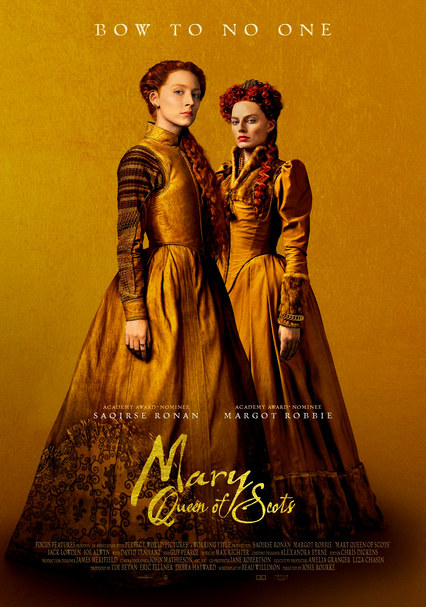
Mary Queen of Scots- 2018

Director Josie Rourke

Starring Saoirse Ronan, Margot Robbie

Scott’s Review #851

Reviewed January 2, 2019

Grade: B+

A period piece with all the trimmings for brilliance (on paper anyway), Mary Queen of Scots (2018) is a very good film, but its pacing misses the mark, preventing it from being a truly great film.

Fantastic acting and wonderful photography are the high points of an otherwise uneven experience, even if most of the components are intact.

This is not so much a total knock as a light critique, as the film is ultimately quite good and just missing the big oomph to take it over the top.

Saoirse Ronan stars as Mary Stuart, the likable Queen of France, who has returned to her native Scotland to reclaim the throne after her husband dies. Only eighteen years of age, she initially refuses pressure to remarry, but conflict ultimately ensues with Queen Elizabeth I (Margot Robbie), who rules neighboring England and Ireland.

The women admire each other from afar but develop a rivalry in power and love. To complicate matters, religious conflict, scandals, and deceit are also present in the story.

The feminist theme is inspiring and makes the film better than merely a soap opera of two rival females sparring over men.

In the mid-sixteenth century, women in control were hardly commonplace and relatively resented by the men forced to serve the “whims of women,” as one male character puts it.

Constantly showcased are males’ attempts at wooing the women in hopes of gaining power and ultimately the throne.

Still, director Josie Rourke (a woman) keeps the power firmly among the women, showing they can be as tough as they are sympathetic.

Furthermore, Mary Queen of Scots continues its progressive agenda with a startling LGBT subplot, which largely enriches Mary’s image.

One young androgynous male friend, presumably a bodyguard, frolics with Mary and other maids and confesses that he feels more like a sister than a brother to her. She accepts him wholeheartedly with an added message of “being your true nature.”

Later, the character suffers a terrible fate that devastates Mary. Regardless of the accuracy, this is a nice addition with an inspiring message.

The acting, particularly among leads Ronan and Robbie, is fantastic. Both young “it” women in Hollywood, the roles of Mary and Elizabeth, showcase their acting talents and chops for handling period piece roles.

Ronan, with flawless pale skin and authentic red locks, is beyond believable as Mary, who exudes strength yet kindness in the role she tackles. She can be stubborn but also fun and light, and Ronan has no trouble making the role her own.

Hot on the heels of playing the trailer trash character of Tonya Harding in I, Tonya (2017), Robbie hits it out of the park and does a one-eighty with the role of Elizabeth. Insecure and barren, afflicted with a skin disorder and a balding head of hair, the actress infuses the character with sensitivity and composure.

Robbie portrays her insecurity and yearning for unconditional love as she wears bawdy wigs and pancake makeup to hide her affliction.

Rourke’s mistake is not including more scenes of Ronan and Robbie together, save for one treasured scene at the end of the film. This is a wasted opportunity, as the treasured actresses could have played off each other’s talents in innumerable ways.

A knock-down, drag-out fight scene would have been a treasure to view.

The male characters do not leave much impact other than perhaps Lord Darnley (Jack Lowden), Mary’s bisexual second husband. As he betrays her on her wedding night with another man, Mary sees little use for him besides producing a child.

The handsome blonde actor adds some pizzazz, but is ultimately unlikable, as are the other similarly written men. Mary’s half-brother and Elizabeth’s advisor (Guy Pearce) are fine but ultimately underdeveloped.

Mary Queen of Scots (2018) is an effort to be commended for its female-driven and pro-LGBT stances. Perhaps unrealistic given the period and questions of historical accuracy looming over the entire film, problems with the production do exist.

The film ebbs and flows with some high moments and some looming blandness, but overall, it is to be respected and thereby recommended.

Oscar Nominations: Best Makeup and Hairstyling, Best Costume Design