Tag Archives: Awkwafina

The Farewell-2019

The Farewell-2019

Director Lulu Wang

Starring  Awkwafina, Tzi Ma

Scott’s Review #927
Reviewed August 6, 2019

Grade: A-

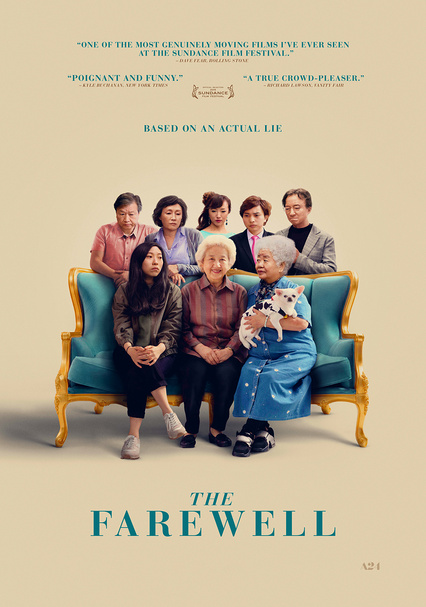
Any film with a dark premise, such as The Farewell (2019), runs the risk of resulting in a bleak and depressing outcome, but the film is anything but a downer.

Surprisingly, to many, the film is classified as both a drama and a comedy, with snippets of humor and sadness prevalent throughout.

Met with widespread critical acclaim, the film successfully furthers the much-needed presence of quality Asian representation in modern cinema well into the twenty-first century.

Young upstart/comedienne Awkwafina, memorable for her humorous turn in Crazy Rich Asians (2018), returns to the big screen in a more subdued role, crafting a passionate and dramatic character that strongly leads the charge in an ensemble project exploring the family dynamic.

The film succeeds remarkably as a multi-generational glimpse into humanity, although it occasionally suffers from a slow pace.

A thirty-something struggling writer, Billi (Awkwafina), lives in New York City near her parents, all of whom are ex-pats from China. Billi is particularly close with her grandmother, Nai Nai (Zhao Shuzhen), who still resides in her birth land as they speak regularly via telephone.

When Billi is informed that her grandmother has terminal lung cancer and has weeks to live, the entire family reunites and decides to hold a mock wedding as an excuse to be all together.

The family makes the decision not to tell Nai Nai she is dying, preferring to let her live out her days in happiness rather than fear.

Awkwafina is the main draw of the film, and much of the action is told from her point of view.

One wonders if perhaps director Lulu Wang drew from personal experience when she wrote the screenplay. The audience is not aware of Billi’s sexuality, nor is it relevant to the film, but the vagueness was noticeable.

She does not date, nor does she look particularly interested in men. She does her laundry at her parents’ apartment and attempts, but fails, to secure a prestigious writing scholarship.

The supporting characters add tremendous depth, making the film more than just Billi’s story, and provide unique perspectives from her mother, father, and aunt, each of whom holds a distinct viewpoint about Nai Nai’s illness.

I adore this technique in rich storytelling, as it not only fleshed out secondary characters but also provides interesting ideas.  Nai Nai is not written as a doting old lady nor a victim; she is strong, witty, and full of life.

Shuzhen, unknown to me before viewing this film, brings tremendous poise to a crucial role, portraying it perfectly.

The Farewell is a quiet film that combines both comic and dramatic elements, often within the same scene, thereby providing relief from the dour subject matter.

Wang strikes the balance just right, ensuring the film does not become too heavy.

A hysterical bowing marathon ensues as the entourage decides to visit the grandfather’s grave, preparing the essentials to comfort him during the afterlife.

In stark contrast to the physical comedy, not a dry eye can be found when Billi and her parents depart China by taxi for the airport. Nai Nai tearfully waves goodbye to them, not knowing that it will undoubtedly be her final goodbye.

Any audience member with an elderly relative whom they seldom see will be deeply moved by this poignant scene. Questions such as “Would you keep a loved one unaware of a terminal disease?” will gnaw at the viewer, the central theme of the story.

Influenced by the buzz and word of mouth surrounding the film, I yearned for a single, powerful, emotional scene, but one clearly defined, bombastic moment never materialized.

Instead, the film offers small tidbits, careful not to overpower the audience or risk making the movie too sentimental or overwrought. I still think a pivotal teary scene might have been added for good measure.

A scene where Billi breaks down in front of her parents was adequate, but never catapulted the film over the top.

The Farewell (2019) is a fantastic film rich with emotion and importance.

Like Black Panther (2017), which brought Black characters to the forefront of the mainstream film genre, this film provides exposure to the Asian population, typically relegated to stereotypical roles such as doctors or Chinese takeout owners.

Wang delights with an independent film steamrolling itself across Middle America.

Independent Spirit Award Nominations: 2 wins-Best Feature (won), Best Supporting Female- Zhao Shu-zhen (won)
Crazy Rich Asians-2018

Crazy Rich Asians-2018

Director Jon M. Hu

Starring Constance Wu, Henry Golding

Scott’s Review #860

Reviewed January 26, 2019

Grade: B+

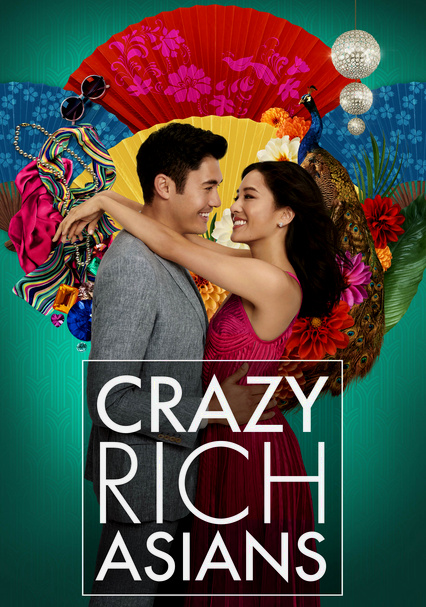
Crazy Rich Asians (2018), the romantic comedy smash of 2018, is a fun romp that is memorable because it centers on the Asian population, which is shamefully underrepresented in mainstream American cinema.

For this point alone, the film is recommended and worthy of praise, but otherwise, it is a standard genre film with gimmicks, stock characters galore, and a predictable conclusion.

The numerous cultural tidbits included must be mentioned, which raise the film above mediocrity.

Rachel Chu (Constance Wu) and Nick Young (Henry Golding) are a happily dating New York City couple; she is a New York University college professor, and he is an entrepreneur.

They fly to Singapore to attend Nick’s best friend’s wedding, which results in antics and anguish. Rachel realizes that Nick comes from an extremely wealthy family and is Chinese royalty, owning a multitude of lavish hotels and real estate.

Most of Nick’s family, especially his traditional mother Eleanor (Michelle Yeoh), disapproves of the pairing, viewing Rachel as a typical American who prioritizes passion over family.

Nick is a sought-after commodity among the single women of Singapore, and Rachel is forced to endure harassment and mockery at every turn. Her allies are Nick’s kind sister Astrid (Gemma Chan), Rachel’s outrageous college pal Peik Lin (Awkwafina), and her equally garish family.

The plot thickens when Nick’s scheming mother does a background check on Rachel and discovers a family secret.

Crazy Rich Asians is a formulaic romantic comedy with the standard situations and characters expected of a genre film. The rivalry between the good girl and her boyfriend’s domineering mother, the comic relief of the gay sidekicks as Peik Lin and another friend of Rachel’s, provides.

The caricatures of Peik Lin’s wild family, her unattractive brother fond of taking secret photos of Rachel, and Eleanor’s snooty, judgmental circle of female friends are all well cast yet one-dimensional.

It is perplexing why the filmmakers decided to make Nick only half Chinese rather than authentically Asian. Sadly, this may have been a reassurance that the film would be more marketable to mass audiences.

The film is presented as an Asian film, but it is an American film.

The storyline justification is that Nick’s father (surprisingly never seen) is British and that he and Eleanor met in college, only she being Chinese. Nick and Astrid’s English accents gnawed at me throughout the film.

Despite the myriad of cliches and manipulations, Crazy Rich Asians has a nice flow and offers a fun two hours. The film is flavorful with bright colors and visual spectacles of stylish and sophisticated Singapore and its modern and sleek nuances.

I adored the locales featuring the skyline and a rich overview of the robust and relevant city/country.

Fantastic is how the filmmakers add spices of traditional Chinese culture throughout the film’s telling, quickly becoming more of an ode to the good history. Nick’s grandmother, Su-Yi (Lisa Lu), takes pride in her excellent and artistic flowers, and Rachel is introduced to the art of dumpling making.

Crazy Rich Asians introduces a history lesson for those unfamiliar with ancient Chinese customs.

Flavorful inclusions of Mandarin Chinese language versions of American pop hits are also lovely additions, so the film has some tidbits to revel in other than the story.

Most songs reference money, such as “Money Honey” by Lady Gaga and “Rich Girl” by Hall & Oates.

The pacing of the film is nice. There is never a dull or dragging moment, and a nice balance of comedy and drama. Humorous is when Peik Lin provides Rachel with a costume makeover, ensuring she looks dynamic for the grand wedding, as she convinces her to fight Eleanor with fire.

Drama ensues when someone casts a dead fish on Rachel’s bed, and Eleanor spits that Rachel will never be enough for her son.

The film’s conclusion is predictable, resulting in a marriage proposal aboard a jet heading from Singapore to New York City. With a movie like Crazy Rich Asians, it is guaranteed that the couple lives happily ever after, riding off into the sunset in great defiance of Nick’s roots.

Due to the film’s success, a sequel is a solid bet, though I am also not betting the follow-up will be any good. Are romantic comedy sequels ever decent?

Filled with cliches, but satisfying most mainstream film-goers, Crazy Rich Asians (2018) creates a film with enough shards of Asian culture to at least get the Asian population on the map with a Hollywood production.

Although the film has a polished look and some stereotypes, it breaks no new ground other than good inclusion, and that is a start.