Category Archives: Harry Belafonte

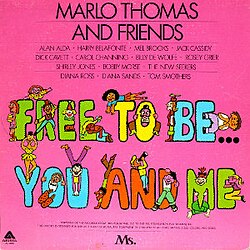
Free to Be…You and Me-1974

Free to Be…You and Me-1974

Director Bill Davis

Starring Marlo Thomas, Alan Alda, Harry Belafonte

Scott’s Review #1,262
Reviewed June 3, 2022

Grade: A

I don’t typically review television specials or television series since, hence the title, my website isn’t about that.

But, because of the sheer relevance and groundbreaking nature of Free to Be…You and Me (1974) and that it is more of a ‘project’ than merely a television special I felt compelled to provide its deserved recognition and praise.

A record album and illustrated book first released in November 1972 featuring songs and stories sung or told by celebrities of the day also makes it meatier than a one-and-done hour-long slot on a random Monday night.

The running time is a mere forty-five minutes in length but a lot happens during this time and leaves any viewer with an open mind thinking about how everyone should see it.

To summarize, the emotions the experience elicits supersedes the limited amount of screen time.

The project was conceived, created, and executive-produced by actress Marlo Thomas who also serves as host. What a great human being she proves she is to bring something so valuable to the small screen.

The result is something so ahead of its time that the message feels powerful watching it for the first time nearly fifty years later in 2022.

You can’t say that about most television.

The basic concept is to celebrate and encourage gender neutrality, saluting values such as individuality, tolerance, and comfort with one’s identity. Strong messages.

These ideals began to emerge throughout the late 1960s when the sexual revolution transpired.

A major theme is that anyone regardless of being a boy or a girl can achieve anything and be whatever they want to be.

I adore early on when a scene from a hospital emerges, infant depictions of Thomas and Mel Brooks debating their genders. They say their goodbyes as they leave the hospital but the moment is long remembered.

Later, Thomas and Alan Alda sing about a boy named William who wants a doll. And why shouldn’t he? Just as Sally, Jennifer, or Mary should be allowed to play with a dump truck should they feel like it.

Surely, the United States, the project’s main region, has slowly become more progressive in the subsequent decades. A sad reminder is that some people still have a problem with gender neutrality or even gender equality.

We’re not out of the woods yet, folks.

But those people are to be dismissed and not embraced.

Guest performers include Alda, Cicely Tyson, Tom Smothers, and Harry Belafonte, while Roberta Flack, Michael Jackson, Rita Coolidge, and Kris Kristofferson help supply the tunes.

A shockingly young Jackson also appears in a skit.

The production features uplifting sketches and songs that urge young and old to welcome diversity and embrace individualism.

I ruminated throughout my viewing how similar in many ways it is to PBS’s Mister Rogers Neighborhood, using puppets to appeal to youngsters and teach treasured messages. The kindness of the characters provides protection and warmth, teaching worth and value.

Free to Be…You and Me (1974) deservedly became an Emmy-winning TV special that taught many children (and adults) how to celebrate and respect diversity.

I hope that someone somewhere gives Free to Be…You and Me a boost and it become shown in schools all across the world.

It’s a timeless masterpiece.
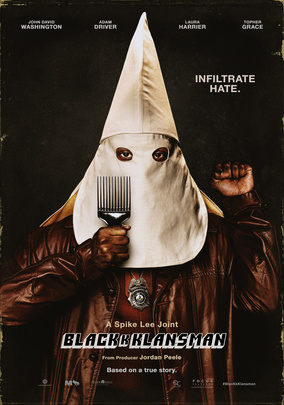
BlacKkKlansman-2018

BlacKkKlansman-2018

Director Spike Lee

Starring John David Washington, Adam Driver

Scott’s Review #802

Reviewed August 14, 2018

Grade: A

Spike Lee’s latest offering, BlacKkKlansman (2018), is a brilliant effort and oh so timely given the tumultuous political climate in the United States in 2018.

Despite the film being set in the early 1970s, the racial issues and tensions that Lee examines are sadly still an enormous problem today. Lee infuses some humor and even romance into the drama, so the film is not too preachy or heavy.

A grand and relevant effort that all should watch.

As the film commences, we are treated to a clip from the 1939 classic Gone With the Wind, and BlacKkKlansman concludes with prominent clips of racial tensions circa 2017.

The timeline is crucial and influential, as the film clearly demonstrates that racism is still alive and well.

Lee, a known liberal, clearly puts a left spin on his work. BlacKkKlansman will likely not be seen by conservative filmgoers, which is sad, as valuable lessons can be learned by viewing this piece.

The story is based on a true story memoir written by Ron Stallworth, the first black police officer to be hired by the Colorado Springs police department. He successfully infiltrates the local chapter of the Ku Klux Klan with startling results.

The film begins with a speech by a doctor (Alec Baldwin) offering a “scientific explanation” of white superiority in 1957. Fast-forward to the early 1970s, where the rest of the film occurs.

Ron is initially hired by the police force as part of a progressive initiative for diversity, but he quickly moves into a detective role. He manages to pose as a KKK member via telephone while another detective, Flip Zimmerman (Adam Driver), goes to meetings in person.

Lee’s focus is clearly on the overall content and message of the film, and therefore, little character development is achieved. I admittedly did yearn to know the “hows ” and ” whys” of many of the characters, but the film is not really about the characters individually, and I am okay with this.

Why did Ron desire so much to become a police officer? What was his childhood like? How did Patrice become President of the black student union? What was her childhood like? What upbringings did some of the KKK members have?

Indeed, not enough time would have been allowed to answer these questions—minor gripe.

Lead actor John David Washington, son of Denzel Washington, was unknown to me before watching this film. He is tremendous in his role, as is Driver in his supporting role of Zimmerman, but again, these are not character-driven roles.

Washington has tremendous chemistry with his love interest, played by Laura Harrier. Ron and Patrice discuss politics and dance the night away, but she is an activist and a cop, making their chances of a happily ever after tough to imagine. Their romance is atypical of most films as it is based on intelligence and not silly, melodramatic aspects.

On the acting front, Topher Grace as the racist David Duke is tremendous. With a kindly demeanor mixed with a bubbling under the hatred of blacks and Jewish people, Lee makes sure he is the foil.

A delicious scene towards the end of the film, when Duke gets his comeuppance of sorts, is well done and received a thunderous roar from the theater audience.

Lee is careful to ensure the bad guys get their just due and are all portrayed as complete fools. With a false sense of nationalism, many hate minorities simply because they feel they are taking over their beloved country.

Not to harp on this, but BlacKkKlansman will attract those who already agree with Lee’s beliefs and politics. If only those who disagree would give the film a chance. Unlikely.

The final five minutes of BlacKkKlansman arguably are the most pivotal experience of the entire film, but they have nothing to do with the actual story portrayed in the rest of the production.

Lee concludes the 1970s portion of the film satisfyingly, then fast forwards to the horrific events that took place in Charlottesville, Virginia, in 2017 when protesters clashed with a racist group, resulting in an innocent woman’s death.

The controversial remarks of President Trump, refusing to cast blame on the racist group, are shown. Sitting in a crowded movie theater, these clips had the most significant reaction from the audience, with some flipping Trump the finger, while others sobbed in anguish and disbelief that we have achieved so little as a nation.

Rarely has a more pertinent or meaningful film been made for the current political climate in the United States. BlacKkKlansman (2018) brilliantly ties racism spanning one hundred and fifty years together and shows how it still exists.

Amid this message, however, lies a great drama containing humor and importance.

Oscar Nominations: 1 win-Best Picture, Best Director-Spike Lee, Best Supporting Actor-Adam Driver, Best Adapted Screenplay (won), Best Original Score, Best Film Editing

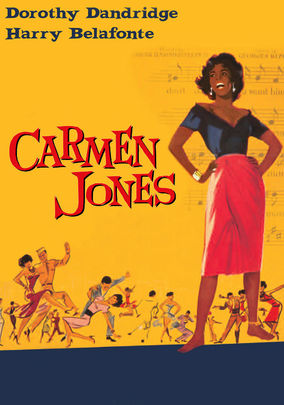
Carmen Jones-1954

Carmen Jones-1954

Director Otto Preminger

Starring Dorothy Dandridge, Harry Belafonte

Scott’s Review #736

Reviewed April 3, 2018

Grade: B+

It was pretty taboo at the time of release (1954) because it featured an all-black cast with no white members. Carmen Jones is to be celebrated for contribution to film history for this groundbreaking feat alone.

Directed by Otto Preminger (who ironically is Caucasian),  the film features legendary actress Dorothy Dandridge in a Marilyn Monroe-style performance worthy of the talents of the stars.

The film is a musical with an inevitable tragedy at the conclusion.

The 1954 feature is based on a 1943 stage production of the same name, based on the music of the famous 1875 Georges Bizet production of Carmen. These facets add to the richness of the film as it is layered with good history, and the well-known tragic elements make the conclusion unsurprising.

Brazen and beautiful, Carmen is a seductress who works in a parachute factory in North Carolina during World War II. After trading fists with a co-worker, Carmen is jailed and assigned handsome Corporal Joe (Harry Belafonte) to escort her to the authorities.

While Carmen is not shy about pursuing the young man, his fiancee, virginal Cindy Lou, fumes and schemes to keep her man.

The result is a triangle. Carmen and Joe eventually fall madly in love, leaving poor Cindy Lou behind, but their love faces hurdles.

The somewhat lighthearted first portion of the film, with coquettish humor mixed in, is offset by a much darker path the film takes. As Carmen and Joe finally profess their love and share a night of passion, she leaves him in the middle of the night, unable to endure prison time.

This results in Joe being imprisoned as the couple ultimately cannot stay away from one another despite repeated obstacles to their happiness. An additional character, a boxer named Husky, with designs on Carmen, is introduced, complicating matters.

In sad form, much like the opera Carmen, the final scene is devastating and startling as Joe treads down a dark and gloomy path of destruction. The character of Joe is nuanced- at first, a “nice guy”; the character is an example of complexity and what a man will do for love.

The viewer wonders what will become of Joe and how he could risk his life performing an act in the heat of passion.

In 1954, what a profound and fantastic role for a female, let alone a black female. Typically cast in roles such as maids, servers, or even less glamorous parts, how wonderful for Dandridge to capture a challenging role of this caliber.

She is a vixen as she sinks her teeth into the meaty and flirtatious Carmen. Dandridge’s pizzazz, flare, and singing and dancing performances made her a star, and she is forever known as a groundbreaking talent.

There cannot be enough said about the importance of casting all-black actors in Carmen Jones. Monumental, of course, given the time. The result is a film of significance to black culture, showing that they no longer needed to appear in “white films” as supporting players but could carry a movie on their own.

How profound and remarkable this was!

My only criticism of the film is undoubtedly related to the progress made for black actors and characters, though there is still plenty more work.

At times, the filming feels a shade dated (presently, there are more great roles for black actors) and has a slightly grainy look.

Some of the supporting characters’ acting is also not the strongest, but as Carmen Jones is a historical film, liberties must be taken.

Thanks to the genius and the funding of Preminger, who needed to produce the film independently due to lack of interest, the result is a film that has gone down in history as worthy, edgy, and open-minded.

Wisely casting talented stars with great pipes, the film is a solid success.

Oscar Nominations: Best Actress-Dorothy Dandridge, Best Scoring of a Musical Picture