Category Archives: Jack Thibeau

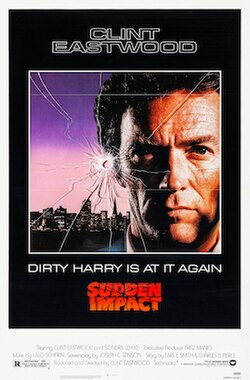
Sudden Impact-1983

Sudden Impact-1983

Director Clint Eastwood

Starring Clint Eastwood, Sondra Locke

Scott’s Review #1,388
Reviewed August 12, 2023

Grade: B+

The groundbreaking and highly influential Dirty Harry, released in 1971 spawned four sequels. Sudden Impact (1983) is the third. It is directed, produced by, and stars Clint Eastwood (making it the only Dirty Harry film to be directed by Eastwood himself) and co-starring Sondra Locke, the star’s longtime girlfriend.

On the surface, the film is standard fare and relatively conventional featuring slick cinematography, a predictable story, shoot ’em-ups, and cartoon villains.

It’s also quite bloody and violent with a theme of justice being served.

Exactly what you’d expect from any action/thriller to come out in the two decades following the original.

The cliches and story setups had by 1983 been seen in so many crime thriller genre films that they feel tired and stale and can be predicted at length.

The expected Dirty Harry catchphrase in Sudden Impact is, “Go ahead, make my day” which is probably what the film is best remembered for though some assume the famous line appears in Dirty Harry.

This isn’t a glowing testament for Sudden Impact.

United States President Ronald Reagan embarrassingly used the “make my day” line in a March 1985 speech threatening to veto legislation raising taxes.

The secret weapon of Sudden Impact though is the inclusion of Locke who is a tour de force in acting and raises the film quite a bit. Her romance with Eastwood (on and off the silver screen) simmers with chemistry making Sudden Impact feel like a much better film than it is.

Jennifer Spencer (Sondra Locke) is a thirty-something blonde bombshell who along with her much younger sister was gang raped, but the crime went unpunished. She now hunts down those responsible one by one and gruesomely shoots them in the testicles before killing them.

She’s not a gal to be messed with.

The murders attract the attention of Harry Callahan (Eastwood), who is on a forced vacation due to his violent approach to police work.

The case gets complicated when Harry develops a relationship with Jennifer, and it’s up to Harry to make the right decision when Jennifer’s life is threatened for a second time.

Locke and Eastwood always do well with marginal material- think Bronco Billy (1980) or Every Which Way But Loose (1978). Both of those films are more comical so it’s riveting to see them co-star in a violence-based thriller.

Not to dwell on Locke (okay, I must), but she’s the best part of Sudden Impact. The first scene involves one of her vigilante murders and her cold, calm, steadiness is magnificent. Through icy eyes, she is filled with rage though is wise and calculating.

When she is not blowing balls to bits, Jennifer leads a successful life as an author and escapes to a whimsical carnival town outside San Francisco to focus on her work. She also finds time to finish killing the remaining members of the gang of rapists.

Locke mesmerizes in every scene she appears in.

Eastwood is good too but his character is the same grizzled, sick of criminal, guy with a gun he’s been since the beginning. Harry’s arguments with the suits in the top office are tired and the actors cast are handily stock types.

The win is Eastwood’s scenes with Locke. As they share dinner there is a romantic tenderness that perfectly offsets the rest of the story. We ask, will he send her to prison or let her go when he inevitably finds out she’s the killer?

Is she justified?

The rapists are cartoon-like and poorly cast and there is no character development. The main villain, Mick (Paul Drake) shrieks and wails and delivers his dialogue in over-the-top fashion. He’s a poor man’s ‘Scorpio’ who he tries to emulate.

A female villain, an assumed lesbian named Ray Parkins, in a purely politically incorrect fashion, has every lesbian stereotype imaginable.

I liken Sudden Impact (1983) to a McDonald’s meal. A greasy Big Mac, fries, and a shake. It’s not fine dining but it’s satisfying and one knows exactly what to expect. Only in this case, Locke is the special sauce.

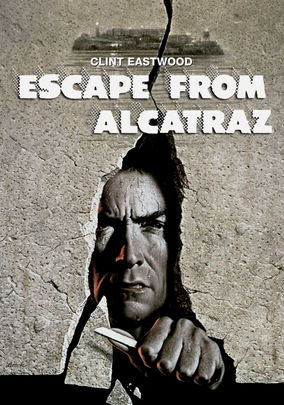
Escape from Alcatraz-1979

Escape from Alcatraz-1979

Director Don Siegel

Starring Clint Eastwood, Patrick McGoohan

Scott’s Review #656

Reviewed July 2, 2017

Grade: B+

Made during the heyday (the 1970s and the early 1980s) of a slew of action and thriller films starring popular actor Clint Eastwood, Escape from Alcatraz is a gritty, man-focused film with not a single female character in sight.

The film is directed by Don Siegel, who also directed Eastwood in several previous films, most notably Dirty Harry in 1971, and contains a grittiness frequently used in this genre of film during the period.

Reminiscent in style of 1975’s One Flew Over the Cuckoo’s Nest in its authority, repression, and exploitation of the victimized commoner, the film is also a good historical account of one of the most famous prison escapes ever achieved in 1962.

Having recently visited the long-since-shut-down Alcatraz prison near San Francisco, California, I found the film wonderful to watch, as much of it was shot inside and around the actual prison grounds.

We immediately meet Frank Morris (Eastwood) as he is unceremoniously led to the infamous Alcatraz prison on a stormy, chilly night in foggy San Francisco. The dark, harsh weather perfectly sets the tone for the dreary prison experience he will face.

Morris is stripped, searched, intimidated by the warden and the guards, and paraded around naked, finally taken to his tiny cell, where he will presumably spend the rest of his life.

The film does not reveal what crimes Morris committed to warrant his tenure at Alcatraz; as a result, the character is more sympathetic.

Slowly, Morris befriends other inmates and devises a plan to escape the impossible prison by digging through the concrete walls with spoons and using the pipes.

The other inmates featured in the film are the Anglin brothers, in for robbery, a kindly older man named Doc, who fervently paints the time away, nervous Charlie Butts, and English, an intelligent black man serving two life sentences for killing two white men in self-defense.

All of these men, in some way, aid Morris in his escape from the torturous Alcatraz.

A side story involves a bully named Wolf, who has designs on Morris from day one. Whether Wolf is actually gay or merely a menace is unknown and not explored.

Throughout the film, Wolf and Morris fight and spend time in solitary confinement, and their rivalry is an interesting subplot.

The film wants the viewer to be on the prisoners’ side, and I am not sure whether, in real life, the prisoners would be as sympathetic as portrayed in the film. Most of them seem to be confined to Alcatraz for robberies or crimes they did not commit, or for circumstances that deem the crimes inevitable in some way.

Furthering a liberal slant to the film is the friendship between Morris and English. An interracial friendship between the men reveals that our hero, Morris, is progressive-thinking and a “good guy”.

Conversely, most of the guards and certainly the Warden (Patrick McGoohan) are written as terrible, unsympathetic people. When an inmate drops dead of a heart attack, the warden coldly remarks, “Some men are destined never to leave Alcatraz alive”.

The Warden is the foil of the film, and in the final scene, the Warden gets a bit of comeuppance when a mocking souvenir is left for him.

To further compare Escape from Alcatraz to One Flew Over the Cuckoo’s Nest, the Warden is a similar character to the infamous Nurse Ratched in their mutual, diabolical sadism.

I am unsure if in “real life” the distinctions between the prisoners and the authority figures were so black and white, but it sure makes for good film drama. It is “the heroes versus the villains” but in reverse.

The inevitable escape sequence is predictable yet highly compelling as Morris and Company enact their escape plan over the course of an overnight.

The usage of papier-mache dolls to fool the guards is heavily dramatic and compelling.

Escape from Alcatraz (1979) is not high art, but it works as a historical account of a real-life incident in one of the most discussed prisons in United States history.

The film is also a perfect vehicle for Eastwood, as he is well cast in the gritty yet likable role of prisoner Morris.

The film is a good, solid late-1970s thriller.