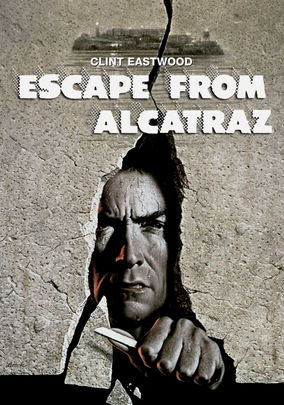
Escape from Alcatraz-1979
Director Don Siegel
Starring Clint Eastwood, Patrick McGoohan
Scott’s Review #656
Reviewed July 2, 2017
Grade: B+
Made during the heyday (the 1970s and the early 1980s) of a slew of action and thriller films starring popular actor Clint Eastwood, Escape from Alcatraz is a gritty, man-focused film with not a single female character in sight.
The film is directed by Don Siegel, who also directed Eastwood in several previous films, most notably Dirty Harry in 1971, and contains a grittiness frequently used in this genre of film during the period.
Reminiscent in style of 1975’s One Flew Over the Cuckoo’s Nest in its authority, repression, and exploitation of the victimized commoner, the film is also a good historical account of one of the most famous prison escapes ever achieved in 1962.
Having recently visited the long-since-shut-down Alcatraz prison near San Francisco, California, I found the film wonderful to watch, as much of it was shot inside and around the actual prison grounds.
We immediately meet Frank Morris (Eastwood) as he is unceremoniously led to the infamous Alcatraz prison on a stormy, chilly night in foggy San Francisco. The dark, harsh weather perfectly sets the tone for the dreary prison experience he will face.
Morris is stripped, searched, intimidated by the warden and the guards, and paraded around naked, finally taken to his tiny cell, where he will presumably spend the rest of his life.
The film does not reveal what crimes Morris committed to warrant his tenure at Alcatraz; as a result, the character is more sympathetic.
Slowly, Morris befriends other inmates and devises a plan to escape the impossible prison by digging through the concrete walls with spoons and using the pipes.
The other inmates featured in the film are the Anglin brothers, in for robbery, a kindly older man named Doc, who fervently paints the time away, nervous Charlie Butts, and English, an intelligent black man serving two life sentences for killing two white men in self-defense.
All of these men, in some way, aid Morris in his escape from the torturous Alcatraz.
A side story involves a bully named Wolf, who has designs on Morris from day one. Whether Wolf is actually gay or merely a menace is unknown and not explored.
Throughout the film, Wolf and Morris fight and spend time in solitary confinement, and their rivalry is an interesting subplot.
The film wants the viewer to be on the prisoners’ side, and I am not sure whether, in real life, the prisoners would be as sympathetic as portrayed in the film. Most of them seem to be confined to Alcatraz for robberies or crimes they did not commit, or for circumstances that deem the crimes inevitable in some way.
Furthering a liberal slant to the film is the friendship between Morris and English. An interracial friendship between the men reveals that our hero, Morris, is progressive-thinking and a “good guy”.
Conversely, most of the guards and certainly the Warden (Patrick McGoohan) are written as terrible, unsympathetic people. When an inmate drops dead of a heart attack, the warden coldly remarks, “Some men are destined never to leave Alcatraz alive”.
The Warden is the foil of the film, and in the final scene, the Warden gets a bit of comeuppance when a mocking souvenir is left for him.
To further compare Escape from Alcatraz to One Flew Over the Cuckoo’s Nest, the Warden is a similar character to the infamous Nurse Ratched in their mutual, diabolical sadism.
I am unsure if in “real life” the distinctions between the prisoners and the authority figures were so black and white, but it sure makes for good film drama. It is “the heroes versus the villains” but in reverse.
The inevitable escape sequence is predictable yet highly compelling as Morris and Company enact their escape plan over the course of an overnight.
The usage of papier-mache dolls to fool the guards is heavily dramatic and compelling.
Escape from Alcatraz (1979) is not high art, but it works as a historical account of a real-life incident in one of the most discussed prisons in United States history.
The film is also a perfect vehicle for Eastwood, as he is well cast in the gritty yet likable role of prisoner Morris.
The film is a good, solid late-1970s thriller.