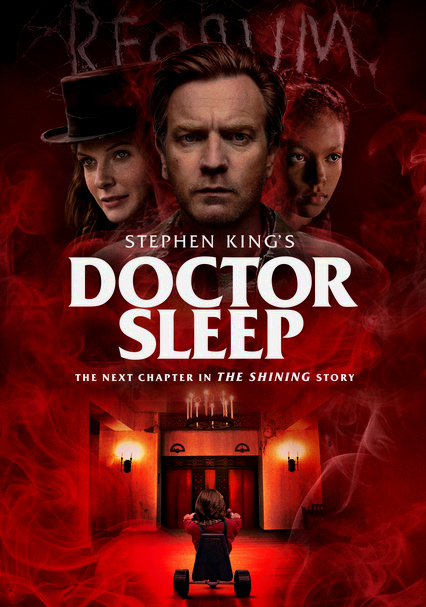
Doctor Sleep-2019
Director Mike Flanagan
Starring Ewan McGregor, Rebecca Ferguson
Scott’s Review #1,026
Reviewed May 22, 2020
Grade: B
Based on the 2013 novel of the same name written by Stephen King, a sequel to his own 1977 novel The Shining, Doctor Sleep (2019) is also a direct sequel to the film adaptation of The Shining (1980).
Events are set several decades after the original events and incorporate elements from the 1977 novel as well. A fun fact is that King hated the film version of The Shining but approved of the script for Doctor Sleep.
The first and last parts of the film are superior to the rest, mainly succeeding when elements of The Shining are incorporated.
The rest meanders and teeters too much into supernatural and computer-generated imagery territory, taking away from the haunting ghost story elements that made the original The Shining such a frightening treasure.
Ewan McGregor plays Danny Torrance, the little kid scarred from the trauma he suffered when his father Jack went mad at the looming Overlook hotel decades earlier.
Danny, now a grown man and a suffering alcoholic, lives a life that is out of control, suppressing his “shining” gifts that allow him to possess psychic abilities.
Hitting rock bottom, Dan moves to a tiny town in New Hampshire and befriends Billy Freeman (Cliff Curtis), who sponsors him in AA. Dan is regularly visited by the spirit of Dick Hallorann, the deceased chef from the hotel who teaches Dan how to contain his demons.
Meanwhile, the True Knot, a cult of psychic vampires led by Rose the Hat (Rebecca Ferguson), extend their lifespans by consuming “steam”, a psychic essence released as they torture and kill those who have the shining.
They primarily feed on young children and pursue Abra Stone (Kyleigh Curran), a young girl whose shining is even more potent than Dan’s. She communicates telepathically with him and forms a pact to destroy Rose and her cronies.
Let’s take the good with the bad.
The film gets off to a perfect start with the recreation of scenes from The Shining when Danny rides his big wheel throughout the winding 1970’s 1970s-style hallways of The Overlook and gazes at the forbidden Room 237.
The synth musical score that made The Shining atmospheric and unforgettable is also included as the bass-infused heartbeat is showcased amid overhead camera angles, a clear ode to The Shining.
The finale of Doctor Sleep comes full circle as Dan and Abra travel from New Hampshire to snowy Colorado and revisit the Overlook, now tattered and ill-forgotten from decades of abandonment.
The showdown between Dan, Abra, and Rose treats fans to clips of Jack Nicholson and Shelly Duvall.
Visits from familiar characters and sets, such as the ghostly bartender, the conjoined twins, the wrinkled, old, naked woman, the gushing elevator blood, and the hedge maze, make their return, providing a lovely feeling of nostalgia.
Unfortunately, between the first thirty minutes and the final thirty minutes, there are another ninety minutes of screen time that don’t always work. For starters, a running time of two hours and thirty-two minutes feels too long for a horror film, and the filler lying in between is that much more apparent.
The action meanders, especially given the anticipated final battle, which is inevitable.
Taking nothing away from either Ferguson or Curran, who are fine in their respective roles of Rose and Abra, neither is the most interesting aspect of Doctor Sleep. They are new characters in the novel and therefore the film but are secondary to Dan and his intricate relationships with Jack, Wendy, and Dick.
The only parts of the story that were interesting to me were the connections and thoughts Dan had to experiences forty years earlier.
The battle scenes between Rose, Abra, and other characters do nothing for the story and take the film too far in the direction of the supernatural and slick technological aspects that The Shining didn’t need.
Since Doctor Sleep was adapted from the successful recent King adaptations of It Chapter Two (2019) and Pet Sematary (2019), perhaps this is the reason for the modern additions.
If Doctor Sleep (2019) could be sliced and diced to eliminate the middle and keep the bookends of the beginning and finale, the result would have paid proper homage to The Shining (1980); instead, we get only halfway there.
The film has some nice elements and stays true to its history, but it contains a few unnecessary additions that detract from its overall quality. And how can a film ever compare to the greatness of The Shining (1980)?