Curtains-1983
Director Richard Ciupka, Peter R. Simpson
Starring John Vernon, Samantha Eggar, Linda Thorson
Scott’s Review 1,528
Reviewed April 13, 2026
Grade: B-
Curtains (1983) is a mid-1980s horror film that sits somewhere between an intended arthouse gem akin to Dario Argento’s Suspiria (1977) and a standard slasher flick, ala Friday the 13th (1980), riddled with clichés.
To be blunt, most of the time it doesn’t know what it wants to be, which is unsurprising given the behind-the-scenes drama enveloping the project.
The plot doesn’t make a whole lot of sense and is a mess from the opening scene until the two sets of credits roll. Weakly billed as Act I and Act II, the dual set of credits is mystifying without knowing the backstage turmoil.
It’s never a good sign when a director ultimately removes his name from the project, but that’s what happened.
Producer Peter R. Simpson butted heads with director Richard Ciupka, so that, in the end, he was frustratedly forced to have his name removed from the film entirely and was reduced to being listed under a pseudonym.
I doubt the gentlemen ever exchanged Christmas cards.
Most of the cast doubted the film would ever see the light of day until, lo and behold, it was released two years after being made.
The streaming quality via Prime is horrendous, nearly making Curtains unwatchable and adding to an already chaotic trainwreck.
Nonetheless, the brief ninety-minute experience contains some clever moments and a compelling whodunit-style murder mystery amid a lonely mansion. These, right off the bat, are horror standards sure to get some credibility.
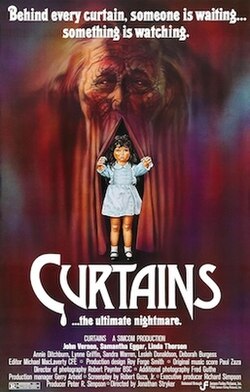
The hideously creepy ‘ugly’ mask that the killer dons is frightening, as is a strange doll that makes recurring appearances. See above and add to more horror must-haves.
In a murky opening sequence, a method actress, Samantha Sherwood (Samantha Eggar), has herself committed to an asylum to study the inmates, only to be double-crossed by her husband, Jonathan Stryker (John Vernon), who intends to keep her locked up.
She escapes to attend his casting session for six starlets whom he has invited to his prestigious and secluded mansion for a weekend retreat/audition for his new movie. Samantha’s motive is revenge and a desperate desire to play the film’s mysterious, mentally unstable star, Audra.
The ambitious female performers the unknown killer targets run the gamut from serious actress to sex kitten to stand-up comic. They are systematically killed one by one, naturally.
A clever and recurring theme is that of dreams. One victim, driving on a deserted highway en route to the mansion, stops to investigate a doll sitting in the middle of the street. A maniac then runs her down before waking up safely in her bed.
This ambiguous sequence and a riveting ice skating sequence on a frozen pond are the film’s best.
Curtains also does a good job at providing frights, as when one victim stages a kinky home intruder sequence with her boyfriend. Assumed to be there to kill her, instead, they simulate a rape before cracking up into hysterics.
The twist at the end of the film is also well done. Perhaps an early influencer to Scream (1996), there are not one but two killers in play, but are they in cahoots or kill independently?
The negatives run from a wacky cat-and-mouse scene amid mannequins, to someone placing a severed head in a toilet that is removed a minute later with no leftover blood and gore.
Neither the doll nor the mask has anything to do with the story other than creepy effects to throw in. And a hunky male hot tub soaker is introduced, then disappears for no reason.
The acting, even by heavyweights like Vernon and Eggar, is surprisingly ineffectual, saved slightly by Lynne Griffin (Black Christmas, 1974).
Despite being a cluttered, disarrayed film, Curtains (1983) does have elements that work. There are more questions than answers left to ponder, but the win, of note, is that the viewer will keep thinking about the film.