Category Archives: Beryl Reid

The Killing of Sister George-1968

The Killing of Sister George-1968

Director Robert Aldrich

Starring Beryl Reid, Susannah York

Top 250 Films #210

Scott’s Review #228
220px-Original_movie_poster_for_the_film_The_Killing_of_Sister_George

Reviewed March 13, 2015

Grade: A-

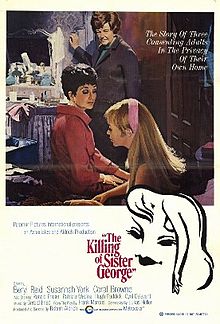
The Killing of Sister George is a British film drama, adapted from a 1964 stage production that was a risky subject matter to tackle for the times- lesbianism- in the late 1960s.

Directed by Robert Aldrich, well known for Whatever Happened to Baby Jane, The Killing of Sister George is a similarly dark tale of loneliness, desperation, and an actress who falls from former grace and success into despair, confusion, and anguish.

It also has some witty, crackling, comedic moments to avoid being a true downer.

Sister George is a successful, well-regarded actress on a popular soap opera named Applehurst. Her character is the wholesome presence in a town fraught with manipulation and drama. She is the moral focal point of the show.

In real life, however, George (interestingly called by her character’s name), is troubled.

She is bitter, angry, and a person with alcoholism, and she frequently berates and even abuses her partner, Childie, played by Susannah York. A third central character in the film is TV Producer Mercy Croft, who is powerful and confused about her sexuality.

When the soap opera powers-that-be decide to kill off the beloved Sister George, the real George’s life begins to spiral out of control.

As enjoyable a film as it is and certainly featuring the competent talents of Beryl Reid in the title role, I cannot help but ponder and fantasize how wonderful the casting of Bette Davis- reportedly considered for the role and inexplicably not cast- would have been.

Davis, famous for playing grizzled, mean, unsympathetic characters, would have knocked this role out of the park, and, sadly, she did not have the chance.

At its core, the film is a sad character study of one woman’s pain and anguish at being discarded. Presumably unable to be hired anywhere else, her soap opera character is her life.

She loves Childie but is not entirely fulfilled by her, either, and the vibrant, polished Mercy threatens that relationship.

This is an interesting triangle as George does not always treat Childie well, but loves her all the same. Childie is a simple character, childlike, and needs a strong mate to counter-balance the way she is- someone to take care of her.

Without a job or prospects, this would be difficult for George. Does Childie love George or want a meal ticket?

The film is understandably rated X for content, presumably for a very explicit sex scene between Mercy and Childie, and when a drunken George molests two nuns in the back seat of a London taxi cab.

These scenes are both cutting-edge and admirable in their risk-taking.

The scene set at the real-life London lesbian club (the Gateway Club) and featuring mostly real-life lesbians is excellent. It provides a real-life glimpse into the gay/lesbian world and lifestyle during the period.

A brave, groundbreaking, risk-taking film with bravura direction from Aldrich, The Killing of Sister George (1968) is a forgotten gem that needs to be rediscovered by film fans everywhere and is an early journey into gay and lesbian cinema.
Psychomania-1973

Psychomania-1973

Director Don Sharp

Starring Nicky Henson, Mary Larkin, George Sanders

Scott’s Review #1,084

Reviewed November 19, 2020

Grade: B-

Psychomania (1973) is a film that has an intriguing premise, but it becomes messy and confusing because elements don’t come together.

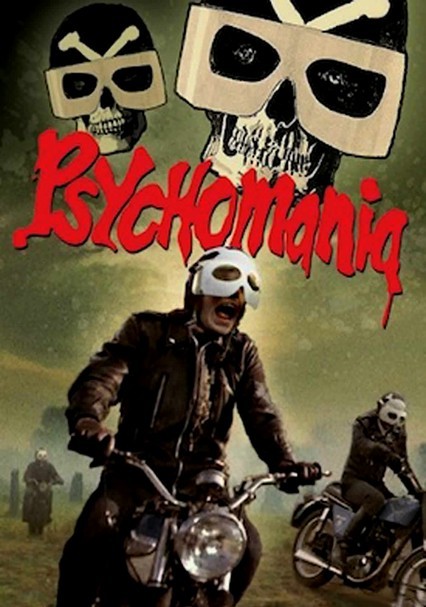
A motorcycle gang wreaking havoc on their English small town decides to kill themselves and come back from the dead to live forever. They intend to do so with the aid of witchcraft and a sinister cult.

Unfortunately, neither the gang comes back to everlasting life nor does the premise provide an adequate payoff. The film meanders along without much intrigue or interest except for an above-average finale.

But even that is too little, too late.

Renowned film and television actor George Sanders, famous for powerful roles in classics like Rebecca (1940) and All About Eve (1950), in which he won an Academy Award, and numerous other roles, co-stars as a butler.

His role in Psychomania is barely more than a throwaway part since he does not have much to do. Hardly the crowning achievement of his long career, he committed suicide soon after the shooting wrapped.

Star, Nicky Henson joked that Sanders saw the finished film and overdosed on pills, realizing how far his career had descended. Hopefully, that’s an urban legend.

Beryl Reid, wonderfully bitchy in The Killing of Sister George (1968) as a lesbian soap opera star, is similarly downgraded, playing a glamorous matron who gets her kicks by holding seances for her neighbors.

She is the mother of the psychopathic leader of a violent teen gang.

Tom Latham (Henson) is the handsome leader of “The Living Dead,” a motorcycle gang that enjoys driving around town intimidating folks. He is joined by his pretty girlfriend, Abby (Mary Larkin), who is good-natured and less rebellious than the others.

Tom has time to flirt with other girls and uses his good looks to his advantage. He is in cahoots with his mother (Reid), and they have a penchant for frogs and black magic.

The gang decides, through Tom’s encouragement, to commit suicide, and if they believe in it, they will return as one of the “undead”.

Each follows suit, except for Abby, and engages in ritualistic activities at their hangout, “The Seven Witches”, which is a poor man’s Stonehenge. They decide to kill Abby because of her defiance.

The DVD quality (mine anyway) was atrocious and did the film no favors. My enjoyment would have increased if the luscious English landscape and its vibrant colors could have been capitalized on.

Mrs. Latham’s home, filled with creative antiques and oddities, would have been enhanced by higher-quality pieces.

The story never comes together. I like the main character, Tom, and find his sneering and posturing appealing in a light-hearted way. Henson is way too good-looking to be believable as a foreboding and crazy guy, but he sure is easy on the eyes.

No chemistry is to be found between him and Larkin, but they are cast well for this type of film- looks like overacting talent. Neither is terrible in the acting department nor great either.

The supporting characters look very British and of the 1970s, which is to be expected. This isn’t an annoyance as much as an astute observation. From the doctors who perform the autopsies to the constables, to the chief inspector, everyone looks their part.

Psychomania has a 1970s look and feel, so it ultimately feels dated because there is not much else to distinguish it from other films.

It’s adequate, but not much more.

On the positive, some of the music is chirpy and hip, which adds a bit of an upbeat, contemporary vibe. The numerous motorcycle scenes make me wonder whether a motorcycle company has a stake in the film, but surprisingly, it works.

The film, targeted as a horror film, is a strange one to categorize. The cult and witchcraft elements give off that vibe. The title of Psychomania (1973) creates a motorcycle/horror effect.

I’m not sure what to make of this film other than a sleazy, greasy, devil-worshipping mess. Poor Don Sharp, well-known for directing many Hammer horror films, seems not to know what to do with the silly script he is handed.

Is it a goofy comedy or straight-ahead horror?