Tag Archives: Margaret Avery

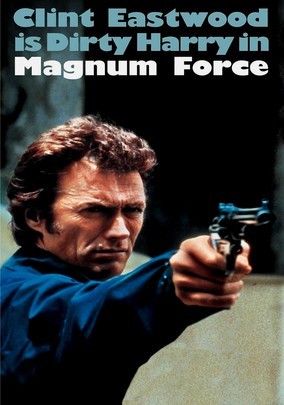
Magnum Force-1973

Magnum Force-1973

Director Ted Post

Starring Clint Eastwood, Hal Holbrook

Top 250 Films #148

Scott’s Review #336
60021588

Reviewed January 9, 2016

Grade: A

The follow-up to the original action thriller to end all action thrillers, Dirty Harry, 1973’s Magnum Force, is as good as the original in my opinion, but flies under the radar compared to the acclaimed Harry.

Both films are similar in style and grit, but Magnum Force holds sentimental memories for me, as I remember watching the film countless times on rainy Saturday afternoons as a kid.

The similarities abound between the two films, as the screenwriter and the score are by the same writer and composer, respectively.

Admittedly, Magnum Force is more conventional and less dirty than its predecessor.

Playing not just the same role of Harry Callahan, the grizzled, hard-nosed Inspector from Dirty Harry, but also Clint Eastwood plays him in quite the same manner.

Not one to blow anyone away with his dazzling acting talent, Eastwood is smart to keep to the status quo. The character is tough and no-nonsense, but has a take-prisoner vulnerability we love and admire.

In this chapter, a syndicate of vigilante cops is taking matters into their own hands by assassinating known criminals who have been let off the hook either by connections or some other form of loophole.

The pattern is for uniformed patrol officers to pull over a criminal for a mundane reason, only to shoot and kill them on the side of the road at point-blank range. They deserve it, but are the cops justified in their actions?

The appeal and mystery of the film is that the police officers wear dark helmets that hide their identities from the audience, adding a level of intrigue.

The film offers up a moral question: do the criminals get what they deserve, and do the police officers have the right to justify their actions?

Especially relevant is the final thirty minutes of the film, as Harry and the central “villain”, Lieutenant Briggs (Holbrook), have a standoff and discuss the topic.

Magnum Force is a shoot-’em-up action flick, so this debate is skirted over largely in favor of car chases and fight scenes. But the point can be thought about.

The best sequence of the film is the finale, as Callahan is lured to an abandoned garage and chased by three remaining cops. The big reveal is that Briggs is running the show, and as he drives around in his early 1970’s Ford LTD, soon to become battered and weathered, it is a great scene, especially for those who enjoy car chases.

Magnum Force (1973) is a no-frills “guy” film, but one done very well and with an interesting, semi-controversial premise.

The film is the 1970s action genre at its very best.

Surprisingly, and to the film’s credit, one can discuss the film after watching it instead of it being a generic, forgettable flick.

The Color Purple-1985

The Color Purple-1985

Director Steven Spielberg

Starring Whoopi Goldberg, Oprah Winfrey

Top 250 Films #153

Scott’s Review #358

60026621

Reviewed January 9, 2016

Grade: A

Steven Spielberg, admittedly a director who focuses more on sentimentality, mixes heartbreak with the courage to blend a recipe that makes for a perfect, mainstream film from 1985.

It is a different direction for him- far extreme from the summer blockbusters he was known for until this time.

Exceptional acting and cinematography lend themselves to The Color Purple, a film based on the much darker novel by Alice Walker. Certainly, one of the best films of the 1980s.

A relative unknown when the film was made, Whoopi Goldberg gives an astounding performance in the lead role.

The film spans approximately forty years in the early twentieth century and is set in rural Georgia.

Celie Harris (Goldberg) is an oppressed black woman, her sister and best friend Nettie is sent away, leaving Celie a virtual prisoner with a man, Albert Johnson (Danny Glover), whom she is forced to marry and care for in addition to his children.

Raped and beaten, Celie is left with little self-worth until two women, rotund, feisty, Sophia (Oprah Winfrey), and Shug (Margaret Avery) inspire her to be something better.

The Color Purple is a very sentimental film filled with inspiration for anyone beaten down or otherwise abused by people or by society.

The depiction of southern life for blacks, especially black women is depicted well, though softened I have no doubt. Liberties must be taken for the sake of film as black men, in particular, are not portrayed well- surely there must have been some decent black men in this time?

But, despite Spielberg being a male, The Color Purple is told from a definite female perspective.

Her role of Celie is Goldberg’s finest and hers is a case of the Academy getting it all wrong; she should have won an Oscar for this performance instead of a conciliation win a few years later for her secondary (and unremarkable) role in Ghost.

Goldberg never achieved any roles as great as Celie.

Her expressions and mannerisms spoke volumes and her occasional wide, beaming smile would melt the coldest heart.

Winfrey, equally brilliant as Sophia (and also robbed at Oscar’s time), is a completely different character. Angry, abrasive, and outspoken, she fills Sophia with life and energy, which makes her big scene heartbreaking to watch.

Defying a white man she is beaten and arrested and reduced to living out her days as a limping maid to a white woman- who she swore she would never serve.

The cinematography and direction of The Color Purple are grand.

Spielberg does a believable job of depicting time accurately. The costumes worn by the cast and the lighting, in general, are bright and colorful, and I think this gives the film a flavor that is nice to watch.

Again, Walker’s novel and the real-life experience were undoubtedly much darker, but for the film’s sake, this adaptation (numerous stage versions preceded and followed) makes for a wonderful film.

Oscar Nominations: Best Picture, Best Actress-Whoopi Goldberg, Best Supporting Actress-Margaret Avery, Oprah Winfrey, Best Screenplay Based on Material from Another Medium, Best Original Score, Best Original Song-“Miss Celie’s Blues (Sister)”, Best Art Direction, Best Cinematography, Best Makeup, Best Costume Design