Tag Archives: Patrick Wymark

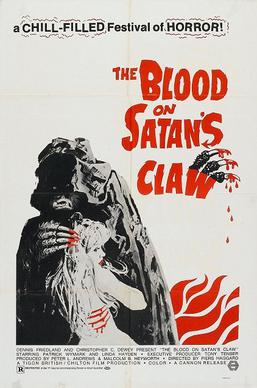
The Blood on Satan’s Claw-1971

The Blood on Satan’s Claw-1971

Director Piers Haggard

Starring Patrick Wymark, Linda Hayden

Scott’s Review #1,050
Reviewed August 7, 2020

Grade: B

I am always up for a good British horror film, with a creepy musical score, satanic elements, and eclectic, good actors. Especially embraceable are offerings from the late 1960s and early 1970s.

The Blood on Satan’s Claw (1971), also released as Satan’s Skin, is very reminiscent of both Witchfinder General (1968) and The Wicker Man (1973), the three often lumped together in a small, brief sub-genre termed folk horror.

The film is not high art, nor is it intended to be. Taking itself too seriously would ruin the experience.

Instead, a gruesome, low-budget offering is just what the doctor ordered for late-night sipping, cocktails, or your preferred enlightenment or sedative.

The elements are all there- thunder and lightning, a perfect score, and the English countryside.

The Blood on Satan’s Claw would have been dynamite if the choice to cast horror legend Peter Cushing or Christopher Lee had come to fruition, but Cushing’s wife was dying of cancer, and Lee wanted too high a salary, or so the story goes.

Anyway, Patrick Wymark was awarded the lead role of a village judge. The actor had a penchant for booze and had to be watched closely.

Sadly, he died soon after filming wrapped.

Those expecting a concise plot will be disappointed. Reportedly, the script was changed repeatedly in a dizzying fashion before filming commenced. Some plot points and characters are introduced only to be unceremoniously dropped or forgotten.

Little wonder why the story confused me to no end.

Many characters have strange reaction shots as if they are reacting to different scenes. No matter, though, the film is a good time despite the inconsistencies.

In a nutshell, a cute plowman Ralph (Barry Andrews) uncovers a hideously deformed skull with one gouging eye and strange fur. When he reports his findings to the local judge (Wymark), the judge is skeptical, especially when the skull disappears before he lays eyes on it.

The village and its inhabitants quickly succumb to a group of teenage devil-worshipers led by beautiful but fiendish Angel Blake (Linda Hayden), who begins to perform blood sacrifices to bring the skull back to life.

Director Piers Haggard, who also wrote some of the script with Robert Wynne-Simmons, does a great job of adding the right elements to create a satisfactory mood.

The ancient setting of early-eighteenth-century England is always a juicy horror add-on, since the unfamiliar time lends it mystique.

The cinematography is gorgeous with lavish fields and stone buildings. I could have done without the laughably bad wigs the male actors were forced to wear, though.

Hayden is the standout for me.

A dead ringer for The Brady Bunch’s Maureen McCormick, only British, mixes deadly with beautiful in an underappreciated role. The actress was at the time a sex symbol, appearing in other horror films such as Taste the Blood of Dracula (1970) and Vampira (1974).

As the teenage ringleader, her best scene is when she serves as a temptress to the local Reverend (Anthony Ainley). She seductively disrobes and confidently walks over to the intimidated man, offering full-frontal nudity and the obvious daydreams of schoolboys everywhere.

Those not turned off by witch hunts, devil fur shavings, or characters sawing off their limbs will find The Blood on Satan’s Claw (1971) a real treat.

The film will please those classic horror fans expecting what the expected is in British horror which is a good thing. The demonic and religious trimmings mix well with a cast that is classically trained with most appearing in similarly themed horror films.

The story is weak and haphazard but the film is recommended to just enjoy the moment with.
Witchfinder General-1968

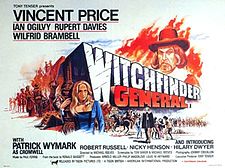
Witchfinder General-1968

Director Michael Reeves

Starring Vincent Price, Ian Ogilvy, Hilary Dwyer

Scott’s Review #904

Reviewed May 31, 2019

Grade: B+

Witchfinder General (1968) is a macabre horror film that creates an intense atmosphere amid a gruesome story centered on witch-hunting.

By the late 1960s, violence and bloodletting in cinema had become more lenient and acceptable. Hence, the film takes full advantage of the timing with an unusual amount of torture, cruelty, and brutality.

The mid-seventeenth-century English period is highly effective, as is the ghastly religious angle, making for compelling filmmaking.

Vincent Price is delicious in any film he appears in, having amassed over one hundred cinematic credits alone, to say nothing of his television appearances.

Practically trademarking his over-the-top comic wittiness and campy performances, his role in Witchfinder General may be his best yet, as he plays the character straight and deadly serious.

This succeeds in making his character chilling and, maybe, the best role of his career, despite numerous disputes with director Michael Reeves over motivation.

During the English Civil War, Mathew Hopkins (Price) took advantage of the unrest, profiting from witch-hunting. He travels from town to town, accusing the unfortunate of witchcraft, until they are mercilessly executed, after which he is paid handsomely.

Matthew is assisted in the accusations and torments by John Stearne (Robert Russell), a man his equal in brutality. Knowing these two men were real-life historical figures makes the action even more challenging to watch.

When he arrests and tortures Father Lowes (Rupert Davies), Lowes’s niece’s fiancé (Ian Ogilvy) decides to put an end to Hopkins’s sleazy practices and goes on a quest to seek vengeance.

The mixture of a romantic love story, as Richard Marshall (Ogilvy) and Sara (Hilary Dwyer) marry, and a revenge tale, as Marshall vows to destroy Hopkins, is a nice combination, as are the numerous outdoor scenes.

Witchfinder General has much going on, and the pieces all come together.

The most horrific moments of the film come during the death scenes as the victims, whom logical viewers can ascertain are innocent. The characters are merely perceived as peculiar, therefore deemed to be up to witchcraft, and do not stand much of a chance despite their endless pleas and cries.

Before they are murdered, they are typically tortured until they ultimately confess to crimes out of desperation and perceived relief. The standard mode of death is either hanging or burning to death.

In one sickening scene, victims are assumed to be witches if they can swim and then are subsequently burned at the stake; if they drown, they are innocent, but of course die anyway.

One unfortunate victim has her hands and legs bound and drowns, followed by one of the witch hunters professing how her death was tragic because she was innocent all along.

In horror films, the most frightening situations are the ones that can conceivably occur in real life, whether it be a home invasion, a psycho with a knife, or being burned at the stake in the 1600s.

The fact that witch-hunting did happen is shocking and resoundingly makes Witchfinder General creepier, especially given that most scenes take place in the daytime. Anyone can create a studio monster, but the realism of the events is the key to the film’s power.

As an aside, while watching the film, I was keen to keep in mind how many countries still treat certain classes and groups of people differently, or even oppress them in the name of God.

Food for thought and an additional component that makes Witchfinder General relevant.

The story and the screenplay are not brilliant, nor do they necessarily need to be, given the treasures existing among the elements. The writing is your basic villains getting their comeuppance with a love story thrown in, standard fare, and adequate.

While pointing out some negatives is “Witchfinder General,” the best title that Reeves could come up with, or anyone else, for that matter? The title does not exactly roll off the tongue, nor does the renamed United States release, The Conqueror Worm, sound much better.

Witchfinder General (1968) is not an easy watch, and the faint of heart may want to avoid it, but its realism and rich atmosphere make it a success.

The lit candles, an old castle, potent red and blue costumes, and one of the greatest horror legends of all time make this a must-watch among horror fans.

Repulsion-1965

Repulsion-1965

Director Roman Polanski

Starring Catherine Deneuve

Scott’s Review #554

Reviewed December 21, 2016

Grade: A

Repulsion is an excellent British film, an early film by the great director Roman Polanski, made in 1965. The film was shot on a low budget, and the action mainly takes place inside a small London apartment.

Repulsion is part of Polanski’s “Apartment Trio,” along with Rosemary’s Baby (1968) and The Tenant (1976), which are all set in apartments.

The film tells the story of Carol (Catherine Deneuve), a beautiful young woman who slowly goes insane throughout a weekend while left alone by her vacationing sister.

Carol is a beauty parlor worker who is seemingly sweet and shy but gradually becomes violent, volatile, and unbalanced. She experiences hallucinations, and it is alluded to that she may have been sexually abused as a child.

She loathes men.

The film is shot in black and white, with eerie camera shots, background noises, and very little music. Its claustrophobic atmosphere makes it all the more disturbing.

These characteristics make the film a challenging experience to watch, but that is to its credit.

We see Carol unravel and are mystified by the aspects that make her this way. The bathtub scene and the scene with Carol’s landlord are highlights of their brutality.

Repulsion (1965) is challenging to watch but an excellent piece of cinema. It is an in-depth character study of an unhinged woman reaching her psychological breaking point.