Category Archives: Lindsay Anderson

If…-1968

If…-1968

Director Lindsay Anderson

Starring Malcolm McDowell

Scott’s Review #1,178

Reviewed September 18, 2021

Grade: A

Malcolm McDowell fascinates me. The mere construction of his facial features astounds me. With his crystal blue eyes and sullen smirk, it’s tough to tell what he is thinking.

He stars in If… (1968), a satire of the student experience amid a strict upper-class English public school.

It’s McDowell’s film debut, which is worth noting.

McDowell, best known for A Clockwork Orange (1971), made several great films in just a few years.

The film follows a group of fed-up pupils, led by Mick Travis (McDowell), who ultimately stage a bloody insurrection at a boys’ boarding school. But is it real or imagined by Mick?

Mick is conflicted when he is caught between the sadistic older boys known as the Whips and the lowly first-year students, affectionately known as Scum, who are forced to do their bidding.

He and his two henchmen, Johnny (David Wood) and Wallace (Richard Warwick), rebel by exhibiting theft and defiant behavior, causing the ire of both the Whips and the school’s out-of-touch administration.

This conflict leads to an unexpected and bloody showdown.

If… was the subject of controversy in 1968 at the time of its release, receiving an X rating for its depictions of violence against school administration and grown-ups.

The specific year was a juicy one in cinema as the more edgy and creative fare was being produced in anticipation of the 1970s.

I champion the film and its director, Lindsay Anderson, for having the guts to make a film of this nature, sure to piss off and shock the education system and those who don’t get what the film is expressing.

One wonders whether the English rock band Pink Floyd drew inspiration from If… when creating their legendary 1979 song ‘Another Brick in the Wall.

The Whips are the villains, and the school administrators are portrayed as complacent or incompetent; as a result, the finale is quite satisfying for viewers.

One will never forget the image of Mick fiendishly standing on a rooftop, brandishing a gun and firing determinedly. His other cohorts join him in celebrating graduation ceremonies. For them, it’s a delightful moment since all the parents and family members are in attendance.

It’s only a film, but I can’t help but wonder how differently the film is perceived by an audience in the post-Columbine era, a vicious school shooting that occurred in the United States, an incident that led to a rash of similar events.

To clarify, since Anderson made a follow-up film to If… with O Lucky Man! in 1973, starring McDowell as the same character, we can rest easier in the knowledge that the events in If… are purely the imagination of Mick.

It’s a satire.

And what schoolboy or schoolgirl hasn’t fantasized about how delicious it would be to give bullies or other bastards their just deserts for making their lives miserable?

Another takeaway I got from If… is that it doesn’t have to be about a prep school at all. Mick and his friends question conformity and rules. Why can’t the viewer do the same in the workplace or in life itself?

I’ve seen the film twice and can never account for the inexplicable shifts from color to black-and-white in various scenes. Anderson claims this was done for budget reasons, but others have done a deeper dive and hypothesized that the color versus black-and-white choice has more to do with fantasy.

Whatever the reason, it successfully offers a surrealistic measure.

If… (1968) is a fantastic film that invites open dialogue after viewing. Isn’t that what cinema is all about? A discussion of the merits and conclusions of a particular movie?
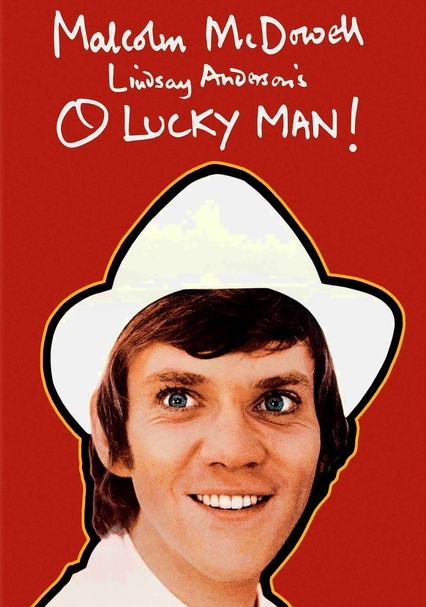
O Lucky Man!-1973

O Lucky Man! -1973

Director Lindsay Anderson

Starring Malcolm McDowell, Ralph Richardson, Helen Mirren

Scott’s Review #1,174

Reviewed September 1, 2021

Grade: A-

O Lucky Man! (1973) is a satirical black comedy that mixes musical songs with a message of capitalism by the driven protagonist. Like a great fine wine, the film has aged well and is still relevant decades later.

The film is a slow build but by the end of the lengthy running time of nearly three hours, I was enamored and hummed the title song repeatedly.

I’m still humming it as I write this review.

Suggested is to watch O Lucky Man! in two or three segments for full appreciation. One sitting would be incredibly tough since some of the events require some level of reflection and thought.

An ambitious young British man, Mick Travis (Malcolm McDowell) is determined to be successful at all costs. Debuting as a coffee salesman, Mick is quickly promoted within his company. Events take a series of bizarre turns when Mick is abducted by a military agency.

Later, he becomes smitten with the gorgeous Patricia (Helen Mirren) and winds up working for her father, sinister executive Sir James Burgess (Ralph Richardson). As Mick’s tale continues, his experiences get progressively stranger.

The clever aspect is that just when you think Mick’s life is dour and drab he rebounds more successful than ever. Hence the title of the film. So, there is an element of adventure and romance amid the capitalist plot.

Lindsay Anderson, who directed O Lucky Man! re-casts McDowell again in the same role he first played as a disaffected public schoolboy in his first film performance in Anderson’s film If… (1968).

I did not realize this at the time I watched O Lucky Man! and I think this knowledge would have made me catch on to the events and the subtexture even more.

Now, I need to rewatch If…

I did however ruminate constantly on McDowell’s other iconic role in A Clockwork Orange (1971) as Alex. The characters are quite similar save for Alex being a juvenile delinquent instead of a rising corporate guy like Mick is.

This is in large part due to McDowell’s looks and acting style. His trademark sneer and bright blue eyes make him mesmerizing in both roles.

I even spotted an actor who played one of the infamous droogs!

A plus to the film is that several actors appear in multiple roles, some difficult to distinguish. Part of the fun is trying to figure out who’s who.

There isn’t a whole lot of chemistry between McDowell and Mirren but it’s interesting the shifting characteristics of the characters. And Patricia is fascinating. When she inquires why people work so hard for things instead of just taking them we realize that she places no value in things because she’s never had to work for them. She’s a rich, daddy’s girl.

There are reasons not to like her but I still did. When she winds up in a homeless lot it’s shocking. And I also loved the character of Mick and his epic journey. He is imprisoned and then reformed in a humanistic way just like Alex was in A Clockwork Orange.

But the best part of O Lucky Man! is the music. Anderson takes periodic breaks from the drama to simply treat his audience to a musical number all performed by Alan Price.

It’s comforting to sit back and enjoy the unforgettable tunes that pepper the film. One could argue that the songs almost usurp the main action but I found them, great companions, to the other.

As if there was any doubt, the soundtrack was widely lauded and was a huge financial success.

A surreal effort, sometimes happy or tragic but always insightful and oftentimes delightful, McDowell, Price, and Anderson are at the top of their respective games.

O Lucky Man! (1973) is a terrific watch brimming with good juices if one just has the patience to let events marinate.