The Two Popes-2019
Director Fernando Meirelles
Starring Jonathan Pryce, Anthony Hopkins
Scott’s Review #994
Reviewed February 27, 2020
Grade: B+
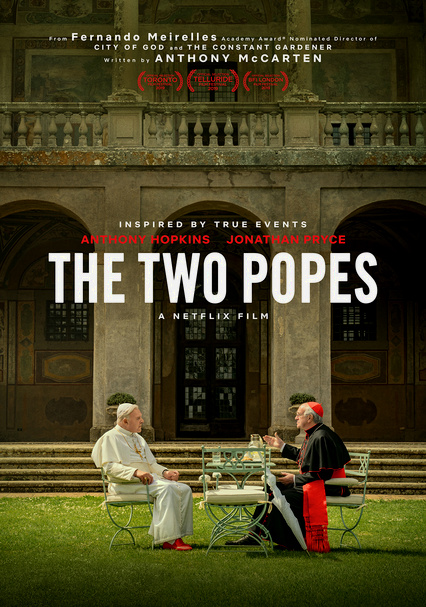
The Two Popes (2019) is a biographical drama that focuses on two real-life religious figures and the close friendship they form while sharing differing ideas and viewpoints.
The two men hold the highest spiritual office, and deep respect culminates over time while past secrets are uncovered.
The film carefully balances past and present but offers too few meaty scenes between the legendary actors for my taste.
Otherwise, a thought-provoking and historical effort, with brilliant sequences of Italy and Argentina.
The film begins in April of 2005 during a pivotal moment in history, following the death of Pope John Paul II. The world is abuzz with the naming of Cardinal Joseph Ratzinger (played by Anthony Hopkins), elected Pope Benedict XVI.
At the same time, Bergoglio (Jonathan Pryce), from Argentina, receives the second-highest vote count.
Ratzinger has a stiff and more traditional approach to Christianity, while Bergoglio is more modern in thinking and open to new ideas.
Seven years later, the Catholic Church is embroiled in the Vatican leaks scandal, which tarnishes the very concept of religion. Benedict’s tenure has been marred by public accusations regarding his role in the cover-up, which has shocked the world.
Meanwhile, Bergoglio intends to retire and arrives in Rome to receive Benedict’s blessing. This is the point at which the men slowly come to terms with each other and develop mutual respect and admiration.
The Two Popes is worth the price of admission for the acting alone. With heavyweights such as Hopkins and Pryce, one can rest easy in this regard and simply enjoy the experience.
The scenes between the two actors are fantastic and fraught with energy.
As the religious figures confide in one another and secrets brim to the surface, the actors are believable as the real-life figures. Even good, old-fashioned small talk is fascinating to watch.
While the present-day sequences enthrall, the flashbacks of Bergoglio as a younger man and his journey into the church are explored a bit too much, sometimes halting the flow.
He was once engaged to be married, but instead joined the Jesuits. He was married in scandal when the perception was that he had collaborated with the Argentine military dictatorship, and he was exiled to serve as an ordinary parish priest to the poor for the next ten years.
The balance between timelines is acceptable, but the flashbacks become too prevalent as the film progresses.
Director Fernando Meirelles seems more comfortable shooting scenes within Argentina since those are best directed using black and white filming to showcase both the ravages of a chaotic nation and the decades preceding the present.
Best known for the wonderful City of God (2003), he also intersperses real-life news sequences featuring the peril of the Argentinian people. The two time periods do not always flow naturally together, though.
A huge positive is the inclusion of the child abuse scandal that rocked the religious world and the brave decision that Meirelles made to focus on the revelation that Benedict knew about the accusations and dismissed them, clearly aiding in their continuation.
Both Popes deal with the struggle between tradition and progress, guilt and forgiveness, and confronting one’s past, making it a character study.
The exterior and surrounding sequences are an absolute treat. Having visited Rome and particularly Vatican City, the Sistine Chapel, a showcase of the Vatican, is wonderful to view on a personal level.
The chapel in the Apostolic Palace, the official residence of the pope, is both astounding due to its lovely religious art and the backdrop for many scenes between Benedict and the future Pope Francis (Bergoglio).
Any viewer fond of world history or religious history will enjoy The Two Popes (2019). With great acting, secrets revealed, conflict, and loyalty, the film is crafted well.
Some momentum is lost in the story’s back and forth, and the film is hardly one that warrants repeated viewings or study in film school; however, it provides a realistic look at modern religion, complete with its arguments and discussions, to delve into.
Oscar Nominations: Best Actor-Jonathan Pryce, Best Supporting Actor-Anthony Hopkins, Best Adapted Screenplay