Category Archives: Gordon MacRae

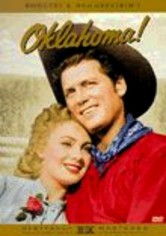
Oklahoma!-1955

Oklahoma! -1955

Director Fred Zinneman

Starring Gordon MacRae, Shirley Jones, Rod Steiger

Top 250 Films #184

Scott’s Review #51
820796

Reviewed June 20, 2014

Grade: A-

Oklahoma! (1955) is one of a slew of memorable Rodgers and Hammerstein musicals to emerge from the 1950s and 1960s Hollywood and to be based on a popular stage version.

The film has an old-west, homespun, comfortable appeal. It is best enjoyed during the summer months.

While Oklahoma! seems a bit too hokey and is not my favorite musical compared to other more sophisticated stalwarts such as My Fair Lady (1964), An American in Paris (1951), or The Sound of Music (1965), it emits a flavor and tasteful appeal of the West.

The plot focuses on a love triangle between a good old boy, Curly, a good girl, Laurey Williams, and brooding Jud, though the real rooting couple is Curly and Laurey.

The trio is supported by many townspeople who gossip about them and help Curly and Laurey admit their true feelings and unite as a couple.

Of course, Jud is the villain, and conflicts come into play throughout the production.

A lesser couple, Will Parker and Ado Annie, also enter each other’s arms amid traditional small-town events such as a lively summer fair.

Stars Gordon MacRae (Curly) and Shirley Jones (Laurey) are very handsome and likable in the lead roles, making for a nice pairing.

Gloria Grahame is as appealing and comical as Ado Annie, especially in her rousing turn bellowing out, “I Can’t Say No,” Charlotte Greenwood is the moral voice of reason as Aunt Eller.

What works best in the film are the settings of Oklahoma, as the viewer experiences such a feel for life in the heartland long ago (though the exteriors were shot in Arizona).

It’s pure fantasy enjoyment with a magical Wizard of Oz feel, though no cyclone or munchkins are anywhere in sight. The film version closely follows the original stage version.

The musical numbers are pretty catchy (“Oh What a Beautiful Morning,” “I Can’t Say No,” and “Oklahoma” are my favorites). The controversial mid-number “Dream Ballet” is provocative, artistically enjoyable, and jarringly different from the rest of the traditional tale.

This jaw-dropping number mirrors a similar spectacle in An American in Paris.

Perhaps Oklahoma! is not entirely on par with other musicals of its day but darned close.

Oscar Nominations: 2 wins-Best Scoring of a Musical Picture (won), Best Sound Recording (won), Best Cinematography, Color, Best Film Editing

Carousel-1956

Carousel-1956

Director Henry King

Starring Gordon MacRae, Shirley Jones

Scott’s Review #1,486

Reviewed July 27, 2025

Grade: A-

Following the success of Oklahoma! in 1955, Carousel (1956) is similarly based on the lauded Rodgers and Hammerstein stage musical. It is firmly nestled among the myriad musical productions that emerged in the 1940s, 1950s, and into the 1960s in cinema.

Darker in tone, the musical drama bears a strong resemblance to Oklahoma! It swaps the Midwest United States for Northeastern Maine. Clambakes and wattery harbors lend authenticity to the film.

Easily paired with Oklahoma! as a double feature, it even features the same stars—Gordon MacRae and Shirley Jones, who return to star in Carousel. As an aside, the filmmakers originally cast Frank Sinatra, who dropped out, so MacRae was a second choice.

As with the original stage production, the film features some of Rodgers and Hammerstein’s most famous songs, particularly ‘Carousel Waltz’ and the emotional ‘You’ll Never Walk Alone’.

It also features arguably the most serious storyline of all their musicals, incorporating domestic abuse into the fray.

The story follows the romance of Billy Bigelow (MacRae), a charming carousel barker, and Julie Jordan (Shirley Jones), a pretty blue-collar worker from a nearby mill in Boothbay Harbor, Maine.

When the attractive young couple abruptly and reactively gets married, they also both find themselves unemployed and broke, which puts a strain on their relationship.

When Billy finds out that Julie is pregnant, he resorts to extreme measures to get money, a decision that leads to tragedy.

Cleverly, the film is non-linear, as the first scene features Billy in what appears to be Purgatory (or the back door of Heaven), where he is told that he can return to Earth for one day to make amends.

We know that Billy has died after a tragic event, but we do not know the details.

To its credit, Carousel is not a cheery, bombastic musical fraught with over-the-top phoniness or too much glee. The characters are darker, which makes it feel unique to me.

Proof of this is evident in a comparison of MacRae’s and Jones’s characters in Oklahoma! to Carousel. While Laurey (Jones) is a respectable, virginal good girl, Julie plays with fire, assuredly spending time alone with Billy after being warned of the consequences.

Curly McLain (MacRae) is a good-natured cowboy who admires the beautiful morning while riding to see his wholesome crush, Laurey, whereas Billy is a rough-talking, macho brute.

Supporting characters like Carrie (Barbara Ruick), Jigger (Cameron Mitchell), and Cousin Nettie (Claramae Turner) are fantastic additions, especially Turner, as she brings down the house with ‘You’ll Never Walk Alone’.

Still, I yearned for a bit more substance to their characters. What makes them tick? Are they fulfilled?

A final highlight is the amazing fantasy musical song and dance number that appears towards the finale. As Billy’s teenage daughter, Louise (Susan Luckey), dances amongst her classmates, she is mocked for her father’s reputation and shortcomings.

She writhes around them in a deliciously choreographed sequence that builds tension and kickstarts the action.

Unlike Curly, I found Billy difficult to like, though the character is softened considerably by the end of the film. He’s honestly a dick through most of the story, hitting Julie, and plotting ways to find fortune at the expense of others.

To make matters worse, he also slaps his own daughter’s hand when he comes down from Purgatory to see her. Are we expected to like him?

Despite the two aforementioned powerful musical numbers, the other songs don’t carry through as much or are nearly as memorable.

For much of the running time, until the great build with Louise’s musical number, there is a slowness to the events. Whereas Oklahoma! has it all, something is missing from Carousel, and the pacing isn’t as fine-tuned.

Nonetheless, I adore the summery New England setting with the authentic location sequences and attention to detail. The darkness and edgy religious-themed trimmings combined with two homerun hitting musical numbers are enough to make me a fan of Carousel (1956).