Category Archives: Royal Dano

Killer Klowns from Outer Space-1988

Killer Klowns from Outer Space-1988

Director Stephen Chiodo

Starring Grant Cramer, Suzanne Snyder

Scott’s Review #1,169
Reviewed August 6, 2021

Grade: B-

A film surely only meant to be viewed late at night and/or in a hallucinated or otherwise drugged state for maximum pleasure, Killer Klowns from Outer Space (1988) is not to be taken seriously.

It does contain great imagination.

It’s kind of a take-off of Invasion of the Body Snatchers (1956) with a wretched 1980s look. It’s a fun film, but as odd and pointless as they come.

There is no explanation offered for the villain’s behavior, nor is one necessary. There is also no political message or motivation.

It’s like someone thought of the weirdest possible gimmick and made a film about it.

For a horror film, the body count is very high, but there is little gore.

Unsurprisingly, it has found a permanent home in the genre-cult-classic category, to be dusted off whenever in need of the wacky or absurd.

Teenage lovebirds Mike (Grant Cramer) and Debbie (Suzanne Snyder) see a comet crash outside their quiet, small-town home one late night.

They investigate and discover a pack of murderous aliens who look exactly like circus clowns. When they do the right thing and warn the local authorities, everyone assumes their story is a prank.

Meanwhile, the clowns attempt to harvest and eat as many people as they can. When they kidnap Debbie, Mike decides to set out on his own to rescue her and stop the bloody rampage. This leads to an epic battle between Mike and his friends and the clowns.

The Chiodo Brothers, who wrote and directed Killer Klowns from Outer Space, are primarily known for special effects, stop-motion, and clay modeling, and the film uses these techniques extensively.

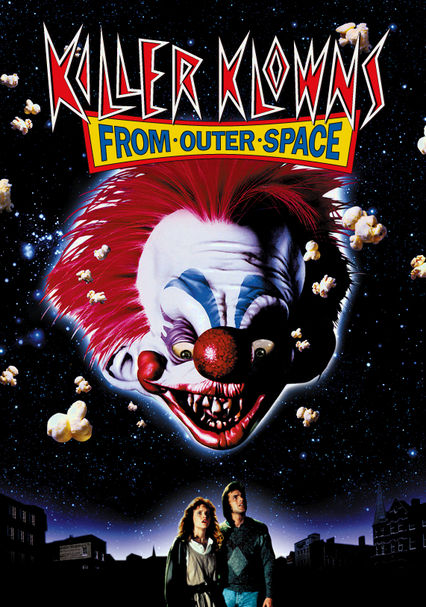
The wonky and lumbering clowns sport sinister smiles and quirky cotton-candy cocoons to keep their prey.

Hardly are they directorial or screenplay masters, so the film feels extremely experimental in many regards. The storyline is basic, and the villains have only one modus operandi. The character development is nil, and the acting is poor.

Is anyone surprised?

The key to enjoying Killer Klowns from Outer Space is that it knows it is a B-movie and embraces that classification. Avoiding all seriousness is arguably what makes it a marginal success.

One can sit back and laugh at it as one would rib an old friend. It is acceptable to both parties.

The clowns, or Klowns, are the real stars of the film. It’s fun to view these odd creatures and admire their costumes. This is the film’s creativity coming through, and the Chiodo Brothers are masterful at it.

One part scary and one part goofy, their lavish costumes are bright and colorful. The creatures themselves are ugly as sin, big and lumbering.

Predictably, the film writes the supporting characters as stereotypical as possible, and maybe that’s the fun in it all. Farmer Gene Green (cool name!) believes Halley’s comet is the strange glowing object falling to earth.

He and his dog are quickly harvested. The police officers are curmudgeons and disbelieving of the teenagers. Various friends of Mike and Debbie are cast as one would expect for a horror film.

The final climax is the best part of the film when an ice cream truck is used as a weapon against the clowns until a myriad of pies start falling from the sky.

Anyone watching the film while stoned would gleefully laugh.

Recommended for the adventurous cinema lover who wants to delve into the bizarre, late-night, campy horror territory.

Killer Klowns from Outer Space (1988) is mesmerizing in its absurdity and harkens back to 1950s science fiction.
Johnny Guitar-1954

Johnny Guitar-1954

Director Nicholas Ray

Starring Joan Crawford, Sterling Hayden

Scott’s Review #655

Reviewed June 15, 2017

Grade: B-

Johnny Guitar (1954) is an interesting film to review for several reasons, but its challenge to the traditional Western mold is the most distinct. Front and center is an aggressive and strong-willed woman, a saloon owner no less, engaged in an antagonistic feud with another woman of a similar disposition.

Of course, since the film stars legendary screen actress Joan Crawford, she is a strong character.

The writing is not brilliant, and other Western stereotypes abound, but Johnny Guitar is a decent watch for Crawford.

In the middle of an Arizona cattle town circa the Wild West, Vienna (Crawford) is a gorgeous woman who owns the local watering hole, which less-than-savory men frequent.

Vienna welcomes the men mostly because one of them is a former boyfriend. The rest of the town, led by Emma Small (Mercedes McCambridge), despises Vienna and her support of the incoming railroad, which makes Vienna rich.

After a bank robbery, Vienna is pursued by Emma and the town into a standoff, in which lynchings, shootings, and fires encompass the rest of the film.

Mixed in with the drama is a romance between Vienna and handsome guitarist Johnny Guitar (Sterling Hayden), and some musical numbers, but mostly, the film is a shoot ’em up led by women.

Let’s take the good with the bad surrounding the film—in my book, any picture starring Joan Crawford gets some credit, and the role of Vienna is undoubtedly uncharted territory for the glamorous star.

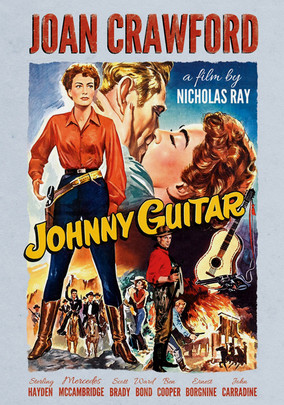
Tough-talking, gun-slinging, and with a short hairdo, rumors abounded that the character of Vienna was gay and in love with her arch-enemy Emma.

This might have happened decades later, but this was 1950s Hollywood, after all. Crawford still dazzles with heavy makeup and bright red lips and is feminine despite the masculine outfit.

Clever, especially for 1954 westerns, is a tough female character in the central role, bolsters Johnny Guitar above middling. Typically, in a genre that sticks to the tried-and-true, the main female rivalry between Vienna and Emma is the best part, but sadly, the back story is never fully explored.

Why do they hate each other? Were they in love with the same man? Is their hatred simply because they are the only women in the town?

The chase scene and the climax of the film are also quite good. How delightful to see Crawford prancing around in peril, riding a horse, and swimming in a creek.

The film turns into a good, old-fashioned adventure, and the cinematography and exterior sets are not bad.

Two aspects of Johnny Guitar stood out to me as negatives. First, the romance between Vienna and Johnny Guitar does not work. Crawford seems too old for Hayden as Johnny, and I never felt any chemistry between the characters. Second, the backstory scene revealing that they were once an “item” is weak.

There are no other female characters besides Emma (a coincidence?), which is a strange aspect of the film. Does one wonder if this was Crawford’s demand? (But I digress.)

The romance between the duo is lackluster, though admittedly, I did feel a rooting factor for them as the final chapter commenced and the pair was in danger.

The storytelling is mediocre, as I never felt invested in the writing, and the entire script feels silly and cheap. The story is laid out in an introductory way- Vienna is told by (arguably) the leader of the town, Ward Bond, to close up shop and leave town within twenty-four hours or else there will be hell to pay.

When some of the men rob a bank and plan to depart for California, Vienna is blamed for a sloppy, contrived plot device and is set to be hanged.

The script is not the high point of the film.

Johnny Guitar (1954)is worth watching for a gender-bending experience and the fabulous addition of Ms. Crawford. However, do not expect a masterpiece in storytelling or to be dazzled by character development.

Fans of the classic Western may be disappointed.

Carrie-1952

Carrie-1952

Director William Wyler

Starring Jennifer Jones, Laurence Olivier

Scott’s Review #240

60011689

Reviewed May 3, 2015

Grade: B

Carrie, not to be confused with the 1976 horror classic Brian DePalma, is a 1952 drama starring Laurence Olivier and Jennifer Jones—two big Hollywood stars of the time.

Shot in black and white, the film tells the story of a self-titled ingénue (Jones) from a Midwest upbringing who travels to Chicago to make her fortune.

Attempting to launch her career, Carrie becomes immersed in a love triangle with Olivier, who is unhappily married and runs a restaurant with salesman Charles Drouet, played by Eddie Albert.

Directed by William Wyler, the film has a melancholy tone as one of the characters sinks into a world of despair.

The highlight of this film is Laurence Olivier’s excellent performance as George Hurstwood, who goes from being a successful restaurant manager with an affluent existence to a poverty-stricken, lonely, and broken older man.

Olivier is so effortless and believable in his performance, as he always was.

However, I felt that Jennifer Jones was miscast. While attractive, yes, I did not think that every man would lust after her on sight alone, as was needed for the character of Carrie. Her acting, while okay, is not on the level of either Albert or especially Olivier, with whom she shares much screen time.

Perhaps Vivian Leigh, Teresa Wright, or Kim Novak might have been wiser choices.

The story itself is compelling and engaging. Here we have a woman- at the turn of the twentieth century- forging ahead to make it on her own- almost unthinkable for a woman, taking menial jobs as a sewing worker in a factory to scrape by.

Carrie resists the urge to become a rich husband-seeking gal and believes in marriage and true love. That is why she is devastated when she learns that George is married.

Will true love win out for them? This seems to be the central aspect of the film.

Behind-the-scenes issues may have contributed to the problems that appear onscreen. Wyler reportedly did not want to cast Jones, Olivier did not like Jones, Olivier was injured during much of the filming, and the film’s ending was changed to provide a “happier” ending.

Initially, George was to commit suicide, which might have successfully made the film more shocking and heartbreaking.

Containing beautiful costumes and interesting cinematography, Carrie has positives but might have been much better than the final product ended up being, but for poor casting and real-life dramas that hurt the film.

Oscar Nominations: Best Art Direction, Black-and-White, Best Costume Design, Black-and-White