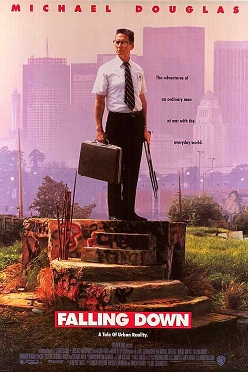
Falling Down-1993
Director Joel Schumacher
Starring Michael Douglas
Scott’s Review #1,192
Reviewed November 6, 2021
Grade: B+
Falling Down (1993) is a film with a message, or arguably several messages.
It’s about a man fed up with almost everything, on the brink of a full-throttle meltdown.
The film blends entertainment with a message about socio-economic unfairness, inequality, and related issues.
Whether people take these elements as seriously as they should is at risk due to the popcorn qualities. It’s almost like it doesn’t know what it is.
Is it a kick-ass thriller, a black comedy, or a fantasy?
The film certainly entertains.
This is unsurprising because Joel Schumacher is at the helm. The man is a mainstream director churning out hits like The Client (1994), Batman Forever (1995), and Batman & Robin (1997) throughout the 1990s.
Some were more successful than others, but Falling Down is his best work.
I am a big fan of Falling Down, with the awareness that the messages peppered throughout may not be taken as seriously as they ought to be. And the reason is that there are too many of them. It’s almost as if they are boxes being checked off a list.
But it bears repeating that the entertainment factor is fabulous.
One scorching summer day in Los Angeles William Foster (Michael Douglas) an already frustrated middle-aged man who is unemployed and divorced is having a terrible day.
When his car breaks down on the freeway, he leaves his vehicle and begins a trek across the city to attend his daughter’s birthday party.
As he makes his way through urban neighborhoods, William’s frustration and bitterness are tested at every turn, resulting in violent encounters with various people, including a vengeful gang and a pursuing veteran police sergeant, Martin Prendergast (Robert Duvall).
Unfortunately for Prendergast, today is the day before his long-awaited retirement.
Douglas delivers an excellent performance as Foster. He makes the character relatable to every viewer who has ever felt so fed up that they want to discharge the people responsible for the unfairness.
He takes his anger out only on those who deserve it, which makes the character something of a hero.
The white supremacist, the belligerent Korean grocery store owner, the gang members, and the lazy construction workers all deserve their just desserts.
Throughout the film, I cheered Foster mightily and chuckled at his wit.
My favorite sequence takes place at the fast-food joint Whammy Burger. All Foster wants is his breakfast, but he arrives one minute past the cut-off as the unsympathetic cashier smugly tells him.
He proceeds to ravage the restaurant in anger.
Despite the humor that Schumacher adds, the message must be taken seriously. Minority characters are aptly shown as repressed or not treated well, and that point sticks with me until the end.
The least interesting story point is the entanglement between Foster and his ex-wife Beth, played by a woefully underutilized Barbara Hershey.
The Oscar-nominated actress can do so much, but her talents are wasted in a throwaway role as an underdeveloped wife.
I never warmed to Robert Duvall’s police sergeant character either, and while sympathetic to Foster’s cause because of a situation with his son, the plot point never develops fully. Prendergast’s overbearing wife and a young police officer he seems obsessed with are never explored well.
Despite great talent, the film belongs to Michael Douglas.
The mood and cinematography deserve accolades. The humidity is suffocating, and the layers of smog hanging over Los Angeles hammer home the film’s stuffy nature. One can imagine the sweaty environment leading to explosions of anger.
What Schumacher does, besides entertaining the audience, is show them that a once-successful man who had a great job and a happy family life can lose it all and snap.
Falling Down (1993) shows that what happens to Foster can happen to anyone.
Let’s live each happy day to the fullest while we can.