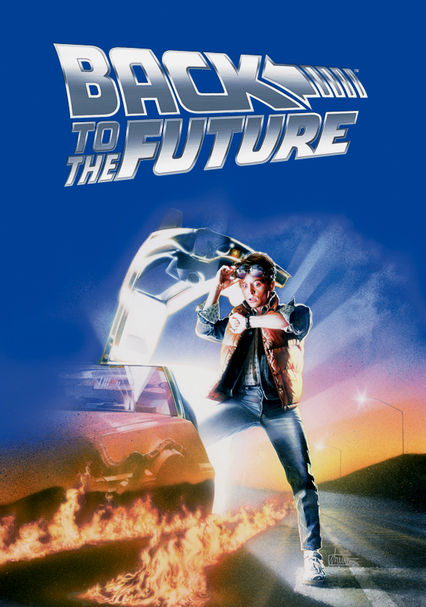
Back to the Future-1985
Director Robert Zemeckis
Starring Michael J. Fox, Christopher Lloyd
Scott’s Review #1,205
Reviewed December 5, 2021
Grade: A-
As a child of the 1980s, I was left with an indelible mark by films like Back to the Future (1985).
I fondly recall excitedly going to the movie theater on a Saturday afternoon with a giant tub of popcorn in tow and enjoying the hell out of this film.
I’ve subsequently seen it several times since.
There exists a magical, futuristic element that left me and countless other youngsters and adults alike with a sense of wonder. And one amazing car!
Michael J. Fox, a huge television star of the 1980s largely thanks to the sitcom Family Ties, powered through to the big screen with the help of this film and others.
The 1980s were a wonderful decade to grow up in.
Small-town California teen Marty McFly (Fox) is thrown back into the 1950s when an experiment by his eccentric scientist friend Doc Brown (Christopher Lloyd) goes awry.
Traveling through time in an amazing DeLorean, Marty encounters younger versions of his parents (Crispin Glover, Lea Thompson) and must ensure they fall in love, or he will cease to exist.
To further complicate matters, Marty then has to return to his own time and save Doc Brown’s life.
Back to the Future is one of those films that has something for everyone, and the stars are perfectly aligned to make it a blockbuster popcorn hit.
Besides the science fiction elements, there is humor, a cool 1950s throwback vibe, romance, and natural chemistry between Fox and Lloyd, who together carry the film.
It’s hardly an art film and goes for the jugular with mainstream additions like a killer soundtrack led by The Power of Love by Huey Lewis and the News, which was all over top 40 radio in the summer of ’85.
Counterbalancing the current times was another smash hit, Johnny B. Goode, a 1958 Chuck Berry tune.
There is a safe vibe for sure, and director Robert Zemeckis knows his action-adventure romantic comedies. This may be his best work, but he also skews adding much diversity or heavy topics. He creates a fun, entertaining film.
Fox is perfectly cast as Marty, and I cannot imagine anyone else in the role. However, method actor Eric Stolz was the original choice and spent several dismal weeks filming scenes before he was replaced.
Fox is the ultimate boy next door, cute but goofy, and relatable to teenage boys across middle America.
Lloyd is perfect as the zany Doc Brown. He is wacky without being too ridiculous and bridges the gap between generations. The character is presumed to be old enough to be Marty’s (in present-day) grandfather, and the two characters rely on each other.
Back to the Future shows that an unlikely friendship can develop.
The film also effectively depicts the vast differences between the 1950s and the 1980s. At a simpler time, the 1950s are viewed as wholesome, while the 1980s are perceived as the decade of excess, and some fun is poked at both generations.
But both generations can also connect.
In a moment of crisis, Marty helps secure his parents’ bond and ensures he is created. This could be viewed as icky to some, but the romance between the two parents is tender and sweet.
The interactions between all characters are sentimental without being saccharine.
Back to the Future was the feel-good film of 1985 and a must-see for those living in the period. It holds up surprisingly well, with the state-of-the-art special effects not looking dated or laughable now.
It also explores growing up as an adolescent and identifying with one’s parents and the differences they have.
Who can’t relate to that in some way?
Oscar Nominations: 1 win-Best Original Screenplay, Best Original Song-“The Power of Love, Best Sound, Best Sound Effects Editing (won)