When a Stranger Calls-1979
Director Fred Walton
Starring Carol Kane, Charles Durning
Scott’s Review #1,046
Reviewed July 29, 2020
Grade: B+
When a Stranger Calls (1979) has the great honor of possessing one of the most frightening twenty minutes in horror film history, kicking the daylights out of the stunned and transfixed viewer from the first frame.
While still a very good film, the pacing slows and shifts into a different kind of film before kicking back into high gear for the final twenty minutes of action.
This results in some imbalance and imperfections throughout.
Carol Kane, Tony Beckley, and Colleen Dewhurst make the film as good as it is, and they are the standouts for me.
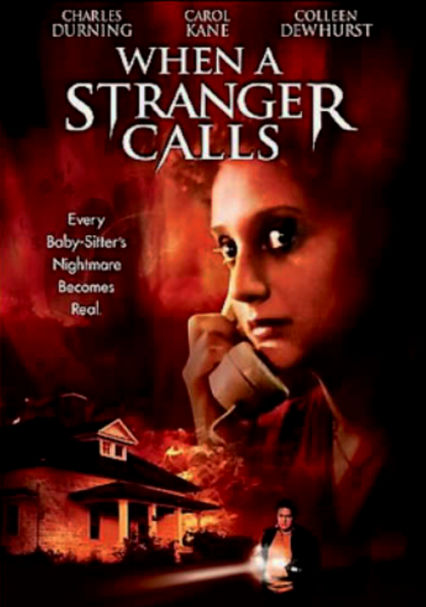
Teenage babysitter Jill Johnson (Carol Kane) calmly walks through an affluent California neighborhood for a quiet evening of watching two children.
The doctor and his wife are embarking on a night of dinner and a movie, and the children will be no trouble, Jill is told, since they are recovering from colds and are already fast asleep in their beds.
Shortly after they leave, Jill begins receiving odd phone calls from a man who asks, “Have you checked the children?” At first, assumed to be a practical joke, the calls become more menacing, prompting Jill to get the police involved.
Now terrified, Jill is told by the alarmed police to calmly get out of the house because the calls she is receiving are coming from inside the house!
She flees and is met head-on by Detective John Clifford (Charles Durning), who apprehends an English merchant seaman named Curt Duncan (Tony Beckley), who has ripped the children to shreds with his bare hands.
He is subsequently sent to an asylum, only to escape seven years later, prompting Clifford to hunt him down like an animal.
The film is sectioned into two segments and multiple genres. The beginning and conclusion are standard horror sequences, while the guts of the film delve into a psychological thriller or crime-drama territory, with similarities to Dirty Harry (1971).
Clifford spends much of his time trying to track down Duncan in a cat-and-mouse game throughout Los Angeles. Colleen Dewhurst plays a middle-aged woman who catches the eye of Duncan one night in a seedy downtown nightclub.
Director Fred Walton makes Clifford a hard-edged, grizzled detective who has seen it all and has no mercy for Duncan, intent on killing him rather than capturing him.
Durning is not the best part of the film, and the role might have been cast with a more charismatic actor.
Perplexing is what Duncan’s motivation is for killing others, other than simply being crazy, which is not a good enough explanation. Was he abused as a child? During some scenes, he is sympathetic, more like a wounded child than a crazed killer.
He wants a friend, whereas Clifford, the good guy, is sometimes unsympathetic and tough to root for.
With “deer caught in headlight’s eyes” expressions and emotions, Kane’s Jill is brilliant at using her eyes to great benefit. The audience feels her peril, fear, and panic during her scenes. When Duncan resurfaces looking for her again (though it’s not clear why he obsesses over her), her nice life, two children, and husband’s lives are all placed in jeopardy.
Dewhurst, who could have easily been cast as the lead in Gloria (1980), is tough as nails and no-nonsense, though she does feel sympathy and some attraction for Duncan.
In 1996, when Scream was released and provided the oomph that the horror genre desperately needed, thanks were justifiably given to When a Stranger Calls for its mighty influence.
The first twelve minutes of Scream (1996) are a direct homage to this film when a stranger calls (pun intended!), and the leading lady’s life spirals out of control due to a phone call and a menacing voice.
Parts of the opening sequence are influenced by Black Christmas (1974), a brilliant horror film instrumental in the making of so many others. The revelation that the killer is inside the house is a plot device that remains scary and satisfying.
Offering a cross-genre approach that works best with its terrifying horror elements, When a Stranger Calls (1979) is a sometimes terrific, sometimes uneven picture.
Thanks to compelling acting, the slowed-down middle portion does not ruin the entire experience, but what an erupting and memorable beginning and end.
Followed by an unsuccessful sequel and an even more disappointing remake in 2006.