Tag Archives: Horror

Halloween-2018

Halloween-2018

Director David Gordon Green

Starring Jamie Lee Curtis, Judy Greer

Scott’s Review #823

Reviewed October 23, 2018

Grade: B+

Let’s be honest—nobody will ever be able to top or recreate the iconic 1978 masterpiece Halloween, so any real attempt is a moot point.

Throughout the subsequent decades, many sequels or remakes have emerged, largely disappointing or turning the franchise into a joke.

With the latest incarnation of Halloween (2018), director David Gordon Green gets it right by creating a follow-up to the original, skipping all the other films. Scoring Jamie Lee Curtis as Laurie is a significant win and seemingly dozens of neat references to the original gem.

Set forty years to the day (Halloween Eve and Halloween, naturally!), the audience is first given a summary of killer Michael Meyer’s (Nick Castle) time spent in Smith Grove Sanitarium once captured following the 1978 Haddonfield killing spree.

Two journalists visit Myers in captivity and attempt to make him speak after forty years of silence by mentioning Laurie Strode and showing him his notorious Halloween mask.

Conveniently, he will be transferred to a maximum-security prison the following day. We know that Meyers will escape.

Meanwhile, Laurie has been living with post-traumatic stress disorder since her attack and lives in a constant state of paranoia.

With two failed marriages and a daughter, Karen (Judy Greer), who is traumatized by her mother’s anxiety, Laurie’s life has not been easy. As an aside, I love how Laurie dons the same hairstyle she had at age seventeen.

While she awaits Michael’s inevitable return, Laurie’s secluded house is peppered with traps and guns, allowing her to be at the ready at any moment. Despite her problems, Laurie is close to her granddaughter, Allyson (Andi Matichak).

When the inevitable happens and Michael escapes by presumably causing a bus accident off-screen, the action truly begins. The coincidence of this happening on Halloween night is to be expected and embraced.

Audiences who see the film are certainly not new to the genre. The target audience is the crowd who either grew up with the original or generations who followed and were introduced to it.

Therefore, the film is wise not to try to reinvent the wheel, giving fans what they expect. The opening graphics (the eerie orange writing and the glowing jack-o-lantern) are intact, as is the “introducing” credit for its heroin—in this case, Matichak.

There are several certainties about a horror film like Halloween. We know there will be “kills,” and we know there will be an inevitable showdown between Laurie and Michael Myers to conclude the film.

The fun is in the trip we take to get there. Who will be slashed and how? A butcher knife? Other Halloween delights?

Since there are arguably three female leads and three generations of Strodes, will the film make one of them feel Michael’s deadly wrath?

Halloween works; a significant reason is the countless nods to its past. Many scenes pay homage to attention-paying fans, creating riches and nostalgic memories.

Allyson’s boyfriend’s father’s name is Lonnie—undoubtedly the kid Dr. Loomis scared away from the Meyers’ house forty years ago. Then there is a neighbor woman wearing curlers and slicing a sandwich with a butcher knife, whom Michael steals the knife from an ode to Halloween II (1981).

Finally, as Allyson sits in the back of her class and glances out the window, she sees not Michael, but Laurie standing across the street, staring at her.

These gems are in large part thanks to clever writing and study.

There are a couple of negatives to mention. I am not crazy about Judy Greer’s casting as Jamie Lee Curtis’s daughter. The actresses look nothing alike, and Curtis does not seem old enough to be Greer’s mother.

Furthermore, attempts to add some comic relief moments—two bumbling police officers talking about brownies, Allyson’s goofy father, and the salty tongue of the kid one of the babysitters sits for—do not work.

How great would it have been to include P.J. Soles, Nancy Loomis, or Kyle Richards in cameos? Since Curtis and Castle returned, I wanted more familiar faces.

In wise form, Gordon Green leaves the window open for a potential sequel, so stay for the end credits. My wish would be for this to parlay to the aftereffects of the killings on the same night, which Halloween II (1981) did so successfully.

The possibilities are endless if the box office returns are strong enough and Curtis is on board for another installment.

Frankenstein-1931

Frankenstein-1931

Director James Whale

Starring Colin Clive, Boris Karloff

Scott’s Review #822

Reviewed October 22, 2018

Grade: A

Those of us who treasure cinematic brilliance in films of the past need to look no further than Frankenstein (1931), a masterpiece in the horror genre.

Some consider it the greatest horror film ever made. The still frightening work is based on the legendary 1818 Mary Shelley novel.

Highly influential to later groupings of horror film sub-genres, the importance of this film must never be forgotten.

In a small European village, a scientist named Henry Frankenstein (Colin Clive) is determined to create human life by stealing fresh body parts from cemeteries and using electrical shock as part of his creation.

He convinces his assistant, Fritz (Dwight Frye), to steal a human brain from a former professor’s laboratory. Due to a clumsy mistake, Fritz must steal the brain of a criminal rather than a “normal” human being, the result being dire when Frankenstein’s monster is created.

The creation of the monster (and no, the monster’s name is not Frankenstein, as some might assume) is astounding, especially given the period of the early 1930s.

With a flattop, heavy eyelids, protruding neck terminals, and his hulking physique, he is a frightening figure with a yearning, childlike nature. The monster’s innocence makes him so tragic.

A compelling scene occurs when the audience sees the monster turn around and face the camera.

What separates Frankenstein from many other horror films is the underlying sadness and empathy we feel toward the monster. The “villain” in most horror films is clearly defined, but who is the villain in Frankenstein?

How can it be the monster when he, unaware of his strength, drowns a young child? We root for the beast when he hangs the dastardly dwarf, and we hate the town of peasants who seek revenge on the monster.

The complexities in this film are endless.

The main character is an interesting study. Title billed: the character is a genius while also teetering on the brink of madness- he is not the film’s hero, nor is he entirely sympathetic.

He is the ruin of a monster who has feelings and sadness in him. Frankenstein’s fiancée, Elizabeth (Mae Clark), is concerned for him, which adds a nurturing element to the dynamic. The intent is for the audience not to despise Frankenstein but to be enthralled with his complexities.

The term “monster film” can conjure feelings of silliness or over-the-top acting, but Frankenstein is more artistic than goofy.

The famous line “It’s alive!” was paid tribute to in later years, but an equally spectacular horror film, Rosemary’s Baby (1968), when Rosemary feels her haunted baby kick. To say nothing of the tribute Mel Brook’s classic Young Frankenstein (1974) paid to the original.

Given that the film was made in 1931, the effects and lighting techniques are beyond impressive. The overall tone of the film is stylistic, with a prevalent fairy-tale beauty unlike any films made at the time, save for perhaps Dracula, the 1931 horror-vampire masterpiece.

Frankenstein and Dracula would make a delicious double feature on Saturday evenings. Director James Whale creates a magical environment, holding up thriving generation after generation, never seeming dated.

Frankenstein (1931) was followed by numerous sequels, the best of which is Bride of Frankenstein (1935). Undoubtedly, the film influenced campy yet influential monster films to follow- most notably the “Hammer Horror films” of the same tone.

Despite teetering on the one-hundred-year-old mark, the brilliant film is timeless and must be introduced to young filmmakers everywhere (especially in the horror genre).

The Nun-2018

The Nun-2018

Director Corin Hardy

Starring Taissa Farmiga, Demian Bichir 

Scott’s Review #812

Reviewed September 19, 2018

Grade: B-

A film such as The Nun (2018) is best described as a genre horror film strong on atmosphere, scares, and effects but weak on story, dialogue, or satisfyingly integrating much of the other films.

To stress, the set pieces and foreboding convent where most events occur are tremendously thought out, adding to the stylistic filming; however, the story stinks, making the overall result barely above mediocre.

This story point, which is said to be connected to The Conjuring (2013) and Annabelle (2014), is all but laughable.

Theoretically, The Nun is a prequel, but since the film is set in 1952, the only connection is a super-quick scene in later years. Ed and Lorraine Warren use a character in The Nun as a case study for their audiences.

Admittedly, I have not seen The Conjuring 2 (2016), but from what I can surmise, what remains of The Nun is a stand-alone film. Was the demonic nun in The Conjuring 2? This may make more sense.

The creepy setting in Romania is a superb choice, given its association with Transylvania and Dracula. The film begins with the suicide of a Roman Catholic nun in a gloomy and largely abandoned Monastery.

Having been visited by an unseen force who kills another nun, a vicious demon appearing in the form of a nun looks on menacingly. Father Burke (Demian Bichir) from the Vatican arrives with Sister Irene (Taissa Farmiga) to investigate, where they meet flirtatious local, Frenchie (Jonas Bloquet).

The atmosphere used throughout almost the entirety of the film is spot on and highly effective.

Most of the scenes are set at nighttime (naturally!) and in or around the vicinity of the spooky, gothic monastery. To double, a gorgeous castle in Romania was used. From the dark and narrow hallways to the crucifixes and obvious religious decor, the props and set design shine through.

The best scenes occur within the grounds of the statuesque building, where dozens of graves can be seen. When bells from the graves begin to ring on their own and spirits can be seen lurking, the audience is in for a good scare.

Even the scenes in daylight hours are fraught with creepy tension. When Frenchy comes upon the nun, dead for days, she dangles from the monastery, eyes gouged and covered with feasting crows, as her blood drips onto the front porch.

The camera close-up of the shot is highly effective, as are others involving the typical jolts and creaky floors that have become a cliche in horror films, but somehow feel fresh and invigorating in The Nun.

And the demonic nun, a grimacing Marilyn Manson-type ghoulish figure, is downright scary.

Unfortunately, along with praise must come some criticisms. The story and the logic do not make much sense, and I stopped trying to figure out the plot points halfway through.

Why the Father and Sister are chosen to go alone to investigate is implausible. A silly, brief mention of a Duke in the old days, evoking a curse in the monastery that was “conjured” up during World War II and must be contained again, is hardly a compelling story.

The plot-driven device (and frankly done to death at this point) attempt to forge a romantic connection between Irene and Frenchy never works. How many times in film have we seen a handsome, young man trying to woo a pretty nun away from her calling?

Filmmakers may have added this for humor, and (hopefully) the characters’ intentional or unintentional religious exclamations of “Oh My God!” or “Mother of God!” are laugh-out-loud silly. With a film like The Nun (2018), riveting writing is not on the wish list- great atmosphere and effects are.

The film delivers excellent content and makes for an enjoyable experience with good thrills and scares. Thankfully, for the horror genre, the film is rated a solid “R” and not watered down for PG-13 audiences.

Just be prepared for some hokey writing.

The Killing of a Sacred Deer-2017

The Killing of a Sacred Deer-2017

Director Yorgos Lanthimos

Starring Colin Farrell, Nicole Kidman

Scott’s Review #774

Reviewed June 15, 2018

Grade: A

For fans of Greek director Yorgos Lanthimos, who created such disturbing and bizarre films as 2009’s Dogtooth and 2015’s The Lobster, The Killing of a Sacred Deer (2017) will be a treasure.

As with those films, the odd story and the peculiar acting styles are prevalent, making the film quite the experience.

I relish the film and its unusual nature. It offers a cinematic experience that is insightful, mesmerizing, extreme, and, quite frankly, brilliant.

Steven Murphy (Farrell) is an esteemed cardiac surgeon who “befriends” a troubled teenage boy named Martin (Barry Keoghan), whose father had died years earlier as a result of Steven’s negligence.

They fall ill when Martin slowly insinuates himself into Steven’s family life. Martin threatens to kill the entire family unless Steven kills either his wife Anna (Nicole Kidman) or one of his two children- the victim can be of his choosing.

The creepy premise is enormously intriguing as the conclusion cannot be foreseen.

A basic yet deep storyline is wonderfully spun, with many possible plot directions.

After forty-five minutes or so of the audience wondering why Steven and Martin meet secretly in diners, hospital corridors, or other remote areas, the teen boy’s true motivations come to the surface as he rapidly and calmly puts his cards on the table for Steven.

Surprisingly, none of the characters are particularly sympathetic.

One would assume that the Murphy family- wholesome, affluent, and astute, would garner audience support, but we slowly peel back the onion on each character.

With a gorgeous house in a quiet Cincinnati neighborhood, Steven and Anna (a doctor herself) are sometimes harsh and physical with their kids. In contrast, the kids (Bob and Kim) develop a strange fascination with Martin.

In this way, each character is peculiar and has dire motivations as the plot unfolds.

Lanthimos is quietly becoming one of my favorite new directors. He slowly churns out one disturbing film after the next. His clear Stanley Kubrick influences bubble to the surface, particularly in The Killing of a Sacred Deer.

The score is crisp with uniqueness, with plodding and sudden bombastic classical music pieces eliciting emotions like surprise and terror from the audience.

From a visual perspective, fans of Kubrick will no doubt notice the long camera shots and slowly panning camera angles. The hospital’s long and foreboding hallways are prominently featured as we follow a character walking along the corridors.

This is highly reminiscent of the Overlook hotel sequences in the 1980 Kubrick masterpiece, The Shining.

One particularly jarring nuance in the film is the speech patterns of most of the actors—clearly dictated by Lanthimos and also present in 2015’s The Lobster.

The character of Steven talks very quickly but with a monotone delivery and in a matter-of-fact style; Kim and Martin also speak this way. I didn’t notice the quality as much with Kidman’s Anna, but Farrell went to town.

I’m not sure this works throughout the entire film since the mannerisms give off almost a comical element.

This uniqueness makes the film more quirky and decidedly non-mainstream, which is to be celebrated.

The climax of the film is brutal.

As Steven brandishes a loaded shotgun, the family gathers in their family room, Anna fussing over her new black dress. As the group dons pillowcases, Steven goes Russian roulette-style on the family, randomly firing a shot until one member is killed.

When the remaining family members see Martin at the diner the next day, they give him icy, hateful looks.

The entire scene is done without dialog and is tremendously macabre.

Rest assured, I am eagerly awaiting Lanthimos’s next project (reportedly already in the works) and hope against hope he continues to use the superb Colin Farrell, the brilliant Nicole Kidman, and newcomer Barry Keoghan again.

Thanks to tremendous acting, a riveting score, and enough thrills and creeps to last a lifetime, The Killing of a Sacred Deer (2017) is at the top of its game.

Independent Spirit Award Nominations: Best Supporting Male-Barry Keoghan, Best Cinematography

The Blair Witch Project-1999

The Blair Witch Project-1999

Director Daniel Myrick, Eduardo Sanchez

Starring Heather Donahue, Joshua Leonard, Michael Williams

Scott’s Review #761

Reviewed May 22, 2018

Grade: A

When a horror film “scares the viewer to death” then that film has superseded what it has intended to do since horror films are a dime a dozen these days.

Fondly remembering sitting in a crowded and very dark movie theater to see The Blair Witch Project (1999), I was left both mesmerized and clutching my seat for dear life. This film had an enormous impact on me.

The film wisely uses hand-held cameras (black and white 16mm film) and Hi-8 video, manipulating the audience into using their imaginations leading to terrifying results making the film one of the scariest horror films of the 1990s.

Sometimes what you don’t see is much more frightening than what is seen on screen.

In 1994 three college-aged amateur filmmakers (Heather, Michael, and Joshua) decided to hike to Burkittsville, Maryland to film a documentary about a legend known as the “Blair Witch”.

The witch is reportedly responsible for mysterious deaths and disappearances over the past two hundred years. They interview, wander, and joke around with each other as a sense of dread begins to develop.

According to the film, the trio themselves disappear, but a year later their equipment is uncovered fully intact with the film footage able to be viewed.

The 1999 film is professed to be the footage left behind by the group.

Throughout the film we watch the individuals conduct interviews with the townspeople and eventually get lost in the woods at nightfall, forced to stay the night as a mysterious entity terrorizes them.

Numerous creepy noises and rustlings scare the group.

In retrospect, with more insight and knowledge about the film, it may be easy for critics to dismiss The Blair Witch Project as either a hoax or a complete manipulation, but in 1999 audiences flocked to the theaters in droves as word of mouth spread.

I saw the film twice on the big screen and was frightened equally with each viewing. More importantly, with the onset of the reality television craze, the film was clever in capitalizing on this trend, so it is to be championed.

Timing is everything!

In the film genre, The Blair Witch Project used buzz and word of mouth to elicit interest before the film was even released- and then the craze began.

The film was highly influential to subsequent releases that also chose to utilize camcorders as their method of storytelling- think 2007’s Paranormal Activity and 2008’s Cloverfield.

The Blair Witch Project is similar in tone to older masterpieces such as 1974’s The Texas Chainsaw Massacre and 1968’s Night of the Living Dead- independent releases made on a shoestring budget that became enormously successful.

As with these films, the camerawork was tremendously important in eliciting necessary realism.

What makes The Blair Witch Project enormously authentic is the tricks used not only on the audience but also on the cast. Reportedly the film was almost entirely improvised including dialogue and situations that the characters faced.

The actors began to feel as if the events they were supposed to act were happening- their map disappeared and noises were created to frighten them.

This clever approach to Method acting elicited the perfect responses from all involved- especially as they got colder, hungrier, and more desperate.

My concern is how well 1999’s The Blair Witch Project will hold up as the years pass. Phenomenally effective and tremendously profitable at the time, dozens of imitations have arisen since the idea of the film was novel. So much so that it makes the original idea seem dated.

One thing remains true- the film gave the horror genre a much-needed breath of fresh air and influenced many films to come.

Independent Spirit Award Nominations: 1 win-Best First Feature (Under $500,000) (won)

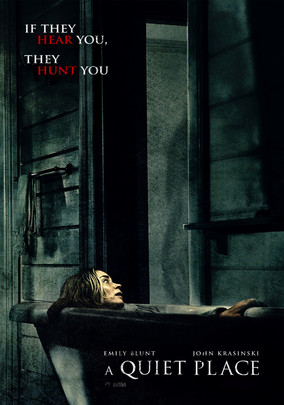
A Quiet Place-2018

A Quiet Place-2018

Director John Krasinski

Starring Emily Blunt, John Krasinski

Scott’s Review #751

Reviewed May 1, 2018

Grade: B+

A clever modern horror film, A Quiet Place (2018) offers a unique premise and novel use of sound to elicit a compelling, edge-of-your-seat story.

The film is a good offering with a science fiction slant and a “quiet” sensibility. It has ample jumps and frights that fit the story rather than being added unnecessarily.

Actor turned director, John Krasinski, shines in this film, to say nothing of the raw talents of Emily Blunt and the two child actors involved.

Only the four principles exist in the story, which is a benefit.

In the year 2020, most of the human population was decimated by vicious creatures called “Death Angels”, who have hypersensitive hearing- they cannot see but pounce on their prey at every sound made. Thus, the survivors must either whisper or communicate nonverbally.

An intelligent couple, Lee (Krasinski) and Evelyn Abbott (Blunt), an engineer and a doctor, have managed to survive with their two children, Regan and Marcus, their youngest son, Beau, having been killed after his toy rocket accidentally goes off.

The family lives on a farm in upstate New York, creating intricate ways to ward off the creatures but constantly fearing impending doom.

As Evelyn is now pregnant and due to give birth any day, in addition to Regan’s deafness, Lee attempts to create a mock ear to enable her to hear. One evening, he takes Marcus to hunt while Regan visits Beau’s grave. When Evelyn enters labor, she steps on a sharp nail, dropping a picture that alerts a nearby creature.

The remainder of the film (only ninety minutes) is spent with Evelyn alone in peril as the rest of the family tries to save her with some eventual dire results, both before and after the baby is born.

A Quiet Place immediately stands out as a unique film, especially for horror. It uses sign language and subtitles to show the characters communicating with each other and the audience. This tactic successfully absorbs the viewer into Abbott’s world and the hurdles they face.

This unconventional approach gives the film more depth than a standard horror film would usually have and is tremendously effective.

Blunt and Krasinski are such marvels, as they are protective and clever parents, that I immediately fell in love with both characters and bought them as a palpable couple. This is no stretch considering the two stars are dating in real life, but their chemistry works well in the film and makes a believable team.

Both Lee and Evelyn will do whatever it takes to protect their brood. After a lovely day of foraging for supplies in an abandoned grocery store, we feel heartbreak when the savage creature annihilates their youngest.

Lee, with Krasinski looking perfectly hunky in his beard and muscles, falls into the hero/Dad role nicely. At the same time, Blunt gives an emotional bravado performance worthy of almost an Oscar nomination if this were a different genre.

Not to be usurped by more seasoned actors, both child actors are wonderfully cast and hold their own.

Millicent Simmonds, an unknown, flawlessly portrays Regan as the young actress who is herself deaf, which translates well onto the large screen. And Noah Jupe plays sensitive yet brave to the hilt. Both assuredly have bright acting futures ahead of them.

The “creature” is a strong element of the film, but also suffers from missteps. Be careful not to be too amateurish-looking or heavy on the CGI effects; the fastness and ferocious nature are effective.

However, no apparent motivation is ever given, and no explanation of how they came to exist is mentioned. Perhaps a sequel will provide more depth. Regardless, I wanted to know more about the creature’s backstory. And how did Abbott’s hold out so long when no others did?

A Quiet Place succeeds as a frightful film with depth and intelligence. Although Paramount Pictures released the film, it may have worked better as an independent film (it could have been edgier) with more grit and less polish from the creature.

Nonetheless, Krasinski is off to a great start as a director and leading man with an impressive horror effort containing nice scares and slight gore.

Oscar Nominations: Best Film Editing

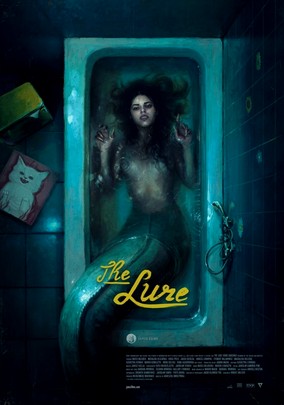
The Lure-2015

The Lure-2015

Director Agnieszka Smoczynska

Starring Michalina Olszanska, Marta Mazurek

Scott’s Review #741

Reviewed April 12, 2018

Grade: B

2015’s The Lure is as odd a film as one can imagine- dreamlike and sometimes even absurd. The story mixes a strange blend of the horror genre with musical numbers, but I would wobble to the side of gothic horror for classification purposes.

Oddly enough, some of the choreography numbers are reminiscent of 2016’s La La Land, but that is where the comparisons between those films end as the former musical numbers dark and the latter cheery.

A tough film to review, The Lure is rather disjointed, but kudos for creativity and unpredictability.

Bravely directed by a female (more kudos!),  Agnieszka Smoczynska, a Polish filmmaker, the story is a cross between an autobiography of her troubled youth, and a retelling of the Hans Christian Anderson fairy tale, The Little Mermaid.

Besides the obvious Polish language content the film does not appear overly Polish- it might have been nice to be exposed to some of the cultures.

The film immediately gets off to a mysterious start as two teenage girls, later revealed to be mermaids/vampires named Silver and Golden, emerge from the water and follow a rock band back to a tacky nightclub where the band regularly performs for patrons there for the strippers.

It is sometime in the 1980s.

The girls perform music and strip, becoming an act called “The Lure”. While Golden continues to thirst for blood, Silver falls in love with a bassist causing her to yearn to be a real girl, and subsequently has surgery to remove her tail and grow real-girl legs.

As part of the fairy tale, if her intended marries someone else Silver will turn into sea foam and die.

The story is perplexing and difficult to follow, yet something is mesmerizing and escapist about it.

I wonder if Smoczynska intended the film to make total sense or left it open to a bit of interpretation. The film is a mix of fairy tales and real-life experiences.

Some portions appear to be rather dream-like, for example, the nightclub singer has thoughts or visions involving Silver and Golden, but what is unclear is whether she is experiencing reality or imagination.

Props must be given to The Lure for originality alone. The film stirs up multiple genres and creates something truly unique.

In particular, the characters of Silver and Golden are transfixing, at times they are sweet and kind, then fangs come out at a moment’s notice revealing evil and a carnivorous bloodthirst revealing a grotesque, haunting countenance.

How Smoczynska created these characters is awe-inspiring and the up-and-coming director must have a wealth of imagination deep within.

On the other hand, the plot never really comes together enough to grab hold of the viewer in a riveting way.

While Silver and Golden are clever characters and we feel some empathy for them, I also never felt completely gripped by them either. I felt no connection to any of the supporting characters either.

Any attempt at figuring out the plot will only leave the viewer frustrated. I would advise taking The Lure as an experience, not a puzzle to unravel.

The Lure (2015) has elements of immeasurable fascination and an enormous creative edge. Attempts to create a unique fable meshed with a disturbing central theme are successful.

The overall story is way too confusing for the average user and ultimately ends up dragging towards the final portion with the final climax a wee bit unsatisfying.

A brave and inventive attempt at achieving something fresh and imaginative in cinema.

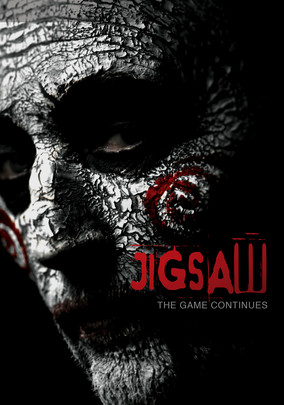
Jigsaw-2017

Jigsaw-2017

Director The Spierig Brothers

Starring Matt Passmore, Tobin Bell

Scott’s Review #739

Reviewed April 9, 2018

Grade: C-

As a fan of the horror genre, and specifically of the Saw film franchise, which debuted in brutal form in 2004 and was directed by James Wan, I am sad to say that it has sadly become a lesser version of what was once clever writing mixed with astounding, tortuous kills.

Jigsaw is the eighth installment in a series that has now run out of steam. It is simply riding on the coattails of what was once its glory days.

The 2017 film can only be appreciated by die-hard fans of the series; it will be unsuccessful in attracting new fans.

Admittedly, Jigsaw does begin significantly as the viewer is thrust into the midst of a compelling rooftop police chase that results in a fleeing criminal, Edgar Munsen, being shot by detectives.

Unknown if events are connected, the action shifts to a remote barn where (in typical Saw fashion) five individuals are held captive, each with a noose around their neck.

Throughout the film, we get backstories-stories of each victim as well as a connecting story of a pathologist, Logan Nelson (Matt Passmore), his sister, and the possibility that John Kramer has either returned from the grave or a copycat killer is on the loose, emulating his shenanigans.

The basic premise and tone of 2017’s Jigsaw are similar to those of the preceding seven installments. However, this version seems a bit watered down and glossy by comparison.

My recurring thought throughout the feature was a reminiscence of a horror version of a network episodic drama- think CBS’s Criminal Minds or the like. This is not a compliment.

The camera style is of a slick production with nary a raw or authentic moment- incredibly produced with good-looking people in peril.

Fans of the previous Saw films will undoubtedly expect the now-familiar twist towards the end of the film- a clever story turn to make one character revealed to be not what they appear to be or even in cahoots with the serial killer, “Jigsaw” (John Kramer).

This quality does surface in Jigsaw, but the surprise is so lame and inexplicable that it is hardly worth mentioning.  Suffice it to say the expected resurfacing of Kramer is an absolute sham. Instead, we are fed a less-than-satisfying riddle of one character faking his death and another sequence occurring ten years earlier.

This twist might be worth its salt if better written, but the reasoning seems thrown together without much thought to staying true to the characters or history.

Other familiar elements in Jigsaw abound, so a fan of Saw, Saw II, or Saw III will undoubtedly find tidbits that will satisfy them.

The film is like a trip to McDonald’s or a neighborhood burger joint- one will more or less get what is expected.

As the barn victims are given choices via a tape-recorded message by a sinister John Kramer voice, each is given a test and must ultimately confess their sins. As fans know, Saw victims are far from innocent and always harbor a neatly tucked away secret.

Such horrific acts like a haggard young mother smothering her screaming baby and framing her husband for the deed or a thief stealing a woman’s wallet and causing her to die when her asthma medicine is missing were thought of by the writers.

Another character once sold a motorcycle with a faulty brake line to an innocent man who later crashed and was killed. These aspects are the fun in a film like Jigsaw in that the tortures the victims endure have elements of “serves him or her right”.

Another solid point about Jigsaw is the kills, which is what fans of the Saw franchise have come to know and love.

In this one, we delightfully witness a victim’s leg severed, another impaled with needles, and yet another gleefully attempting to shoot one of the other victims trapped in the barn to allow her freedom, only to realize the gun is rigged to shoot herself instead.

These are fun moments that make Jigsaw less than all bad.

Having created the eighth version of a once great franchise that introduced the world to the term “torture horror”, by 2017 has grown ultimately stale and tired with a few glimpses of former glory created in the familiarity aspects.

All great things must end, and the Saw series has more than crumbled from its former days of glory.

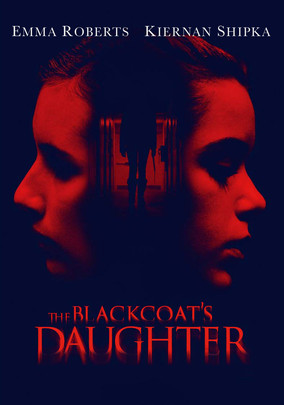
The Blackcoat’s Daughter-2017

The Blackcoat’s Daughter-2017

Director Oz Perkins

Starring Emma Roberts, Kiernan Shipka

Scott’s Review #732

Reviewed March 12, 2018

Grade: B+

The Blackcoat’s Daughter is an eerie 2017 independent horror film that combines various chilling elements to achieve its goal.

While slow at times, the film is primarily a fusion of the supernatural, the occult, and the psychological. It offers a unique experience and is unpredictable in nature.

Parts of the film are downright scary and spooky as religion meets satanism, always a safe bet for an unsettling experience.

Writer/Director Oz Perkins should be well on his way to a successful career in the industry with this, almost full-on artsy, film.

The action begins in a prestigious Catholic boarding school in a quiet, wintry area of upstate New York. As students (largely unseen) leave the school for a February break, Kat (Kiernan Shupka), and Rose (Lucy Boynton) are left behind when their parents do not arrive to pick them up.

While the girls hunker down for the night, hoping their parents show up the next day, a third girl, Joan (Emma Roberts), who may be a psychopath, is en route towards the school, enlisting the help of a strange married couple (Bill and Linda), whose daughter had died years ago and was the same age as Joan.

Also in the mix are two school nuns who are rumored to be Satanists.

Little is known about the town, but the fact that nobody is around making the setting a significant plus.

This may very well be due to budgetary restrictions associated with the film. Still, regardless, the use of very few characters or extras is a score, with the number of principal characters below ten.

The cold and bleak nature of the town and Joan’s stark journey create a very successful ambiance.

Many scenes throughout The Blackcoat’s Daughter are set during nighttime in relative seclusion. Given the icy texture of upstate New York in the middle of winter, the setting chosen by Perkins is spot on and quite atmospheric.

The overall story of The Blackcoat’s Daughter is peculiar and mysterious and does not always make complete sense.

In fact, by the time the film concludes and the credits roll, not much of the film adds up from a story perspective, leaving me somewhat unsatisfied.

Since Bill and Linda’s daughter looks identical to Rose, are we to assume that the events at the school occurred a decade before the events involving Joan? What ends up happening to Kat is perplexing, haunted by spirits, and forced to kill, is she healed at the end of the film? Or is Kat Joan?

Too many loose ends are left.

The film is heavy on the violence and the gore and dares not hold back in showcasing the victim’s pain and suffering before they cease to exist. More than one character lies bleeding and immobile as the killer calmly approaches to finish the deed.

Three characters are decapitated in horrific form as we later see their severed heads lined up in a boiler room. The demonic chanting “Hail, Satan!” may turn some viewers off, as would the overall storyline.

Those who feel that 1973’s The Exorcist is disturbing need not see this film as similar elements abound.

Also worthy of a quick mention is the cool, unique musical soundtrack created by singer/songwriter Elvis Perkins, brother of the director.

With goth/techno elements, the score is noticed (in a good way) at various points throughout the running time and adds to the film’s overall feel.

The Blackcoat’s Daughter (2017) succeeds as a disturbing and experimental piece of independent horror-making that will pique the interests of horror aficionados.

With plenty of blood-letting and squeamish parts, Oz Perkins knows what works. The story, though, would have been improved by a clear, definitive beginning, middle, and end, to avoid a confusing outcome.

Still, I look forward to more works from this up-and-coming director.

Happy Death Day-2017

Happy Death Day-2017

Director Christopher B. Landon

Starring Jessica Rothe, Israel Broussard

Scott’s Review #726

Reviewed February 20, 2018

Grade: C+

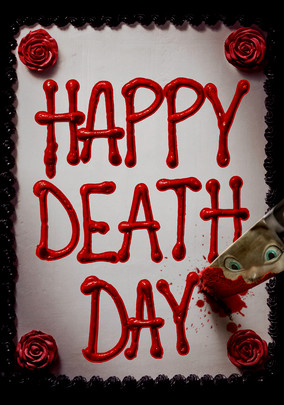
Happy Death Day is a 2017 horror/slasher film that cleverly incorporates the “Groundhog Day” theme into its story.

Oddly, the film was released in October instead of February, a missed marketing opportunity.

Despite a unique premise, the film is overly complicated, especially for this genre. Rather than succeeding as a late Friday night treat, Happy Death Day becomes tough to follow, leaving too many questions and puzzling thoughts in the after-effects.

We first meet snobbish and sarcastic sorority sister, Theresa “Tree” Gelbman (Jessica Rothe), as she awakens with a pounding headache and a bad attitude one morning in the dorm room of a handsome classmate, Carter Davis (Israel Broussard).

She barely remembers the drunken tryst as she haggardly goes about her morning. Today is her birthday! Irritated by the day, she dismisses her kindly roommate and her father.

She is rude to a former one-night stand, finally going to a party, where she is followed and brutally murdered by a figure wearing a campus mascot mask.

She suddenly awakens to the same morning she has just experienced!

Perplexed, Tree spends the remainder of the film on the hunt to figure out who killed her and unravel the mystery of halting the events by going on a continuous “loop” of the same night, each time uncovering more clues.

Mixed in with the events, Tree realizes she has feelings for Carter and should become a more sociable person.

Star Jessica Rothe is excellent in a breakout film role, though she had a small part in the musical La La Land in 2016.

Her chemistry with Broussard is adequate, though when we talk horror, romance is not at the top of the list, blood is.

Unfortunately, Happy Death Day offers few accurate kills or scares—the film is rated PG-13, for heaven’s sake.

A nice aside and testament to the character of Tree is her possession of both “good girl” and “bad girl” qualities. Trendy in slasher films is that the girl who parties and has sex is offed before very long, but in Happy Death Day, we are served both in the same character.

Tree is, in fact, butchered, but when brought back to life, the character eventually blossomed into the clear heroine. This is a nice twist on a traditionally written character.

I enjoyed the perpetual whodunit factor that screenwriter Scott Lobdell carves into the fabric. A bevy of suspects is introduced and the tale changes direction with each loop.

The story becomes more complex with each loop, and characters’ stories or motivations shift each time. Furthermore, a few more characters are introduced giving the story more layers.

This is both a strength and a problem—Trees professor Dr. Gregory Butler, her secret lover, is a suspect.

Is Tree’s sweet roommate, Lori, who wants nothing more than to treat her friend to a lovely birthday cupcake, too good to be true?

Things spiral out of control from a story perspective at a certain point.

What is the point of the local serial killer, John Tombs, injured and conveniently staying at the campus hospital, other than to serve as a red herring? Who is the masked killer and why do they suddenly disappear from the story? How is Tree able to seemingly change the details of her murder so much so that it ends up never happening?

The reveal of the actual killer is perfect, but how did we get to this point? By the big reveal at the end, I had stopped trying to figure out the film.

Slightly above par, Happy Death Day (2017), while spirited and reaching for something different, becomes muddled and senseless, leaving the viewer wondering how all the various “groundhog day” stories add to a satisfying conclusion.

Sadly, by the film’s conclusion, one will likely not wish to waste time bothering to care. Still, some props for creativity must be awarded.

Village of the Damned-1960

Village of the Damned-1960

Director Wolf Rilla

Starring George Sanders, Barbara Shelley

Scott’s Review #701

Reviewed November 30, 2017

Grade: B

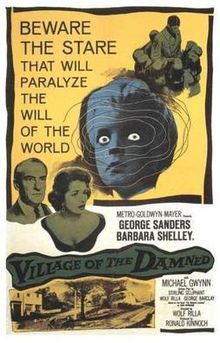
Village of the Damned is a 1960 black and white horror film released during a spectacular year for the film genre- and specifically for the horror genre.

With legendary films such as Hitchcock’s Psycho and Michael Powell’s British Peeping Tom making their debuts at the same time, what a coincidence that Village of the Damned (also British) shares the same year.

The film is a satisfying treat- certainly not on par with the aforementioned duo of masterpieces, but on its terms, it is a fine film with just enough suspense and intrigue to make it a memorable affair.

Anything in movie horror involving children is downright creepy, so German director Wolf Rilla is wise to adopt a film based on a 1957 novel entitled The Midwich Cuckoos by John Wyndham.

I adore the title and wish Rilla had kept it for the film. Alas, he did not, but the story is well-written and almost like an extended episode of The Twilight Zone or a similar television chapter from the 1960s—it just seems like more of an episodic experience.

No disrespect, of course, but the film does not contain the bombast expected from a feature film, but rather a compartmentalized, small tale.

In the sleepy little town of Midwich, England, a polarizing force suddenly and without warning overtakes the city, causing all the inhabitants to fall unconscious and into a state of inactivity.

Attempts by the military to enter the town fail, even as an airplane crashes to the ground after attempting to cross into Midwich.

As quickly as these events occur, the townspeople “wake up” and resume normalcy. Two months later, all women of childbearing years suddenly become pregnant, causing gossip and intrigue. As the years pass, the children look similar, with platinum-blonde hair, piercing eyes, and rapid growth spurts.

Furthermore, they all are telepathic and communicate with each other in this manner.

The central characters include a prominent professor, Gordon Zellaby (George Sanders), and his wife, Anthea (Barbara Shelley). They are the parents of one of the children, named David, who appears to be the leader of the other children.

As the children become increasingly menacing and intelligent as they grow older, sometimes hurting or killing other townspeople by somehow “possessing” their thoughts, Gordon must race to find a way to trap and stop the children from more dastardly deeds.

The use of black and white cinematography and the small-town setting successfully give Village of the Damned an eerie and mysterious vibe, is little or no bloodshed nor the traditional horror-themed elements- hence the above Twilight Zone reference.

The film does not need these to succeed, as the psychological mystique is compelling enough. We wonder, “What is wrong with these kids?” and “Why do they act so strangely?” “Are they possessed?” and  “Is this some weird experiment?”

The answers are never really explained in detail.

Slight negatives to the film are the only limited character development among any prominent characters such as Gordon or Anthea, and these roles are one-dimensional- the children are the stars.

Sanders and Shelley are adequately cast, but I can think of numerous other actors who could have played these parts well.

The conclusion to Village of the Damned is unspectacular, and I was left with an unsatisfied feeling, especially as related to other more satisfying aspects of the film as a whole.

I felt like a bit of potential was not reached.

Gordon merely orchestrates a big event, sacrificing himself to destroy the children, and the film ends.

Village of the Damned was followed by a 1963 sequel entitled, Children of the Damned, which was not deemed a critical nor a commercial success.

Years later, in 1995, the film was remade and directed by John Carpenter but also received poor reviews.

Grindhouse: Planet Terror-2007

Grindhouse: Planet Terror-2007

Director Robert Rodriguez

Starring Rose McGowan, Freddy Rodriguez

Scott’s Review #692

Reviewed October 15, 2017

Grade: B-

The umbrella title of “Grindhouse” is part of a 2007 double-feature, one film directed by Quentin Tarantino (Death Proof), and the other directed by Robert Rodriguez (Planet Terror).

The gimmick was part of an attempt at something novel and also book-ending fictional trailers within the films. The term “grindhouse” refers to a cinematic specialty of either B movies or exploitation films- largely during the 1970s.

While Planet Terror gets credit for being unique and fun, it is oftentimes too cartoon-like and rather over the top throughout.

The premise of Planet Terror is not one to be taken seriously- as our heroine, Cherry Darling (Rose McGowan), quits her stripper job vowing to move on to bigger and better things, she runs into her ex-boyfriend, El Wray (Freddie Rodriguez), and the two teams up to lead a group of rebels, who are fleeing for their lives after a vicious zombie outbreak.

The attack was caused by a group of military officials, led by the vicious Lieutenant Muldoon (Bruce Willis).

The film contains an undeniable retro feel- the sets and the props traverse back to the 1970s in style and look, however, characters do use cellular phones.

Rodriguez attempts to make the film an homage or a throwback to a different time in cinema- this feat is quite impressive and the film is a marvel from a stylized perspective.

Another positive is that the film is reminiscent, by the camera styles and angles, of an actual 1970s film, with grainy elements and a comforting old-style texture, which works.

The plot, though, is the source of frustration, and many aspects of the film are just plain silly. The actors play way over the top as they were probably directed by Rodriguez to do, but the result is too much like watching a cartoon rather than a piece of art.

Rodriguez appears to be copying many aspects of Quentin Tarantino films- specifically, the mixture of violence with camp, although these attempts do not always work.

The acting and casting are fine. Bruce Willis shines in the lead villain role and plays demented to the hilt. Unquestionably “borrowed” by Rodriguez through Tarantino, Willis, who was dynamic in Pulp Fiction, knows how to do his thing well in films such as this.

Muldoon is quite a different character than boxer Butch Coolidge in 1994’s masterpiece, Pulp Fiction, but the acting style is the same.

Stars such as Josh Brolin, Kurt Russell, and Rosario Dawson also make appearances so the film is assuredly a star-studded affair.

The casting of McGowan and Freddy Rodriguez as the leads is acceptable and the pair make a decent screen coupling. Still, her artificial leg which doubles as a deadly machine gun, and his maniacal persona seem somewhat forced and, again, way over the top.

Planet Terror was a moderate box office success upon release in 2007, but watching the film in 2017, ten years later, unfortunately, some of the clusters have been tarnished and the gimmick is not as catchy as at the time of release.

Still, a decent offering in the horror, cartoon, and campy genres, but much better films exist, like anything by Tarantino.

Mother!-2017

Mother! -2017

Director Darren Aronofsky

Starring Jennifer Lawrence, Javier Bardem, Ed Harris, Michelle Pfeiffer

Scott’s Review #687

Reviewed October 4, 2017

Grade: A

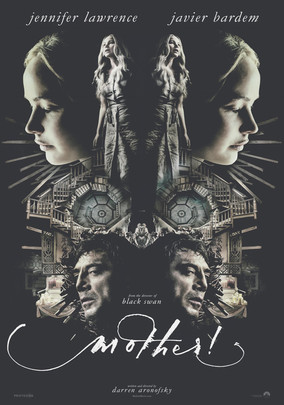
Mother! is an intense, disturbing, and brilliant 2017 work by acclaimed director Darren Aronofsky.

Having crafted left-of-center works such as 2000’s Requiem for a Dream, 2008’s The Wrestler, and 2010’s Black Swan, I shudder to think this film rivals the other in the insanity department.

With four principal characters portrayed by Hollywood mainstays, this film generated much buzz upon its release.

The film is thought-provoking and analytical, and we will discuss it after the conclusion. I appreciate the complex watches and Mother! succeeds in spades.

The film is set entirely within the confines of one enormous house in the middle of a vast field of land. Aronofsky never reveals the location, adding mystery to the already intriguing premise.

A young couple known only as Him (Javier Bardem) and Mother (Jennifer Lawrence) cheerfully enjoy married life together and seem very much in love. He is a renowned author suffering from writer’s block, and his mother fixed the house after it had burned long ago.

One day, a Man (Ed Harris) arrives looking for a place to stay. While Him is delighted by the visitor and encourages Man to stay, the mother is not as pleased.

When Man’s wife, Woman (Michelle Pfeiffer) arrives, the houseguests turn Him and mother’s lives upside down. This is merely the beginning of a complex puzzle.

As the plot unfolds, Mother! is oozing with one bizarre event after the other. Mother witnesses unsettling images such as a beating heart within the walls and a bloodstain on the floor that will not go away.

When relatives of a Man and a Woman overtake the house, and a violent event occurs, things go from dark to downright chaotic.

Giving too many plot points away would ruin the element of surprise, making Mother! a difficult film to review. The film is polarizing and mesmerizing, and each of the principal characters’ motivations can be analyzed and questioned.

Why do he and his mother react differently to the visitors? What manifests their resentment towards the mother?

Each actor gives a compelling turn, and Aronofsky admits that the mother’s character is the one he most relates to. Logically, one might assume that Bardem’s Him might receive that honor since the character is a famous writer. How strange, and this revelation by the director will only result in more character analysis.

How wonderful to see Michelle Pfeifer back in the forefront of a Hollywood film—it seems eons have passed since we last saw her grace the silver screen, and she is back with a vengeance.

Her bitchy portrayal is purely delicious, and she encompasses Woman with the perfect amount of venom, toughness, and mystery. As she icily quizzes mother about her intentions of starting a family, she slowly immerses herself in mother’s life without missing a beat.

The film is unconventional and layered with symbolism and differing interpretations. Is Aronofsky’s message biblical? Is it political? Or could it reference the obsessions everyday folk have with celebrities?

After much pondering, all three possibilities came to mind. The biblical message seems the most solid and plausible explanation, but with Aronofsky films, the pleasure is in the analysis.

The film’s final act is particularly macabre, as the action has exclusively focused on the four principal characters until this point, and the setting is mainly bright.

A slow burn, if you will, suddenly, all hell breaks loose as mobs, blood, fire, death, and darkness take over. The brutality and cannibalism involved will churn anyone’s stomach.

Quickly note the lurid closeups of Jennifer Lawrence’s face during most scenes. Indeed, the camera loves her, but more is happening here. Is the intention to make the viewer focus more on her character or to sympathize more with her character?

Mother! has stirred controversy among film-goers. Some have ravished its elements and themes, while others have reviled and revolted against it.

Time will tell if Mother! (2017) holds up well, but my hope and guess would be that it will become a film studied in film schools everywhere.

It-2017

It-2017

Director Andres Muschietti

Starring Bill Skarsgard, Jaeden Lieberher

Scott’s Review #684

Reviewed September 20, 2017

Grade: A-

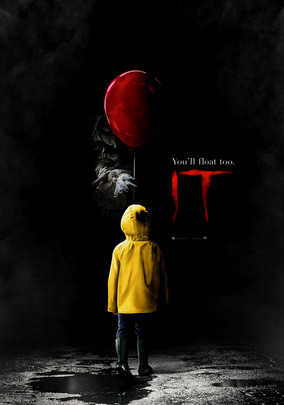
An enormous hype has gone into the first big-screen adaptation of the epic-length 1986 Stephen King novel, It.

An above-average mini-series based on the book was released in 1990, but the film version is much more effective.

Officially entitled It: Chapter One (2017), it divides the story in half, only focusing on the characters as children, not as adults decades later.

The film is highly effective, with a fantastic story, visuals, cinematography, and a rocking musical score. Simply put, it is one of the better Stephen King film adaptations.

As rabid Stephen King readers will understand, at over eleven hundred pages in length and spanning thirty years, a two-hour and fifteen-minute film simply wouldn’t encompass the author’s artistic vision.

To be determined is how chapter two will measure up to the glory of the first chapter.

Derry, Maine, is the sleepy little town where the action takes place. The period is 1988, but it is worth pointing out that the novel takes place in the late 1950s.

On a stormy afternoon, seven-year-old Georgie takes a paper boat, constructed by his older brother Bill Denbrough, outside to see if it sails. He meets a clown in the storm drain, who introduces himself as “Pennywise the Dancing Clown.”

Pennywise toys with Georgie turns vicious, and tears the boy’s arm off.

Months later, life goes on as Bill and his group of friends known as “The Losers Club” all separately begin to see variations of Pennywise.

The film is part of a teenage summer adventure balanced with a terrifying horror film, and director Andres Muschietti achieves this mixture seamlessly.

Lighting is one example of how the film goes about in this fashion.

Most of the outdoor sequences are bright, sunny, and airy. Conversely, the terrifying scenes, usually involving the entity of Pennywise, are shot using dark lighting, eliciting fear and a perfect mood.

The casting is terrific—I specifically found actor Jaeden Lieberher as Stuttering Bill, Jeremy Ray Taylor as Ben Hanscom, and actress Sophia Lillis as Beverly Marsh to be wonderful performers and clear standouts among the teenage characters.

Lillis, bright-eyed and with a strong-willed composure, resembles a young Scarlett Johansson and could have a bright future ahead of her. Lieberher’s earnestness and stuttering ability are believable, and his innocence is reminiscent of every kid’s.

Lastly, Taylor fills a pudgy new kid in town, Ben, with comedy and romanticism in his unrequited love for Bev.

Thriving is the portrayal and appearance of the demonic entity Pennywise. Since the fictional clown has over thirty years of interpretation and imagination, bringing him to cinematic life was challenging.

The risk would have been making him either too horrific or cartoon-like- the result is a perfect hybrid. Bill Skarsgard exudes crazy in his brilliant performance, teetering between goofy and playful with Georgie and evil personified as he taunts and terrorizes the kids in his dusty hideaway.

Interestingly, none of the adult characters are written sympathetically. From the creepy Alvin Marsh to the nerdy pharmacist, even the stern librarian and the overbearing Mrs. Kaspbrak are each laden with an unlikable quality.

The closest adult to being “nice,” Bill’s father, finally screams at his son to accept the fact that Georgie is dead.

Two small complaints include the two secondary bullies—the King Bully Henry Bowers cohorts are not given their comeuppance and simply vanish from the screen, never to be mentioned again.

Secondly, the sound exterior shots of Derry, Maine, exude a New England freshness and a small-town mystique. It’s too bad the scenes were not filmed in Maine at all but somewhere outside of Toronto, Canada—more realism would have been nice.

Due to the massive success of the adapted film, legions of fans will undoubtedly hold their breaths waiting for the resurrection of Pennywise and “It” to be unleashed on film fans everywhere- probably in 2019.

I will be one of those fans.

Clown-2016

Clown-2016

Director Jon Watts

Starring Andy Powers, Laura Allen

Scott’s Review #681

Reviewed September 16, 2017

Grade: B-

As a fan of all things horror and with a robust appreciation for the genre, clowns in said genre are always a stroke of genius, and the 2016 film Clown establishes a creepy premise right off the bat.

After seeing the film, it was not until a few days later that the story began to marinate in my mind, and I gained a bit more appreciation than I had once the film had ended.

Clown is one hour and forty minutes long, but it reminds me of the mid-2000s Showtime horror anthology series Masters of Horror.

The film has a unique, creepy vibe, is also a highlight of the cherished series of yesteryear, and oddly plays out like a vignette.

The premise is creepy as the action kicks off.

When Kent McCoy (Andy Powers), a likable young father who works far too much maintaining his real estate business, is notified by his wife, Meg (Laura Allen), that the clown they hired to entertain at their son Jack’s birthday party has canceled, he is determined to save the day.

Kent discovers an old clown suit in the attic of one of his abandoned houses and dons the costume. The next day, Kent and Meg are startled when Kent cannot remove the costume, even when pliers, a hacksaw, and other horrid machinery are used on him.

The story then introduces a strange character named Herbert Karlsson (Peter Stormare), who informs Kent that the clown costume is not a costume but the hair and skin of an ancient demon from Northern Europe.

Kent realizes that the demon needs to feast on and devour children to survive, and he becomes ravenous and hungry. Karlsson attempts to kill Kent, revealing that the only way to destroy the beast is via beheading.

The clever and compelling part of the story is the mixture of clowns and children in peril, a recipe for success in most horror films.

The fact that Kent and Meg slowly begin the temptation to harm children is both shocking and compelling.

The McCoys are average, everyday folks, Meg even working as a nurse, so the likelihood of the pair harming kids on any other day is remote, but tested by a vicious demon and their son Jack in peril makes Clown work well.

My favorite sequence occurs during a birthday party at Chuck E. Cheese. While the kids play in a lavish and dark tunnel, the demon (Kent) is on the loose, causing havoc and eating two children.

When Meg drives an unwitting young girl home, she is conflicted and tempted to offer the girl to the demon as a sacrifice to hopefully save Kent.

The girl’s pleading is palpable.

The film is gruesome from a violent perspective and hesitates not to go where many horror films dare not to go, with the death and slaughter of young children.

One kid, in particular, is shown disemboweled. The kid is written as a bully and gets his comeuppance in grisly form.

Sad is the death of a lonely trailer park-type kid, only looking for a friend in Kent. Little does he know his short days are numbered.

As strong and measured as the story idea is, Clown does have some negatives. The film has an amateurish quality, not because it is independent. Instead, the style almost comes across as a student film.

Some of the acting is not great, specifically Laura Allen’s performance as Meg. The filmmakers might have been wiser to make this project more of an episodic venture instead of a full-length release.

Clowns, kids, and demons make a fun combination for horror, and the aptly named Clown is a solid B-movie effort in the glorious chambers of the cinematic horror genre.

With a few tweaks and zip-ups, Clown (2016) might have been an even more memorable film. It will not go down in history as a masterpiece, but it has the necessary elements for a good watch.

Bride of Chucky-1998

Bride of Chucky-1998

Director Ronny Yu

Starring Jennifer Tilly, Brad Dourif

Scott’s Review #680

Reviewed September 11, 2017

Grade: D+

Bride of Chucky (1998) is the fourth installment in the famed late 1980s Child’s Play hit franchise. The late 1980s was not the best time for the horror genre in general, but the film was quite the highlight in a slew of duds.

By this time in the series, (1998), the child/victim of the doll premise is dropped in favor of dark humor, thus the series immerses itself more into the horror-comedy arena.

A treat is the inclusion of a fantastic hard rock soundtrack led by the Rob Zombie classic, Living Dead Girl, adding some points to the film’s final grade, otherwise have been more dismal.

The film is not great and I find perverse pleasure in reviewing poor films. However, Bride of Chucky does have its place- as a late Saturday night viewing choice amid strong cocktails it contains a certain charm.

Not to be taken seriously, the placement of a love interest for Chucky gives the film macabre romantic humor.

Still, the film suffers from lackluster acting and quickly turns into drivel by the time the credits finally roll.

The action picks up from where Child’s Play 3 leaves off and the appearance of Chucky is now weathered and stitched giving the doll a more gruesome and maniacal look- this works given the elimination of a child lead character.

Left for evidence in a police compound, Chucky is stolen by Tiffany Valentine, played by Jennifer Tilly. The girlfriend of a deceased serial killer, Tiffany is convinced that the spirit of her boyfriend exists within Chucky and she is determined to bring him back to life using a voodoo ritual.

When the act finally works, Chucky and Tiffany reunite, but shortly afterward, Tiffany is also turned into a doll and the duo sets out on a killing spree.

The best aspect of the film is the camaraderie between Tilly and actor Brad Dourif, who voices Chucky. The duo has a light, comic banter that is fun to watch, as well as fantastic chemistry.

Granted the actors only voice the dolls for a small part of the film, but their back-and-forth works well.

This is what makes Bride of Chucky tongue in cheek- let’s face it, with talking dolls as your main characters, director Ronny Yu wisely avoids making the killings too grisly or heavy-handed, but rather, frequently uses quips and one-liners throughout the film.

As Chucky and Tiffany slice and dice their way to Hackensack, New Jersey, their motivations are to embody a neighborhood boy, Jesse, and his girlfriend Jade, played by a young Katherine Heigl.

Along the trek, the foursome is faced with ludicrous obstacles, such as the brief introduction of a con artist couple who meet their doom by flying shards of glass after stealing Jesse’s money.

The side story of Jade’s overprotective police chief Uncle, played by a miscast John Ritter, does not work at all. His schemes to plant marijuana in Jesse’s van are little more than plot-driven machinations to advance the thin plot.

The characters of Jesse and Jade are trivial and secondary and Heigl’s acting is particularly garish to say nothing of the lack of any chemistry between Heigl and actor Nick Stabile.

Heigl seems to wear a pout throughout the entire film. But, not to worry, these characters are as meaningless as all the others.

The gimmick ending, surely meant to “spawn” yet another sequel is as interesting as it is grotesque and a small highlight in a poor film.

Bride of Chucky (1998) provides a nice lineage to the history of the franchise, a killer musical score, and decent chemistry among the leads, but also suffers a similar fate to many horror films, especially sequels- poor acting, a silly tone, and no character development.

XX-2017

XX-2017

Director Jovanka Vuckovic, Annie Clark, Roxanne Benjamin, Karyn Kusama, Sofia Carrillo

Starring Natalie Brown, Melanie Lynskey

Scott’s Review #677

Reviewed September 1, 2017

Grade: B

XX is a 2017 American anthology film featuring four unique horror vignettes directed by female directors—a brazen feat in itself as this gender is too often underrepresented in the genre.

The chapters do not always make complete sense, but they achieve a creative, unpredictable edge and the feeling of watching something of substance.

Another anomaly is that each features a female lead, giving the film a measure of female empowerment.

Immediately, we are treated to an odd tale named The Box, based on a short story written by an author notable for composing tales of the gruesome Jack Ketchum.

In this story, a young boy named Danny, cheerfully riding a train with his mother and sister during the holidays, innocently asks an odd-looking man to peek inside a shiny, red, gift-wrapped box.

When the man agrees, Danny initially goes about his day but stops eating, much to his parent’s horror. This installment is my favorite of the four as it is the only holiday-themed chapter and contains a morbid quality amid the cheeriness of the season.

The perspective soon switches from Danny to his mother, Susan, and the conclusion is surprising.

Next up, The Birthday Party features middle-aged Mary, intent on holding a birthday party for her young daughter, Lucy. When Mary finds her husband dead, she dresses him up in a panda costume and attempts to conceal him from the group of anxious young party-goers.

The conclusion is a mix of the hilarious and the disturbing. This vignette features a nanny and a neighbor, both odd and mysterious characters. I admire the black comedy in this one most of all.

Third in the series is Don’t Fall, which transports the viewer to the middle of the desert. Four friends are on an expedition seeking adventure. The main character, Gretchen, is deathly afraid of heights.

When the group discovers a cave with ancient, evil writings on it, one group becomes possessed and embarks on a killing spree against the others.

Very short in length, Don’t Fall suffers from absurdity and has the least character development of the four—it is also the one I found to be the weakest.

Finally, Her Only Living Son is the strangest in the quartet. Cora, a working-class single mom, has only one son, Andy. About to turn eighteen, he is rebellious and known to be cruel to classmates—even gleefully tearing off one poor girl’s fingernails.

Ironically, the high school faculty seems to worship Andy, deeming him remarkable and seeming somewhat entranced by him. As Cora becomes influenced by her mailman, Chet, it is revealed that Andy’s father is a Hollywood star and wants nothing to do with Cora or Andy.

When Andy develops claws on his fingernails and toenails, Cora fears that he is not her ex-husband’s son at all but the spawn of Satan. This tale is a miniature of the classic 1968 horror film Rosemary’s Baby, haunting and devious in tone.

Enticingly, each chapter runs the gamut in theme and is unique and different enough from the others to be distinguishable and not suffer from a blended or all-too-similar feel.

Indeed, each situation is implausible in “real life,” and some head-scratching plot points abound. For instance, how is it possible for an emaciated child, under a doctor’s care, not to be force-fed?

Also, a teenager growing claws and hooves? Really? But horror, and sometimes supernatural, or even silly, elements can be fun.

XX, new for 2017, is reminiscent of the successful horror anthology that the Showtime cable network was daring enough to air from 2005-2007- this series ran the gamut in stylized and edgy horror escapades, using various directors to achieve this result.

Here’s to hoping that XX opens new doors and prompts a new horror series. XX has a few flaws but is successful in undoubtedly pleasing the legions of horror fans.

Annabelle: Creation-2017

Annabelle: Creation-2017

Director David F. Sandberg

Starring Anthony LaPaglia, Stephanie Sigman, Talitha Bateman

Scott’s Review #672

Reviewed August 17, 2017

Grade: B+

Annabelle: Creation (2017) is a prequel to the successful 2014 horror film entitled Annabelle and the fourth installment in a total of the popular The Conjuring series (2013-present).

Over just a few years, these films have become well-crafted, intertwined stories in the modern supernatural horror genre.

Compared to another latter-day horror franchise, Saw, Annabelle/The Conjuring elicits more of the classic spook factor rather than the gore associated with the Saw franchise (2004-present).

The time is 1943, set somewhere in the desert and mountainous region of California. Dollmaker Samuel Mullins (Anthony LaPaglia) and his wife Esther (Miranda Otto) live a cheerful existence with their young daughter, Annabelle, whom they nickname Bee.

The family attends church services regularly and plays cute games of hiding and seeking in their vast farmhouse and land. When one sunny day, Bee is struck and killed by a passing car, the couple is devastated beyond repair.

Twelve years later, a group of orphans led by Sister Charlotte (Stephanie Sigman) are invited by Mr. Mullins (Mrs. Mullins is now bedridden due to a mysterious accident) to spend some time at the farmhouse when their orphanage shuts down.

The six orphans, led by best friends Janice (Talitha Bateman), and Linda (Lulu Wilson) embark on the quiet farmhouse and immediately are met by strange goings-on, most notably a life-sized doll living inside a forbidden room, which Janice inevitably stumbles upon out of curiosity.

Stricken with polio, Janice has been left a disabled person, unable to move around very well.

As Janice discovers the creepy doll, or shall we say, Janice awakens the doll from a strange closet covered with bible verses, the doll terrorizes the girls. It wreaks havoc on Janice and Linda in particular.

An evil entity inhabits the doll, and the peculiar circumstances following Annabelle’s death years earlier rise to the surface as secrets are revealed and demons seek refuge in the farmhouse.

Annabelle: Creation is exceptionally well made and inundated with scary elements of surprise. The farmhouse, in particular, is a fantastic setting for a horror film—the remote locale, the eerie quiet, and the dark, unfamiliar layout of the house all come to fruition throughout the film.

Specifically, a scarecrow, a stairwell chair-lift, and the years between 1943 and 1955 are of special importance.

Besides the common horror elements that the film uses to its advantage, it is just downright scary and tense. On plenty of occasions, the cameras are positioned so that a figure or object could easily be lurking behind a particular character but out of sight from the audience.

Sometimes, nothing appears, and the scene goes on, but other times, a scare occurs that makes us jump out of our seats—this is good, classic horror at its finest. One knows not what is, or could be, coming next.

I did not find Annabelle: Creation predictable in the slightest, which makes the film succeed.

As if I was not entertained enough throughout the film, the final set of scenes, now some twelve years after 1955, brings us to the very beginning of 2014’s Annabelle. We witness the very first scenes of that picture, now making perfect sense and weaving the two films together in a compelling fashion.

Apt viewers will remember that Annabelle begins with a horrific, brilliantly crafted, and shot home invasion scene. Now, the storyline will make more sense, and viewers will experience an “oh wow” moment.

I was left with a couple of slight gripes about Annabelle: Creation.

The character’s appearances are quite modern-day—not the clothes per se, but the hairstyles, mannerisms, and figures of speech—and I never, for a second, believed the time was the mid-1950s.

To build on this point, and at the risk of an honest historical inaccuracy critique, a black orphan would never have resided with white orphans, let alone be one of the “popular girls,” nor would the orphans ever have been led by a sexy, Indian nun wearing heavy mascara.

I get that the filmmakers deemed inclusiveness a higher priority over historical accuracy. Still, these details are noticed and readily apparent as not having existed if the film were “real life.”

Furthermore, the point was repeatedly hammered home that the film was a massive supporter of Christianity and went out of its way to promote the goodness of religion over evil.

Annabelle: Creation (2017) reaffirms my belief that good, old-fashioned horror films can still be successfully made in the modern era, using elements firmly etched in the genre but used in a contemporary, scary, and sinister way.

Here’s hoping the creators come up with another good idea and create another segment in this thrilling dual franchise.

Homicidal-1961

Homicidal-1961

Director William Castle

Starring Jean Arless, Patricia Bresling

Scott’s Review #661

Reviewed July 8, 2017

Grade: A-

Homicidal is a 1961 horror film, shot in black and white, that is a direct homage to the successful Psycho, made only a year earlier.

While some would argue Homicidal is a direct rip-off of Psycho, I see the film as containing elements of Psycho but twisted around so that its unique story is created.

Regardless, Homicidal is a fantastic, edge-of-your-seat film that never drags or slows down and deserves recognition.

The surprise ending is terrific.

The story starts when a tall, leggy, blonde woman confidently walks into a local California hotel to request a room.

There is something mysterious about the woman. She appears to be a woman of some wealth and convinces a young bellhop to marry her for $2,000.

Hesitant but enamored by the woman, he accompanies her to the local justice of the peace, who marries them in the middle of the night. The woman (Emily) then savagely bludgeons the justice of the peace and flees the scene.

Later, she brags about the murder of a mute and sickly older woman named Helga, who she is caring for.

From this point, other characters in the small town are introduced, and we slowly learn more about the intriguing Emily (Jean Arless).

Flower shop owner Miriam (Patricia Breslin) and her brother Warren are central to the story. Warren will inherit a fortune on his twenty-first birthday the next day. Miriam’s boyfriend, Karl, is the local pharmacist whom Emily appears to fancy.

All of these characters come into play as the intriguing plot develops. Is Warren’s inheritance a motivating factor? Will he be killed? Why isn’t his sister, Miriam, receiving any money? Could she be secretly plotting something?

The comparisons to Psycho are endless.

The gender-bending twist during the final act is the most obvious. Arless deserves kudos for tackling both roles in a wonderful, compelling fashion.

The fact that Arless resembles Psycho actress Janet Leigh is another similarity. Otherwise, Miriam and Karl resemble characters from Psycho, and Helga could be a dead ringer for Mother Bates. Even some sets, specifically a staircase, resemble the one in Psycho.

Director, William Castle, brilliantly adds a gimmick to Homicidal that works very well as the film is about to reach its shocking climax, the action suddenly stops and the introduction of a “fright break” ensues.

At this point, Castle gives the audience forty-five seconds to leave the room to avoid what comes next. We see the clock countdown in real-time. What a fantastic idea!

Throughout the film, I noticed some actors, most notably Jean Arless, playing their roles within a melodrama. Suddenly, there is a knock at the door, or a car drives up, and the character quickly turns their head in a fast movement to look in an almost cartoonish way.

Rather than see this as a negative, this style works for me and adds a bit of humor to the film.

Another positive is the way the film is gruesome in several parts. As a character descends the staircase from a stairlift, the image of the body is shrouded in dark shadows. When the dismembered head topples down the stairs, it is macabre and compelling.

The justice of the peace death scene is also well done and will please horror fans with its hefty bloodletting. Surprisingly, only two murders occur.

Certainly not as crafty and containing a smaller budget (though Psycho was also small), Homicidal is quite a solid effort in a B-movie way.

Success is primarily due to the fantastic direction of William Castle, who carved a similar story to Psycho (1960) but in a different way so that his film does not feel like a carbon copy.

Homicidal (1961) is a film for fans of classic, solid horror films.

Strait-Jacket-1964

Strait-Jacket-1964

Director William Castle

Starring Joan Crawford, Diane Baker

Scott’s Review #650

Reviewed June 7, 2017

Grade: B

Strait-Jacket (1964) stars legendary Hollywood film star Joan Crawford on the heels of her successful “comeback” role in What Ever Happened To Baby Jane? Circa 1962.

Following this film, older actresses achieved some semblance of success in camp-leaning B-horror films, and Crawford led the pack.

Strait-Jacket is a perfect example of this subgenre. The glamorous Crawford sinks her teeth into this film with gusto, playing an ax-wielding former mental patient who has been released to the outside world after a lengthy stay in an insane asylum.

William Castle, a popular director of the time, could churn out films quickly and for very little money, a talent marveled at by studios. In the cult vein, Castle created Strait-Jacket on a dime and with one of the biggest stars in the world- now slowly in decline.

In “real life,” Crawford felt the role was beneath her, yet one would never know it by the brilliant performance she gives, a performance that makes Strait-Jacket better than it ordinarily would be.

We first meet Crawford’s Lucy Harbin (twenty years before present times) as she returns home late one night to a remote area, having spent the weekend out of town. Her husband is a philanderer and has picked up a cheap girl at a bar, making love to her while his young daughter, Carol, pretends to sleep.

In a fit of rage, Lucy decapitates them both while a horrified Carol watches. Years later, Carol (Diane Baker), now a grown woman,  prepares to introduce a recently released Lucy to her intended, Michael, and his affluent parents.

Living on a remote farm with Lucy’s brother and his wife, Lucy, and Carol experience strange occurrences: a dastardly child’s song, cut-out faces from a photo album, and “imagined” decapitated heads.

Castle wisely gives Lucy a makeover, changing her graying, matronly appearance to a sexy, youthful one reminiscent of her days before the murders.

Soon, the film, short at one hour and thirty-two minutes, reaches a climax when Lucy appears to begin chopping new victims to bits. But is everything as it seems?

As a viewer, Strait-Jacket’s appeal is watching Joan Crawford tackle the role. Talented beyond belief, and with expressive eyes and facial features, she owns the role and subsequently the entire film, though Diane Baker is no slouch either.

Crawford, never one to phone in a performance, was happy with any role she received at this time in her career. She gives Lucy grit and vulnerability so that the audience roots for her.

As the film progresses, we slowly wonder if Lucy is hallucinating, still unstable, or perhaps being set up by someone else.

Strait-Jacket is laced with several good scares, as a grizzled farmhand and a vacationing doctor meet their fates. The build-up to the kills is quite well done. A slamming door or a figure in the shadows are all used to tremendous effect and elicit suspense.

To Castle’s credit, he uses elements of fright to make the film better than the writing is.

The plot itself is fine, but indeed not high art, nor anything rather inventive. The “big reveal” at the end is rather hokey and seemingly a play on the Alfred Hitchcock classic Psycho (1960), but lacking the high intensity- the ending is also a tad abrupt.

Strait-Jacket (1964) is a terrific little horror film featuring one of the legendary actresses of Hollywood film history- and that is more than enough for me to recommend this film to both Crawford fans and horror film fans, or ideally both.

The Faculty-1998

The Faculty-1998

Director Robert Rodriguez

Starring Josh Hartnett, Piper Laurie, Salma Hayek

Scott’s Review #648

Reviewed June 4, 2017

Grade: B

Having watched The Faculty, a  teenage horror/science fiction flick,  at the time of release in 1998 (now almost twenty years ago!), I fondly remember sitting in the movie theater watching this soon-to-be cult classic take hold of its audience.

Despite some now-dated (in 2017) special effects, the story holds up well, and what a treat to see some “stars of tomorrow” mixed in with some venerable veterans, take center stage.

The Faculty stirs up a strange hybrid of classic films (Invasion of the Body Snatchers, Alien, and The Breakfast Club) to create a fun, and gory, horror film.

The action takes place in a small town said to be somewhere in Ohio, though the film is shot in Texas. A football town, and home to the Hornets, sports are central to Herrington High school- both to students and faculty.

It becomes immediately evident that some of the staff is not “right” after two of the teachers stab Principal Valerie Drake (Bebe Neuwirth) with a pencil and scissors and flee with no emotions late one night after a faculty meeting.

Later, student Casey Connors (Elijah Wood) confesses to his group of friends that he believes the teachers are being controlled by aliens. Naturally, they are skeptical until strange events among the staff begin to take shape once the students watch the staff’s activities closely.

The film then turns into a clever whodunit as one student after another is revealed to be infected and therefore an alien.

A highlight of The Faculty is its stellar casting- there is the younger set of actors, who share great chemistry- Josh Hartnett (Zeke), Wood (Casey), Jordana Brewster (Delilah), Clea Duvall (Stokes), Laura Harris (Marybeth), and Shawn Hatosy (Stan) all make up the troupe of characters thrown together due to unlikely circumstances to figure out the big mystery- who amongst the staff is an alien and where they come from?

All of the students are from different social classes, which makes their antics unique- Zeke, the rebel, Stan, the jock, Stokes, the “weirdo”, and Casey, the nerd. In this way, the film reminds me of The Breakfast Club, a mid-1980s “coming of age” high school film.

Additionally, the staff comprises some of the best in the business- stalwart Piper Laurie appears as the drama teacher, luscious Salma Hayek as the sexy school nurse, comic Jon Stewart as the science teacher, and rugged Robert Patrick as Coach Willis.

What a treat for film fans to watch a film such as The Faculty to see a bevy of popular film and television stars amongst the cast.

Director, Robert Rodriguez, most notably known for creative left-of-center work such as Machete (2010) and Sin City (2005) and for being a frequent collaborator of Quentin Tarantino in his edgy collection of films, helms a rather mainstream piece of work in The Faculty.

The film is targeted at your typical, mainstream audience, but with the right blend of clever quirks added in.

Delicious is the ode to the classic science-fiction classic Invasion of the Body Snatchers (1956 and 1978), only set in a suburban high school. Clever still is the revelation of the teachers as the robotic “pod people” or aliens from outer space.

This cute reference, in 1998, and still today is an innocent knock on authority figures as the high school kids slowly get their comeuppance against some of the staff.

There comes a point in the film where nearly everyone is an alien and the film runs out of gas. However, the final scene is wonderfully constructed as the film ends as just another day in the life of a small-town high school- life goes on and all is well.

The Faculty (1998) is a treat to watch in present times as a “trip down memory” lane experience.

10 Cloverfield Lane-2016

10 Cloverfield Lane-2016

Director Dan Trachtenberg

Starring Mary Elizabeth Winstead,  John Goodman

Scott’s Review #643

Reviewed May 11, 2017

Grade: B+

10 Cloverfield Lane is a 2016 psychological thriller billed as somewhat of a successor to the 2008 hit Cloverfield, though I fail to see the apparent correlation between the films.

Furthermore, the two stories seemingly have little or nothing to do with one another.

Despite these pesky details, 10 Cloverfield Lane is a perfect, edge-of-your-seat type film that is unpredictable and thought-provoking.

By the time the credits roll, it is a film worthy of discussion—an excellent quality for a movie.

Without any dialogue during the opening sequence (a clever move), we meet Michelle (Mary Elizabeth Winstead), a twenty-something woman presumably on the outs with her boyfriend, who we never see.

Alone, she flees their residence and drives into the night to parts unknown. The couple is metropolitan, living in central New Orleans.

Now in the middle of Louisiana, and hearing radio reports of strange blackouts, Michelle is soon involved in a terrible car accident. When she awakens, she finds herself chained to a bed inside a small bunker inhabited by two men, Howard (John Goodman) and Emmitt (John Gallagher, Jr.).

They insist that the outside world is no longer and all human beings are dead as a result of a catastrophic attack. Initially skeptical, Michelle slowly uncovers various clues that baffle her about the truth.

10 Cloverfield Lane may very well be John Goodman’s best film performance.

He plays Howard with gusto and mystery, and the audience is primarily baffled about whether to trust this man. Is he a vicious abductor, creating a make-believe world to keep Michelle hostage-or is he telling the truth?

He plays the character as creepy and surly but with a tinge of vulnerability and sadness.

I certainly was both fascinated and confused by Howard and could not determine his true motivations.

Winstead also deserves credit for portraying a strong yet sympathetic female character who is never reduced to playing a victim, a testament to the actress’s ability.

Over the years, Winstead has appeared in several duds (Black Christmas, 2006, and The Thing, 2011), so seeing her in a film worthy of her talents is nice.

Michelle is intelligent and determined to deduce her surroundings and formulate a clever escape plan. However, in a nice twist, the filmmakers ask whether she wants to leave the safety of her bunker after all.

Producer J.J. Abrams weaves a story with twists and turns, keeping the tension and interest high throughout the film. The primary question that reoccurs is, “What on earth lies outside of the bunker?”

I enjoy that this film is not the typical, cookie-cutter fare in which we root for the female victim to escape the clutches of a male maniac—it is much deeper and more complex than that.

Most enjoyable is how events slowly unfold, and we, the audience, begin to question thoughts we have harbored throughout the run of the film.

A perfect example of this comes in the final chapter, when events take off in an entirely different direction than the rest of the film. I felt a bit suffocated inside the bunker. What a relief to finally have some action occur outside of this location and into the fresh air.

But what lurks in this new setting?

One slight oddity is that the film includes Bradley Cooper’s voice as Michelle’s boyfriend, Ben, who is heard only by telephone. I did not notice this until the credits rolled, and it seemed like a silly and unnecessary inclusion.

Also, we never know the turmoil between Michelle and Ben. Is their domestic trouble simply plot-driven antics, or does it have a deeper meaning?

In a nutshell, 10 Cloverfield Lane (2016) is a film best watched when one does not know the first thing about the plot or circumstances surrounding events.

The film was enjoyable because I did not know the twist, the conclusion, or even who starred in it. This kept all of the elements of surprise from me, making it more enjoyable.

Chained-2012

Chained-2012

Director Jennifer Lynch

Starring Vincent D’Onofrio

Scott’s Review #627

Reviewed March 24, 2017

Grade: B-

Chained is a 2012 independent horror film directed by Jennifer Lynch, who is the daughter of the brilliant film and television director, David Lynch.

His influence is readily felt throughout.

The film is an exercise in cerebral, psychological horror, and is quite mesmerizing for most of the experience. The ending, however, is the pits and takes away from the enjoyment of the rest of the film in its asinine, quickly wrapped-up, conclusion.

The film is set in an unknown area- all the audience knows is a  decrepit, isolated, cabin in the middle of nowhere and that the shack exists in somewhat proximity to a college town.

Since the film is shot in Canada that is a good enough locale for me to accept.

One day a seemingly happy husband drops off his wife and nine-year-old son at the movies but implores them to take a taxi home as the bus is too dangerous. When they heed his advice, they are accosted by a deranged serial killer, Bob (D’Onofrio), who drives a cab and whisks them away to his remote home.

After he kills the mother, he makes the son, whom he re-names Rabbit, his slave, reducing him to household chores and a somewhat accomplice to the subsequent victims he brings home.

As the years pass and Bob continues to kill, he is determined to have, a now mature, Rabbit, follow in his footsteps.

A large chunk of Chained (and the film is aptly named because Bob commonly keeps Rabbit chained) takes place in Bob’s lonely home and Bob and Rabbit are all each other have for support. Bob presumably earns a living by stealing the cash his victims carry.

Many scenes of a binding nature, albeit perverse, are featured as the two dole away the time between Bob’s kills, almost like a father and son.

Jennifer Lynch wisely moves the film at a slow pace for appropriate build-up.

Bob’s psychologically troubled childhood is told through flashbacks as he is victimized by his abusive father and forced to have sex with his mother, who blames him rather than her husband.

As a result, Bob hates women, and lures victim after victim into his cab and then slices and dices them back at his home.

Bob is sympathetic, like a wounded bird, and whether he rapes the victims before killing them is unclear, as much happens off-screen.

The cabin is purposely suffocating and when Bob teaches Rabbit intellectual facts and encourages him to read and study to become smart, it is a bonding experience.

Slowly, Bob trusts Rabbit more and more.

When Bob makes Rabbit pick out a young girl in a school yearbook to kill, the film kicks into high gear. Suddenly, it becomes vague whether Rabbit is loyal to Bob or still determined to escape. Will he help his intended victim instead of killing her?

David Lynch’s imprint is blatant in both the pacing of the film and more specifically in the low hum musical score, common in his films.

Daughter Jennifer knows her father’s techniques as they continually come into play. A nice homage to Mulholland Drive (1992) appears when a sweet older couple rides in the back of Bob’s cab, reminiscent of the older couple featured in Mulholland Drive.

The gloomy ambiance is highly effective in Chained and the relationship between Bob and Rabbit, not sexual or overly violent, becomes rather sweet in some moments.

The rushed conclusion of the film is disastrous and Lynch’s attempt at a twist goes haywire in the “makes sense” department.

After a compelling fight scene with Bob, Rabbit finally kills him, escapes his clutches, and returns to his father’s open arms (now newly re-married with another son) only to reveal to his father that he knows he orchestrated Rabbit and his mom’s abduction years ago and that Bob is Rabbit’s uncle!

To matters even more confusing, after a dramatic event, Rabbit is sent away yet again and returns to the cabin as his only safe place.

This final act is a real dog, makes little sense, and is tough to digest.

I will give some liberties to 2012’s Chained since the director is spawned from the great David Lynch and the mood and several characteristics mirror his work, but still with her unique vision an obvious characteristic.

Most of the film is a solid effort, but due to the ending of the film being such a letdown, the body of work seems incomplete.

Snakes on a Plane-2006

Snakes On A Plane-2006

Director David R. Ellis

Starring Samuel L. Jackson

Scott’s Review #607

Reviewed January 11, 2017

Grade: B

Snakes on a Plane, the surprise internet bruhaha sensation of 2006 has much to criticize.

The plot is inane, the acting way over the top, and the subject portrayed in such a dumb manner, I could see the results being horrific, but there is just something I enjoyed about the film too, as admittedly stupid as it is.

I simply could not help but sit back and enjoy it.

I enjoyed the setting of an airplane- trapped at 35, 000 feet, in peril, has always enamored me (think Airport disaster films of the 1970s).

The story involves a plot to release hundreds of deadly snakes on a passenger flight, to kill a witness to a murder trial.

Of course, innocent passengers are met with their dire fates as the cartoon-like characters are offed one by one, horror film style.

Sadly, the film did not live up to anticipated expectations, commercially or critically, and was considered somewhat of a dud after all of the hype, but I rather enjoyed it for what it was.

Hardly high art, it entertained me.

My Bloody Valentine-2009

My Bloody Valentine-2009

Director Patrick Lussier

Starring Jensen Ackles, Jaime King

Scott’s Review #604

Reviewed January 11, 2017

Grade: B

What can I say? The remake of the classic slasher film from 1981 is a very slick version of the perfect Valentine’s Day treat- My Bloody Valentine.

To compare the 2009 offering to the original is unfair since I consider that one top-notch. This version is what I expected it to be.

Though several aspects of it were changed from the original, it was entertaining all the same.

The sleepy mining town that the film is set in becomes immersed in scandal as a string of grisly murders occurs in one of the town mines. It is revealed that a tragic accident occurred at one time causing several deaths. The one remaining victim awakens from a coma and goes on a killing spree.

At the same time, youths throw a party near the mine and a series of deaths begin again.

The 3-D effects are necessary for a film like this because, without them, this movie would have been as generic as anything else in the same style.

The story is lame and implausible, and the characters are dumb, but looking past all that, as I usually do in the horror genre, this was a fun ride.

Lots of gore, nudity, violence, and a few genuine scares.