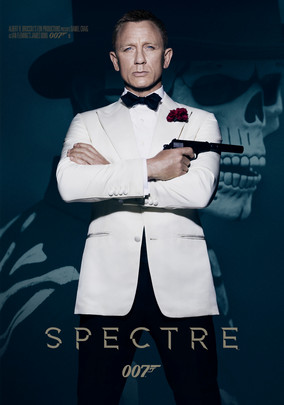
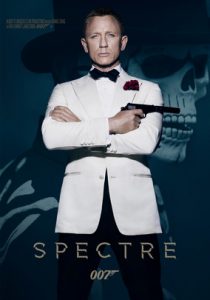
Spectre-2015
Director Sam Mendes
Starring Daniel Craig, Christoph Waltz
Scott’s Review #401
Reviewed May 5, 2016
Grade: B+
A modern treat for James Bond fans, Spectre (2015) is a slick, costly production sure to please die-hard lovers of the storied franchise.
It contains a rich history and nods to recent installments, wrapping the story arc up, a fantastic villain, and fast-paced, compelling story-telling.
It lacks an interesting lead Bond girl, a quality that detracts from the film, and what is a must for the cherished franchise.
This is the only major flaw in an otherwise fantastic film. In typical Bond fashion, his adventures take him to London, Rome, Mexico City, Austria, and Morocco.
Speeding along in what is now the twenty-fourth Bond film, and still feeling fresh and relevant, Spectre commences where its predecessor, Skyfall, left off, mainly hot on the heels of M’s (Judi Dench’s) shocking death.
How wonderful to see her again, albeit in a videotaped message crucial to the central plot.
The new M is a male character again and portrayed by Ralph Fiennes. In the film’s sub-plot, a new character, C, comes into play as the head of the Joint Intelligence Service, who deems the 00 section outdated.
The focal point is Bond’s avenging of the former M’s death by taking down Spectre, an organization not seen in a Bond film since 1971’s Diamonds Are Forever, but once again a strong presence.
The opening sequence in Mexico City kicks off the energy of the film.
Fast-paced, and with an awesome helicopter chase/fight sequence, it is a long sequence that thrills. We watch, engaged, as it swirls and tumbles mid-air, while hundreds of spectators in a large outdoor square flee for safety.
The film then forays into the inevitable Bond song, “Writing’s On The Wall”, this time written and performed by Sam Smith. This particular song has received mixed reviews, but I am fond of it.
This leaves the audience geared up for a wild adventure to come.
The return of the crime organization, Spectre, to the story brings a rich history and is the most interesting part. We have a rooting value since it is familiarity.
Even more pleasing is the return of Bond’s arch-enemy Ernst Stavro Blofeld, known more forcefully as “Number 1”, who has been played by such legendary actors as Donald Pleasance, Telly Savalas, and Max Von Sydow.
In Spectre, Christoph Waltz takes over the role and a major win. Waltz, a tremendous actor, plays Blofeld in a sly, wicked manner, taunting, yet with some comedic elements.
In a compelling scene (and the first one containing Waltz), James Bond appears, hidden, at a Spectre summit. He recoils as he recognizes the shadowed Blofeld, realizing the detrimental repercussions this will mean.
I only hope that in subsequent Bond films, Waltz returns.
Let’s discuss the Bond girls in the film.
Ironically, the small role featuring the oldest Bond girl in franchise history (aged fifty and played by the gorgeous Monica Bellucci) is more compelling than the lead Bond girl, Dr. Madeleine Swann, played by Lea Seydoux.
As Lucia Sciarra, widow of the Italian crime lord, Sciarra, there is more chemistry between Daniel Craig and Bellucci than between Craig and Seydoux.
I would have much rather seen Sciarra as the primary focus, but she is shamefully underused, appearing in two scenes only. Seydoux seems to lack energy and I noticed zero chemistry between her and Craig.
I am not sold on the new Moneypenny either, Bond’s labored sidekick and always suggested one-sided love interest, in earlier films it used to be a fun dynamic. She was a secretary, older, and their flirtation was charming, light, and fun. She was almost a mother figure to him.
There are no flirtation or romantic hints as the character has been modernized to fit the twenty-first century.
Despite this character’s misses, the film is exceptionally well-made with loads of action. Sometimes Bond films hold up well, other times they do not.
Time will tell what fate holds for Spectre (2015), but my hunch is that it will age well.
Oscar Nominations: 1 win-Best Song-“Writing’s on the Wall” (won)