Us-2019
Director Jordan Peele
Starring Lupita Nyong’o, Winston Duke
Scott’s Review #882
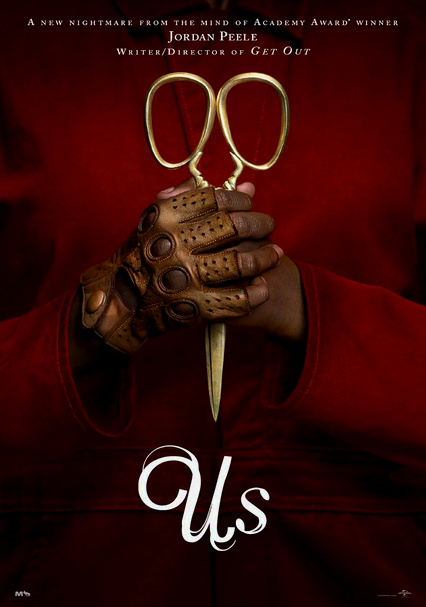
Reviewed April 1, 2019
Grade: A
Hot on the heels of his critically acclaimed and shockingly Oscar-nominated horror film Get Out (2017), Jordan Peele does it again with an even more thought-provoking creation.
Us (2019) combines classic horror elements with macabre and insightful qualities, crafting an ambitious project that can be dissected and discussed at length following the climactic and psychologically perplexing ending.
One thing is for sure: Peele has earned his spot among the most influential and elite directors circling Hollywood.
The film begins in 1986 as an event entitled “Hands Across America,” a publicity campaign encouraging people to hold hands to create a human chain to fight hunger and poverty, gripped the United States.
Nine-year-old Adelaide Thomas goes on vacation to Santa Cruz, California, with her parents, only to wander off into a deserted house of mirrors.
When she meets her doppelganger, she is terrified beyond comprehension and requires therapy to resume an everyday life.
Events return to the present day as Adelaide (now played by Lupita Nyong’o) is married to Gabe Wilson (Winston Duke) with two young children, Zora and Jason. Coaxed into a weekend getaway to none other than Santa Cruz to visit their wealthy friends Josh and Kitty Tyler (Tim Heidecker and Elisabeth Moss), Adelaide is apprehensive about the trip with a dreading sensation that her doppelganger is returning to get her.
When a strange family dressed in red jumpsuits appears on Wilson’s driveway, the plot transforms in a bizarre direction, especially since the family looks precisely like the Wilsons.
Us is exceptionally layered and reminiscent of the expression “peeling back the onion” in analysis and discussion possibilities. For starters, a character thought to be one person is revealed to be another, causing the audience to spin into confusion and not know who they were rooting for or against all along.
The astounding questions are endless and, in Peele’s brilliant fashion, can be asked at different times during the film. Why do the doppelgangers exist? What do they want? What does Hands Across America have to do with anything? What do the rabbits symbolize?
One gruesome scene and a favorite is the barbaric scene when the Tylers are suddenly attacked by their doppelgangers, home invasion style.
Reminiscent of the infamous Charles Manson murders, the family is slain quickly and mercilessly as the audience is left agape at the brutal slaughter. So much happens in this scene, first and foremost is the realization that there are more doppelgangers than we initially thought.
To lighten the mood a bit, Peele adds morbid comic relief as the family’s voice-controlled Siri system misunderstands the dying victim’s plea to call for police and mistakenly plays “F#@$ the Police” by N.W.A. instead.
Nyong’o has the most opportunities to showcase her acting ability by tackling two very different types of roles. As Adelaide, she is kind, capable, and your typical suburban Mom, but as her doppelganger Red, she is grizzled and desperate with a dry, throaty voice filled with pain and defeat.
At first thought a villain, the audience eventually learns the complexities of Red’s story more clearly, and the Oscar winner delivers both parts with exceptional grace.
The supporting actors bring their characters to life with gusto, with special mention going to Duke and Moss. Duke’s character of Gabe contains inept humor, coming across as slightly incompetent and the typical goofball dad-type character.
Moss takes her one-note character of Kitty, a spoiled, never-made-it-as-an-actress whiner with a wealthy husband, and infuses naughty passion into her doppelganger.
As she playfully applies lipstick while coquettishly watching herself in the mirror, she soon gives the term “plastic surgery” a new definition as she curiously carves her face.
Peele delivers a treasure with Us (2019), and I salivate at the thought that the film is only the novice director’s second attempt. Not suffering from the dreaded sophomore slump, he is becoming a modern director whose works are more like events than mere film releases.
Quentin Tarantino is a director who has also achieved this status because his directorial style is vastly different from that of other directors. I cannot wait to feast on Peele’s next attempt.