Tag Archives: Nancy Borgenicht

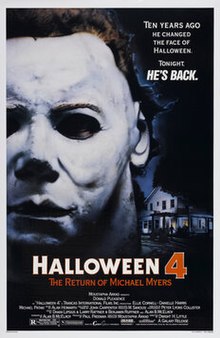
Halloween 4: The Return of Michael Meyers-1988

Halloween 4: The Return of Michael Meyers-1988

Director Dwight H. Little

Starring Donald Pleasence, Danielle Harris

Scott’s Review #1,312

Reviewed October 27, 2022

Grade: B

Give me a good slasher flick any day and I’m a pretty happy guy.

Especially if it’s one from the Halloween franchise (my favorite series other than Friday the 13th, naturally), and viewed around the demonic holiday is the perfect flavor.

There is so much atmosphere to embrace with pumpkins, masks, and trick-or-treaters nestled seemingly safe in a small town ripe for the picking by a knife-wielding maniac.

By 1988 though, the slasher genre had severely waned and felt quite redundant with watered-down sequels and copycat patterns resulting in a stale crop of films.

Halloween 4: The Return of Michael Meyers (1988) is an okay film and a worthy entry to the franchise. It is most notable for fixing what many fans thought was a terrible mistake.

Halloween III: Season of the Witch (1982) omitted maniacal Michael Meyers entirely which made many fans seeth with rage, so Part 4 corrects this miss by adding his name to the title card.

John Carpenter and Debra Hill, the main contributors to the original Halloween (1978) were not involved so executive producer Moustapha Akkad went for a conventional and safe route, creating a standard slice em and dice em affair.

The allegedly comatose Michael Myers (George P. Wilbur) is being transferred from one hospital to another, but he wakes up when the ambulance crew chatter about his surviving niece, Jamie (Danielle Harris).

Out for fresh blood, he slaughters his attendants and sets out to find his one living relative who is being cared for by a kind and resourceful foster sister named Rachel (Ellie Cornell).

Meanwhile, the ever-cautious Dr. Loomis (Donald Pleasence) remains on the killer’s path intent to destroy the monster once and for all.

The overall tone of Halloween 4: The Return of Michael Meyers is by the numbers providing an offering that would only satisfy fans of the franchise and not dare ruffle any feathers or acquire new fanatics.

Even the premise of Meyers escaping a hospital and targeting a family member is identical to the original film and its sequel. The familiar Haddonfield Hospital and Smith’s Grove Sanitarium return like good friends not seen for years.

There are no points given for originality but that’s not necessarily a bad thing. After all, Haloween III tried to reinvent the wheel and was largely derided for its efforts.

I liked the film and I like Part 4 for different reasons.

Meyers is front and center with his pointy butcher knife and hulking frame, and that’s pleasing and comforting. The mask is a bit paler and his height shorter but it’s the same Michael we all know and love.

Missing is Jamie Lee Curtis as Laurie Strode, presumed to have died, but the return of Pleasence is a major win as he takes center stage and has more screen time than he has ever had as Loomis. Scarred and looking older and more withered, his determination is even stronger to best Meyers.

In a neat little twist, Michael looks to pass his killing baton to his niece as she attempts to butcher her stepmom, similar to what Michael did to his sister many years earlier.

Borrowing heavily from its predecessors, Halloween 4: The Return of Michael Meyers (1988) is satisfying but not revolutionary. There are enough nods to history combined with a new batch of teenagers to mutilate to forge ground and continue the legacy.

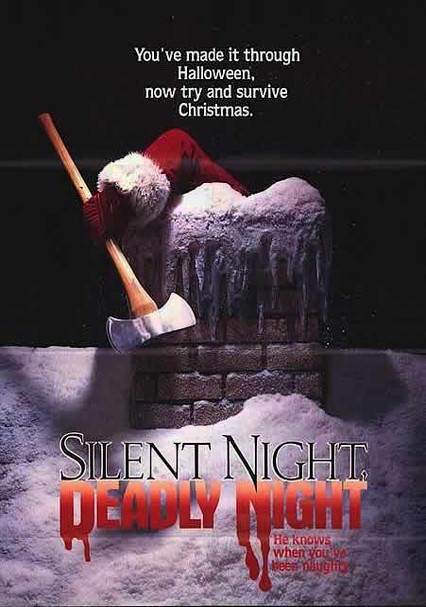
Silent Night, Deadly Night-1984

Silent Night, Deadly Night-1984

Director Charles E. Sellier Jr.

Starring Robert Brian Wilson

Scott’s Review #974

Reviewed December 30, 2019

Grade: B

Silent Night, Deadly Night (1984) is a fun, holiday-themed horror/slasher flick that is cheery mayhem in the spirit of the season, and a worthy addition to any horror fan’s collection.

The film is best watched late at night for the intended effect, and it is obvious to see around the holiday it celebrates.

It would make a great companion piece to Black Christmas (1974), a superior film, but both contain eerily similar musical scores, the former updated with electronic beats for the 1980s.

The horror film was met with ridicule and protest upon release for promoting a killer Santa Claus, despite the story being slightly overreacted to and misinterpreted.

The ‘real’ Santa Claus does not perform the slayings, but rather a mentally unstable young man dressed in the red suit does the dirty deeds.

Nonetheless, the film was unceremoniously yanked from theaters after parents expressed fear that their kids might be traumatized by the film. Silent Night, Deadly Night has graduated to cult-classic status and is entertaining, perhaps embracing its derision instead of running from it.

The action begins in rural Utah in 1971, as the Chapman family drives to a retirement home to see their catatonic grandfather. When left alone, the elder warns five-year-old Billy to fear Santa Claus, but his parents disbelieve him.

On their way home, they stop along the roadside to help a man dressed as Santa Claus, whose car appears to have broken down. The man robs and kills the parents, sparing Billy and his brother from death.

Three years later, Billy and Ricky reside in an orphanage led by the sadistic Mother Superior and a kindly nun, Sister Margaret (Gilmer McCormick).

Ten years later (present times), the now-grown Billy (Robert Brian Wilson) is benevolent and friendly, obtaining a job as a stock boy at a toy store with the help of Sister Margaret.

As Christmas Eve approaches, Billy has flashbacks of his parents’ murders and later is forced to play Santa Claus for the Christmas party when a co-worker falls ill.

As the staff becomes inebriated, a female co-worker is nearly raped, causing Billy to go berserk and kill both the assailant and the victim, who blames Billy. He then spends the night prowling the area for victims he can stab or behead.

Fun is the name of the game with Silent Night, Deadly Night.

The film is a macabre treat for slasher fans. The kills are respectable with the traditional methods used- an ax to the head and a bow and arrow death, along with more elaborate deaths like strangling with a chain of Christmas lights, and a bare-chested female victim being impaled on a moose head.

The highlight is the beheading of a mean teenage bully as he gleefully sleighs down a hill on a stolen sled.

Plenty of gratuitous bare chests (female) common in these types of films are in store for the lusty male viewer, but a nude male is glimpsed as well to make for some R-rated diversity.

Par for the course with slasher films made decades ago is the omission of cultural diversity. Not one Black, Latin, or Asian character is ever seen. The pure-as-snow Utah setting might be one justification.

If one were to attempt to analyze Silent Night, Deadly Night (not recommended), one could deduce a specific religious message, or at least a questioning of Catholicism, specifically the harshness of Mother Superior and her interpretation of punishment as good, implemented in the name of god.

Or maybe she is just a sadistic character? In perfect contrast, Sister Margaret is loving, protective, and nurturing to the orphans.

Whatever the filmmakers’ intention, humor is the recipe, as their strictness and rigidity are played for laughs.

Proper for any horror film, the final scene leaves room for a sequel. Indeed, four follow-up films were made, with the younger Ricky taking over as the serial killer.

In satisfying form, Ricky glares at Mother Superior and exclaims “Naughty!” before the credits roll. The unrated version of Silent Night, Deadly Night is the preferred version to watch.

Pull up the covers, light the fire, and kick back with a six-pack of Bud Light, roast some marshmallows, and enjoy Silent Night, Deadly Night (1984) for what it is.

Bad acting, sins of the flesh, and a delightful holiday slaughter, with unintentional (or intentional) humor and clichéd characters, make for robust enjoyment on a lightweight scale.