Tag Archives: Linnea Quigley

Graduation Day-1981

Graduation Day-1981

Director Herb Freed

Starring Christopher George, Patch Mackenzie

Scott’s Review #1,482

Reviewed June 7, 2025

Grade: B

Essentially borrowing from Halloween (1978), Friday the 13th (1980), and other slasher films of the genre’s original heyday, Graduation Day (1981) even adopts the gimmicky holiday/big event model (prom night, Mother’s Day, etc.) made popular.

A whodunit mystery, killer point of view camera work, and revenge motive come into play, making the film a standard entry in the slasher catalog.

Released in 1981, the film capitalizes on trends in the horror genre, much like many rock bands did during the grunge movement or the Los Angeles hair metal movement, for comparison.

There are red herring devices and comical, one-dimensional characters thrown in to soften the film. Making Graduation Day a second-tier slasher film, no more and no less.

Still, the film is fun, with the guessing of the killer’s identity being the most successful and compelling aspect. The murderer carefully marking a red X over each victim post murder is delightful.

A small role by aspiring actress Vanna White, who soon became a television game show legend on Wheel of Fortune, makes Graduation Day a fun relic from another time. Her acting isn’t good, so she lucked out with a continuing career in showbiz. The script does her no favors either.

A suburban high school track team is devastated when their star runner, Laura Ramstead, drops dead following a race, having been pressured relentlessly to win by aggressive coach George Michaels (Christopher George).

Months go by, and Laura’s older sister, Anne (Patch Mackenzie), a U.S. Navy Officer, returns home to attend graduation in Laura’s honor.

Conveniently, she leers at one of Laura’s fellow trackmates and has an identical grey tracksuit and black gloves to those of the killer. Later, we see that the coach does as well.

Has Anne returned to town to avenge her sister’s death? Or does the coach blame the other track members for Laura’s death? Is Laura’s devastated boyfriend Kevin (E. Danny Murphy) out for revenge?

Herb Freed, a director I’m not familiar with, co-wrote and co-produced the venture, which is a positive. This means he undoubtedly had more creative freedom to make the project his own.

Many scenes take place along a deserted walking path, reportedly on the way to campus. Intended victims traverse the trail while someone watches them from the sidelines. It’s either the killer or someone else. One character laughably states that she is looking for the auditorium (on a trail?) and can’t find her way.

The editing team deserves praise for the opening sequence, a slow-motion ode to Brian De Palma’s Carrie (1976), no doubt, as Laura crosses the finish line as adoring students and teachers chant her name and words of encouragement.

Later, a cool roller-skating scene is shown amid a performance by the new wave rock band, Felony.

The filler scenes between less critical characters, such as the principal (Michael Pataki) and the ditzy secretary, aptly named Blondie (E.J. Peaker), for example, play well.

What fans watching the film mostly want to see, though, are the kills, which are well done and clever. My favorite is when Tony (Billy Hufsey) is decapitated from behind while taking a leak.

Another track member attempts to pole vault, resulting in death when steel spikes have replaced the pads in the pole vault pit, and he is killed upon impact.

The screenplay is weak, and the killer’s motivations and reasons for the revenge are lightweight. The track members had no intention to or responsibility for Laura’s death, so the conclusion is unsatisfying.

Graduation Day (1981) is an ideal weekend movie, the kind of entertaining, low-budget horror film that will work best for audiences looking to unwind and have fun after a long, busy workweek.

That’s why I watched it, and it’s perfect for fans of the slasher genre who may not have heard of it.

A Nightmare on Elm Street 4: The Dream Master-1988

A Nightmare on Elm Street 4: The Dream Master-1988

Director Renny Harlin

Starring Robert Englund, Tuesday Knight, Lisa Wilcox

Scott’s Review #1,030

Reviewed June 8, 2020

Grade: B-

By 1988, a tepid year in cinema, and with the slasher genre nearly dead on arrival, the release of A Nightmare on Elm Street 4: The Dream Master (1988) had the cards stacked against it.

The franchise feels tired and out of gas by this point, so more comedy and humorous lines were added along with a return to a similar concept offered in A Nightmare on Elm Street 3: Dream Warriors (1987), the dream sequences.

The film is so-so with not much making it stand out as compared to the superior first three offerings. Thankfully, Robert Englund is the mainstay and main attraction.

A year after the events of the previous film, Kristen (Tuesday Knight) and her friends have been released from the stifling Westin Hills sanitarium, putting the horrific events behind them.

Their attempts to resume normal teenage activities like attending class and partying are thwarted by Freddy Krueger (Englund) who begins to infiltrate Kristen’s dreams.

As usual, a fresh batch of teenagers is along for the ride as they struggle to stay awake by watching Music Television (MTV) and revisiting the lavish junkyard featured in the previous installment.

The redundancy of another franchise film using the tired “one year later” to begin events anew is feeling like a cliché.

The main character Kristen being played by a different actress does not help the film only making it lack any consistency, the fact that actress Patricia Arquette had little interest in returning for around two in the role is not the film’s fault, but a brand-new character instead of a recast might not have been a bad idea.

Recasting prominent roles may work in daytime soap operas but not in the movies.

A Nightmare on Elm Street 4: The Dream Master, while quite similar to its predecessor, Dream Warriors, so much so that they could easily be watched in tandem, has some positive qualities.

I love the MTV angle, the network music channel overtaking nearly every United States teenager’s living room or bedroom throughout the 1980s.

If the filmmakers wanted to get teenagers who might not necessarily watch horror films, this was a perfect marketing tool. The target audience is perfectly aligned, and the film feels fresh and relevant for its time of release.

The drawback to the above point is that making a film that is timely means that decades later its risk is being referred to as “of its time”, and sadly that is what has happened with Dream Master.

Nobody will scramble to watch this installment when other better chapters are out there. There may hardly be a reason to watch this one against you unless a Nightmare marathon is on the docket.

The junkyard set and the creepy church set are very good, so the film does well from a visual perspective.

Englund is Freddy and his familiarity cannot be dismissed, but the actor seems to be phoning in his performance by this point in the franchise. Finally receiving top billing, as he should, he shares his familiar witty remarks and playfully taunts his victims like a cat would before pouncing on a mouse.

The actor adds even more humor to his one-liners, but this sacrifices the horrific moments of which there are not many. A successful horror/comedy fusion is a delicate balance and there is not enough meat on the bone.

Entertaining at best, A Nightmare on Elm Street 4: The Dream Master (1988) is not well remembered, nor should it be. A dated affair, with emotionless teenage actors needing acting lessons and surely never to be heard from again, round out the cast led by Robert Englund.

The film is a letdown because it is too much like Dream Warrior and suffers from too much predictability.

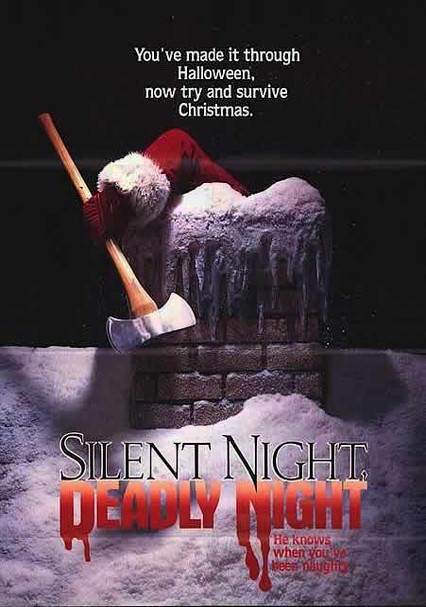
Silent Night, Deadly Night-1984

Silent Night, Deadly Night-1984

Director Charles E. Sellier Jr.

Starring Robert Brian Wilson, Gilmer McCormick

Scott’s Review #974

Reviewed December 30, 2019

Grade: B

Silent Night, Deadly Night (1984) is a fun, holiday-themed horror/slasher flick that is cheery mayhem in the spirit of the season, and a worthy addition to any horror fan’s collection.

The film is best watched late at night for appropriate effect, and obvious to view around the holiday that it celebrates.

It would make a great companion piece to Black Christmas (1974), a superior film, but both contain eerily similar musical scores, the former updated with electronic beats for the 1980s.

The horror film was met with ridicule and protest upon release for the promotion of a killer Santa Claus, despite the story being slightly overreacted to and not interpreted correctly. The ‘real’ Santa Claus does not perform the slayings, but rather a mentally unstable young man dressed in the red suit does the dirty deeds.

Nonetheless, the film was unceremoniously yanked from theaters after parents expressed fear that their kids might be traumatized by the film. Silent Night, Deadly Night has graduated to cult-classic status and is entertaining, perhaps embracing its derision instead of running from it.

The action begins in rural Utah in 1971, as the Chapman family drives to a retirement home to see their catatonic grandfather. When left alone, the elder warns five-year-old Billy to fear Santa Claus, which his parents disbelieve.

On their way home, they stop along the roadside to help a man dressed as Santa Claus, whose car appears to have broken down. The man robs and kills the parents, sparing Billy and his brother from death. Three years later Billy and Ricky reside in an orphanage led by the sadistic Mother Superior, and a kindly nun, Sister Margaret (Gilmer McCormick).

Ten years later (present times), the now-grown Billy (Robert Brian Wilson) is benevolent and friendly, obtaining a job as a stock boy at a toy store with the help of Sister Margaret. As Christmas Eve approaches, Billy has flashbacks of his parent’s murders and later is forced to play Santa Claus for the Christmas party when a co-worker falls ill.

As the staff becomes inebriated, a female co-worker is nearly raped causing Billy to go berserk and kill both the assailant and the victim who blames Billy. He then spends the night prowling the area for victims he can stab or behead.

Fun is the name of the game with Silent Night, Deadly Night.

The film is to be enjoyed and is a macabre treat for slasher fans. The kills are respectable with the traditional methods used- an ax to the head and a bow and arrow death, along with more elaborate deaths like strangling with a chain of Christmas lights, and a bare-chested female victim being impaled on a moose head.

The highlight is the beheading of a mean teenage bully as he gleefully sleighs down a hill on a stolen sled.

Plenty of gratuitous bare chests (female) common in these types of films are in store for the lusty male viewer, but a nude male is glimpsed as well to make for some R-rated diversity.

Par for the course with slasher films made decades ago is the omission of cultural diversity. Not one Black, Latin, or Asian character is ever seen. The pure-as-snow Utah setting might be one justification.

If one were to attempt to analyze Silent Night, Deadly Night (not recommended) one can deduce a specific religious message or at least a questioning of Catholicism, specifically the harshness of Mother Superior and her interpretation of punishment being good and implemented in the name of god.

Or maybe she is just a sadistic character? In perfect contrast, Sister Margaret is loving, protective, and nurturing to the orphans.

Whatever the intention of the filmmakers, humor is the recipe as the strictness and rigidity are played for laughs.

Proper for any horror film, the final scene leaves room for a sequel. Indeed, there were four follow-up films made with the younger Ricky taking over as the serial killer.

In satisfying form, Ricky glares at Mother Superior and exclaims “Naughty!” before the credits roll. The unrated version of Silent Night, Deadly Night is the preferred version to watch.

Pull up the covers, light the fire, and kick back with a six-pack of Bud Lite, roast some marshmallows, and enjoy Silent Night, Deadly Night (1984) for what it is.

Bad acting, sins of the flesh, and a delightful holiday slaughter with unintentional (or intentional) humor and cliched characters make for robust enjoyment on a lightweight scale.