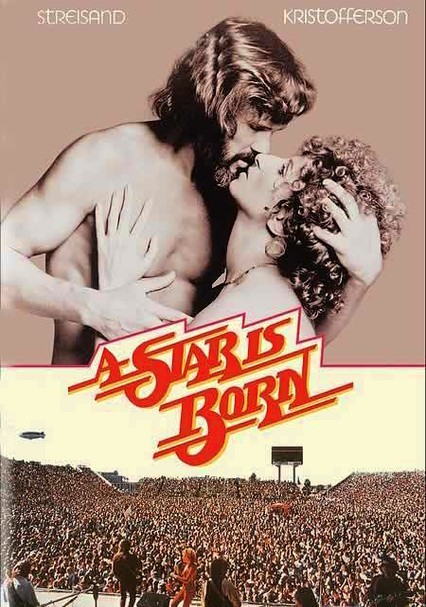
A Star Is Born-1976
Director Frank Pierson
Starring Barbra Streisand, Kris Kristofferson
Scott’s Review #1,276
Reviewed July 13, 2022
Grade: B
Four incarnations of A Star Is Born: 1937, 1954, 1976, and 2018 have been created. Strangely enough, the most recent film starring Bradley Cooper and Lady Gaga is worlds above the others, though I haven’t yet seen the 1937 version.
The fourth time is rarely the charm in film remakes.
The focus of this review, however, is largely on the 1976 film starring Barbra Streisand and Kris Kristofferson. A hit movie at the time, and nonetheless despised by some, the film is perfectly fine, though it bears multiple rewatchings, and it’s inferior to the 2018 film.
There is no question about that.
Amazingly, it was nominated for four Academy Awards and deservedly won for Best Song. The other nominations are generous.
Watching A Star Is Born circa 2022, the 1976 rendition suffers severely from a dated tone, mostly because of the jaw-droppingly hideous perm hairdo worn by Streisand.
Did somebody think it was flattering in 1976?
The chemistry between Streisand and Kristofferson starts tepid but intensifies as the film plods along. The ending is underwhelming, and I expected more emotional pizazz than I was given, leaving me with almost a ‘so what’ reaction to a devastating turn of events.
Until that is, Barbra sings her heart out in one unbroken, gut-wrenching shot of seven or eight minutes.
For those unfamiliar, the story surrounds John Norman Howard (Kristofferson), a troubled rock star on the decline, frequently indulging in excessive drugs and drinking and trying to write hit records.
He drunkenly wanders into a club one night and watches aspiring singer Esther Hoffman (Streisand) perform, and is instantly smitten. The two begin dating, and soon John lets Esther take the spotlight during his concerts.
However, even as Esther finds fame and success with her singing, John continues his downward spiral.
Let’s face it. The main draw is who is playing the lead roles in a film like A Star Is Born. To make a love story work, there must be sizzling chemistry so that the audience is invested in the romance. Streisand commands the center stage, and her singing is the selling point.
Otherwise, Ms. Streisand suffers another bout of miscasting as she did in 1969’s Hello, Dolly. She’s too talented and established to be believable as an aspiring singer.
Her singing saves the film.
The gorgeous song “Evergreen” is quite a powerful moment and a great strength. Without it, the film would have felt lacking and mediocre.
The tune raises the overall experience a notch.
The chemistry is merely the warm-up act. It’s ho-hum until a smoldering bathtub scene occurs where John and Esther soap each other down and fall madly between the sheets for a night of passion.
It’s Streisand’s sexiest scene, and the romance takes off.
Back to Streisand’s vocals, the scene is preceded by a gorgeous songwriting sequence at the piano between John and Esther, as they craft a new song. As they collaborate, a connection and bond between the characters form.
Those are the romantic highlights.
Otherwise, the scene in which John becomes infatuated with Esther lacks appeal, since he is drinking and arguing with another patron and barely has time to notice her. This was thankfully changed in the 2018 version when John was mesmerized by the rising talent.
Additionally, when John invites Esther to his concert, and she watches from backstage, nothing happens. In the 2018 version, he drags her out to perform with him, and it’s a moment.
Some films are best reviewed on their own merits, but what great fun to compare renditions of the same film, because why not?
The supporting characters have little to do except for an impressive turn by Gary Busey as John’s drug-pushing manager.
There is little reason to watch A Star Is Born (1976) more than once, or at most twice, to confirm that the film lacks a bit. It’s not terrible, but hardly memorable unless the desire is to giggle over an incredibly bad 1970s hairstyle by one of the greatest divas.
Then, move on to the outstanding Cooper/Gaga 2018 version.
Oscar Nominations: 1 win-Best Cinematography, Best Original Score, Best Original Song-“Evergreen” (won), Best Sound