Category Archives: Riki Lindhome

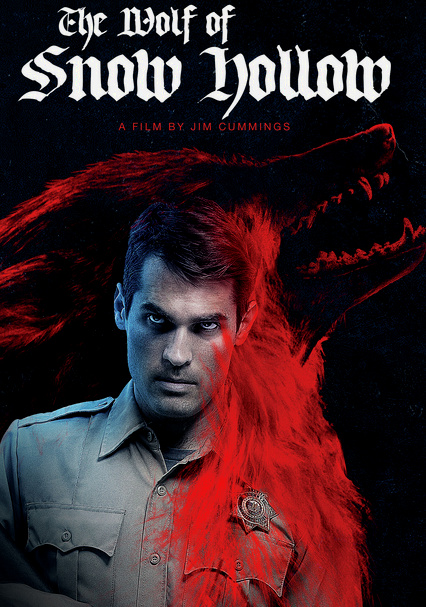
The Wolf of Snow Hollow-2020

The Wolf of Snow Hollow-2020

Director Jim Cummings

Starring Jim Cummings, Riki Lindhome

Scott’s Review #1,166
Reviewed July 28, 2021

Grade: B

Jim Cummings, who writes, directs, and stars in his self-created horror-comedy offering about a killer werewolf, delivers a film named The Wolf of Snow Hollow (2020).

It has sprinklings of both Fargo (1996) and The Silence of the Lambs (1991) mixed in with an appropriate amount of comic moments to offset the stark horror.

While the film can be watched and enjoyed any time of year, the snowy drifts and the Christmas and New Year’s seasons are well-positioned for a holiday horror feast. Especially clever is the inclusion of the song Auld Lang Syne during the finale of the film.

The film excels at offering a compelling locale and set trimmings.

To further the point and emphasize the Fargo comparisons, the setting is wintery Utah, and many of the characters resemble those found in the Coen brothers’ film.

The kooky police force, the odd characters, and the snowy plains are a nice nod to the film.

A small-town cop, John Marshall (Jim Cummings), struggling with a failed marriage, alcoholism, a rebellious daughter, and an inept team of officers, is assigned to solve a series of brutal murders that are occurring only during a full moon.

As the hunt for the killer consumes him, he struggles to deal with his sick father, played by Robert Forster, who is also the acting sheriff.

Are the murders being committed by a werewolf or someone donning a disguise? Part of the fun for the audience is the guesswork. Just the premise alone of a werewolf on the loose in a small town is compelling.

The film is somewhat disjointed from a plot perspective.

Besides the main plot of the murders and the subsequent whodunit, that should be enough to satisfy a quick one-hour-and-twenty-three-minute running time.

The relationship between father and son is touching and is a win. Since Forster died shortly after the film was made, this adds even more poignancy.

There are some loose ends, however, that either don’t add up or are too predictable.

The frequent shots of an unnamed townsperson suspected of the killings, who lives with a wolf and takes drugs, are way too obvious a red herring. Spoiler alert- he’s not the killer. And Marshall’s daughter sneaking out to a car to have sex with a boyfriend is an obvious plot ploy for her to be attacked.

I’m not sure why so many films present police officers as being incompetent, unintelligent, or corrupt. Still, The Wolf of Snow Hollow is guilty as charged with some clear clichés meant to be humorous.

The film is still enjoyable and never dull. Lots of dark comedic elements lighten things up, like when John flies into rages or banters with his father or female police officer and sidekick Officer Julia, played by Riki Lindhome.

The mystery of the killer is compelling, and the final sequence is enthralling. I was immediately engrossed with the first scene when a young couple visits the snowy town and dines in a local eatery, preparing to embark on a romantic weekend.

The assumption is that these two are the main characters, but when the girl is murdered, things change in a different direction.

On a quick inclusion note, when a townsperson utters an anti- LGBTQ+ slur, he is railed at by a character, though no gay characters appear.

The Wolf of Snow Hollow (2020) is an entertaining affair. It borrows from some other films, but resurrects the werewolf storyline, which is intriguing in itself.

Since Cummings took on the bulk of this film himself, I’m curious what else he will bring to the cinematic table, in the horror genre or otherwise.
Knives Out-2019

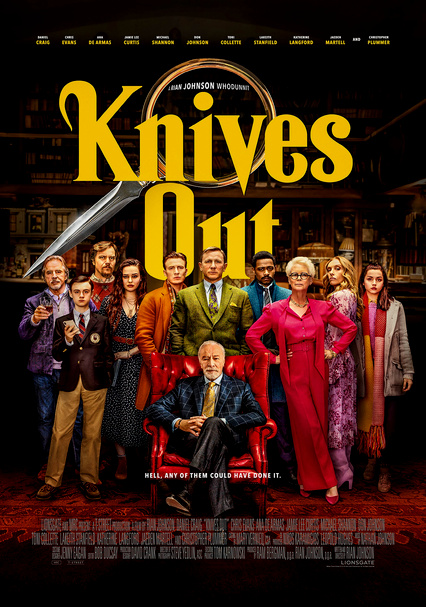
Knives Out-2019

Director Rian Johnson

Starring Ana de Armas, Daniel Craig

Scott’s Review #969

Reviewed December 17, 2019

Grade: B+

Knives Out (2019) is a cleverly constructed whodunit, crafted in a style not dissimilar from the famous board game Clue. This facet is mentioned by one character during a scene in the film.

With a sizable cast of film stars, both young and old (mostly old), the result is a good time, featuring intelligent writing, surprises, and a crowd-pleasing tone. The project is presented by a cast who undoubtedly had a ball during filming.

The point of the film is to try and figure out whodunit and why, in perfect murder mystery form.

It is explained through narration that wealthy crime novelist Harlan Thrombey (Christopher Plummer) has invited his family to flock to his mansion for his eighty-fifth birthday party. The next morning, Harlan’s housekeeper Fran finds him dead, apparently having slit his own throat.

An anonymous figure hires private detective Benoit Blanc (Daniel Craig) to investigate the situation. When Blanc arrives at the grand estate to interrogate family and friends, tidbits of scandal and intrigue slowly emerge as layers are revealed.

The sizable cast features Hollywood stalwarts like Jamie Lee Curtis (Linda, Harlan’s daughter), Don Johnson (Richard, Harlan’s son-in-law, and Linda’s husband), Chris Evans (Ransom, Harlan’s grandson), Michael Shannon (Walt, Harlan’s youngest son), and Toni Collette (Joni, widow of Harlan’s deceased son Neil).

Helpful is how the film takes the time to introduce and explain each prominent character, so that the viewer has a good sense of who’s who and how one character relates to the others before the tangled web unravels.

The delicious aspect of Knives Out is the numerous twists and turns it offers throughout its runtime.

Surprisingly, it was a key revelation exposed quite early on, so that the pacing is more left of center than classic whodunits of days past. Once the new story arc is revealed, the plot thickens further, and we know that more events will ultimately unfold, as the story cannot be this simple.

This successfully kept me engaged as a viewer throughout the entire experience.

Having witnessed the previews at length and the way the trailer presents a Hercule Poirot/Agatha Christie/Jessica Fletcher-type sleuth to solve, it was delightful to see one character snuggling on the couch, absorbed in an episode of the 1980s television series “Murder, She Wrote.”

Director Rian Johnson offers several sly homages to influential tidbits of pop culture that helped shape his film and retain its amusement.

Another momentous positive is the incorporation of a political discussion among the family as they brood and fret over how much money they stand to inherit from their dead patriarch.

Donald J. Trump, a man who catapulted the United States into controversy post-2016, is never mentioned by name. Still, immigration, children in cages, and expletives are carefully hurled about in his honor, so there is no question about the connotations.

Harlan’s caregiver is Marta (Ana de Armas), the heroine of the film and the standout, whose mother is an undocumented immigrant.

So political overtones abound.

Knives Out seamlessly blends dark humor with traditional mystery, ensuring it never loses its edge. The big reveal at the end is neither brilliant nor disappointing. It simply bubbles to the surface after numerous red herrings and lies.

The final sequence is palpable, and savvy viewers will wonder what one character will possibly do next to either please or anger the rest of the characters.

Might a sequel be at hand?

A film not meant to be high art or anything more than an entertaining good time, Knives Out (2019) achieves its intent by offering an experience reminiscent of an Agatha Christie tale that is fun for the audience.

The benefits are reaped, as the film received an enormous box office return. Thanks in large part to a talented cast, a gloomy mansion, and wealthy individuals faced with peril and comeuppance, these elements make for a wonderful recipe for a good, solid mystery.

Oscar Nominations: Best Original Screenplay

Million Dollar Baby-2004

Million Dollar Baby-2004

Director Clint Eastwood

Starring Clint Eastwood, Hilary Swank, Morgan Freeman

Scott’s Review #798

Reviewed August 2, 2018

Grade: A

Million Dollar Baby (2004) is arguably Clint Eastwood’s best-directed film of his career.

Rivaling Mystic River (2003) by a hair, the film has a raw emotional appeal, empathetic and richly carved characters and mainstream sensibility.

These combined elements resulted in huge box office success and Oscar wins for Picture, Director, Actress, and Supporting Actor in the year of its release.

Frankie Dunn (Clint Eastwood) is a hardened boxing coach who owns a run-down Los Angeles gym. He works with his best friend and assistant, Eddie (Morgan Freeman). When an aspiring female boxer, Maggie (Hilary Swank), arrives and begs Frankie to train her, he initially declines, but at Eddie’s urging, eventually relents and leads her to great success as a top female boxer.

Frankie and Maggie forge a close-knit, father/daughter relationship, a substitute for the damaged one he has with his daughter.

The final portion of Million Dollar Baby takes a very dark turn, as Maggie is illegally punched during a fight by a fellow boxer, causing her to become a quadriplegic. These events are what change the tone of the film from a very good sports drama to a great tale of morality.

Many emotions and debates transpired after this film was released and the common question of, “What would you have done?” engulfed viewers for months, all through awards season.

The heartbreaking effects of the story events raise the film head and shoulders above most typical sports films.

Too often Eastwood creates films that are palpable, but in a way generic, and very Hollywood. Grand Torino (2008) and Invictus (2009) are good examples of this- especially Invictus given the sports drama element.

Some assumed that Million Dollar Baby was to be a female Rocky (1976) and the film was indeed marketed as such. For this reason, some felt robbed or duped, but I celebrate this film as leaning a firm left of center with a refreshing, progressive approach.

The performances are amazing all around, even by Eastwood- never known for his acting talent. The characters are written as character-driven, but not caricatures. Wounded, grizzled, and flawed, in his senior years, Frankie sees his life has passed him by, having achieved nothing.

Never has Eastwood portrayed a character as complex and reserved as Frankie.

Swank deserved her second Oscar (1999’s Boys Don’t Cry was her first) for simply becoming a boxer- her pre-filming prep schedule reportedly was insane. More than the muscle and toning she achieved, are the raw acting talent and wounded emotions she possesses.

The character is written as pained and vulnerable, but also very strong. She has achieved little in her life- working as a waitress in Missouri and stealing scraps of leftovers to survive. Her family is trash through and through, only wanting her eventual riches for themselves.

The character is inevitably championed as we empathize with her plight emotionally.

Finally, Freeman deserves recognition for being the ultimate supporting actor. Eddie Dupris, a former fighter blind in one eye, is the center point of the story and frequently narrates the actions of others, oftentimes offering a glimpse into the psyche of individuals.

The voice of reason, he is observant and analytical, almost knowing Freddie better than Freddie knows himself. They quarrel and disagree, but are forever friends and loyal to a fault. Freeman possesses quite a reserve as the audience becomes curious about his past life.

Million Dollar Baby (2004) is Eastwood’s best film- Mystic River comes a close second, however. A seemingly formulaic story and genre are weaved into a web of humanism, emotions, and power.

The film is about the characters, which makes it succeed.

Eastwood has not been able to quite surpass this beautiful story, but thankfully received dripping praise and accolades for a film not soon forgotten.

Oscar Nominations: 4 wins-Best Picture (won), Best Director-Clint Eastwood (won), Best Actor-Clint Eastwood, Best Actress-Hilary Swank (won), Best Supporting Actor-Morgan Freeman (won), Best Adapted Screenplay, Best Film Editing