Tár-2022
Director Todd Field
Starring Cate Blanchett, Nina Hoss, Noémie Merlant
Scott’s Review #1,315
Reviewed November 18, 2022
Grade: A
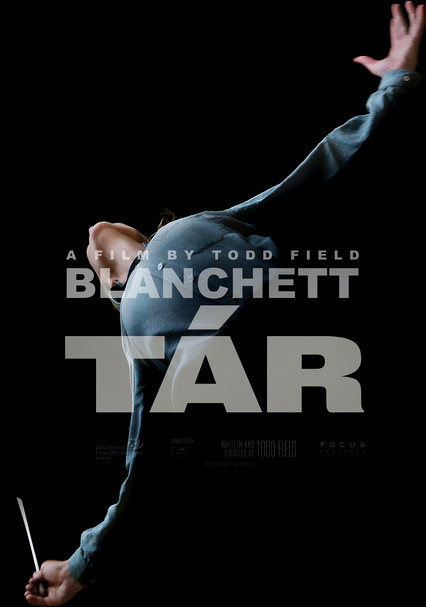
Tár (2022) is a brilliant film that truly belongs to Cate Blanchett. I cannot picture any other actress in this role but her.
I can pretty much watch any film that she appears in, with my favorite being her self-titled role in Carol (2015). But Tár is a close second.
In Tár, again in the title role, she plays a brilliant woman whom the audience admires but slowly discovers pieces of her personality are tarnished and brittle beneath the surface. As the film progresses, her character’s psyche is gradually peeled back, like an onion.
This lofty praise of Blanchett is in no way meant to diminish the rest of Tár because it revels in grandiose riches. The pacing, musical score, and other acting performances are to be championed.
When I found out that Todd Field was directing Tár, my spirits began to soar.
After all, he directed In the Bedroom (2001) and Little Children (2006), two tremendous films set a quiet, small-town settings that brim with secrets and scandals, which slowly rise to the surface.
The subdued locales are scrapped in favor of Berlin, a busy, behemoth of a city in Germany. Some of the events take place in New York City, resulting in a large, cosmopolitan atmosphere. A cold, grey, stark quality encompasses the luminous settings.
Tár requires the viewer’s absolute patience to get the most out of it. It can be tough to follow with very long sequences, but the Field/Blanchett combination culminates in a muddy and dazzling conclusion.
Blanchett plays Lydia Tár, the groundbreaking conductor of a major German Orchestra. We meet Tár at the height of her career, in high demand, as she’s preparing both a book launch and a much-anticipated live performance of Mahler’s Fifth Symphony.
What could go wrong? In Lydia’s case, just about everything.
Over a few weeks, her life begins to unravel. The result is an examination of power and its effect on those who have it and those who don’t.
The timely #MeToo movement is in top form.
The gender flip is also quite interesting since typically it’s males who have and abuse the power, but Lydia is a female and a lesbian.
I spent a good part of Tár feeling perplexed, anxious, and compelled. It’s a slow burn, but I always knew, with Field in the director’s seat, that a big payoff awaited me. I happily jumped into his arms and waited for the shit to hit the fan.
The key to Tár is that many of the events have happened off-screen and before the current events of the film. There is a mysterious, suicidal, former student of Lydia’s in the mix. She sends desperate, pleading emails to Lydia and her assistant.
We wonder how the former student is connected to the events.
Lydia relies on Francesca (Noémie Merlant), her attentive personal assistant, and Sharon (Nina Hoss), her ailing wife and concertmaster, for almost everything.
Soon, a new and gifted Russian cellist named Olga (Sophie Kauer) arrives on the scene. With Lydia smitten, how will Olga fit in with the other women?
Francesca, Sharon, and Olga are three pivotal female characters, and each actress is exceptional in the role.
Tár reminds me of both Whiplash (2014) and Black Swan (2010) for different reasons. It envelops the world of classical music like Whiplash did for jazz and Black Swan did for the ballet world.
All three films can be watched closely together, and more similarities can be noticed.
Tár is a film that can be owned and watched again to piece together the jagged puzzle pieces. It’s a rare moment in modern cinema that can be rewatched.
Since it contains music, the orchestra and maestro sequences are wonderfully constructed, so the coldness of the events mirrors the song choices.
Stark and boiling over with gems like mystique, uncertainty, and sophistication, Tár (2022) rejuvenates modern film with a bleak yet thought-provoking story of a powerful woman.
It’s a film that engrosses and thrills.
Oscar Nominations: Best Picture, Best Director-Todd Field, Best Actress-Cate Blanchett, Best Original Screenplay, Best Cinematography, Best Film Editing
Independent Spirit Award Nominations: 1 win-Best Feature, Best Director-Todd Field, Best Lead Performance-Cate Blanchett, Best Supporting Performance-Nina Hoss, Best Screenplay, Best Cinematography (won), Best Editing