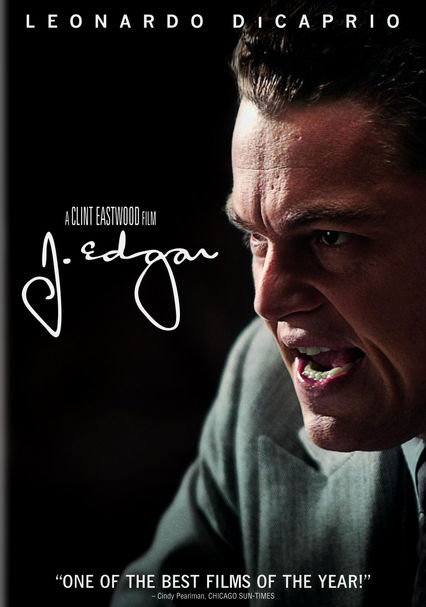
J. Edgar-2011
Director Clint Eastwood
Starring Leonardo DiCaprio, Armie Hammer, Naomi Watts
Scott’s Review #1,099
Reviewed January 12, 2021
Grade: A
When director Clint Eastwood and actor Leonardo DiCaprio align, exceptional things can happen. This is evidenced by J. Edgar (2011), a compelling and well-constructed drama with a biographical and character-driven focus.
One gets inside the head and psyche of the title character, J. Edgar Hoover, the head of the Federal Bureau of Investigations, with DiCaprio playing him flawlessly.
The film is left-of-center, surprising for the mainstream director, though his film-making style is familiar. Eastwood does what he does best by constructing a slick and “Hollywood” experience.
There are not daring camera angles or unique uses of light that Stanley Kubrick might use. He creates a steady affair that will appeal to the American heartland, getting butts to the movie theater on his name alone.
The film opens in 1919 when a young Hoover (DiCaprio) is tasked with purging radicals from the United States and obtaining their secrets, something he’d carry with him for decades. He meets a new Secretary, Helen Gandy (Naomi Watts), whom he makes an awkward pass and an even more awkward marriage proposal.
She refuses, and they become professional and personal allies.
The story then plods along with historical stops through the decades like the Lindbergh baby kidnapping, Martin Luther King Jr., and Richard Nixon.
Hoover is always involved in these escapades.
Hoover, who served as the head of the bureau from 1924 until he died in 1972, was a powerful and ruthless man.
Eastwood carefully dissects him, professionally and personally. He never married, lived with his mother, traveled, and enjoyed dinners with one man who in death, bequeathed his estate.
You do the math.
He was a gay man when one couldn’t be an openly gay man. Thus, he is conflicted, and Eastwood does a great job of showing the demons he wrestles with.
The relationship between Hoover and lawyer, Clyde Tolson (Armie Hammer) is my favorite part of J. Edgar because it’s interesting and humanistic.
DiCaprio and Hammer give outstanding performances with flawless chemistry and charisma.
When Hoover professes his love for Tolson and quickly recants his statement then professes love for an actress, we view his turmoil. He loves Tolson but cannot bear to accept it even though it would free him from his chains.
Despite the tender nature of the sequence above or that his mother was a traditional, no-nonsense, shrew, Hoover is not portrayed as a hero. He was a complicated and damaged man and Eastwood hits this point home.
He blackmailed Martin Luther King Jr., kept sexual secrets on several Hollywood stars, and participated in various abuses of power.
The film does admit that the director also instituted fingerprinting and forensic measures that reduced crime.
Those who desire a straightforward lesson in history may be slightly perturbed by the focus on Hoover’s personal life. Eastwood could have easily made Hoover’s career the only facet of the production-enough material that exists for this.
Instead, we get to see the inner workings of the man. Kudos for this.
Dustin Lance Black, who wrote Milk (2008), a portrait of a gay man, is back at the helm serving as a screenwriter. But the two films are not modeled after one another. They are very different animals.
While Milk celebrates a man refusing to deny who he and others are, demanding their just civil rights, J. Edgar provides the narrative of a man fleeing from who he is.
Offering a rich and complex biography of a tortured man, the audience is exposed to a person wrestling with inner turmoil. Hoover was a famous man, but the film could easily represent those thousands of men who could not bring themselves to accept who they were.
The largest praise goes to DiCaprio who makes us sympathize, pity, and admire the complexities of his character.
J. Edgar (2011) hits a grand slam.