Category Archives: Gore Vidal

Fellini’s Roma-1972

Fellini’s Roma-1972

Director Federico Fellini

Starring Peter Gonzales, Britta Barnes

Top 250 Films #122

Scott’s Review #649

Reviewed June 5, 2017

Grade: A-

Fellini’s Roma (1973) is a trippy experience set in Rome across two different periods.

As with all Fellini films, the film is meant to be experienced rather than analyzed.

One must nestle into the life that Fellini offers on-screen- in this instance, the fabulous city of Rome, Italy, in both positives and negatives.

The experience was very good for me, as both a world of odd characters and of ancient Rome oozed from the screen appealingly and absurdly.

From a plot narrative- there is a rot one. Arguably, the only character portrayed is Rome herself. The film takes place in both the 1930s and the 1970s and is said to be an autobiographical tale of director Fellini’s experiences growing up in Rome.

We see little Fellini as a youngster, experiencing the vast city for the first time, and as a teenager, now living in the city. Interestingly, the film moves back and forth between the two periods with no rhyme or reason.

Throughout the film, we see both the beauty and the ugliness of Rome- the majestic Colosseum and the dirty entrails of the gloomy city. Scenes of seedy brothels, mainly in the 1930s, and a myriad of strange and scantily clad females prance before the cameras, looking for a lucky score amid the droves of men lusting after them.

Another depicts a fashion show, of sorts, taking place at the Vatican, involving nuns and priests in bizarre costumes.

The 1930’s setting is my personal favorite. Gritty, cold, and harsh, Rome’s bleakness is depicted. Unsurprisingly, this has much to do with the historical period: since Mussolini was in power and on the eve of World War II, the darkness was apparent.

In a frightening scene, bomb sirens wail while a woman shrieks in panic. The brothel scenes are downright creepy, and the subsequent theatre scenes involving drunken, rowdy, young men leering and cursing at the entertainment are a particular slice of a life sequence.

In contrast, the 1970s sequences are layered with more beautiful depictions of the city. Brighter colors predominate, and there appear to be scientists or explorers digging into ancient ruins, finding gorgeous art that is subsequently damaged by the wind. We also see hippy types basking in the sunlight.

Again, much of this film is largely open to interpretation.

I adore Fellini’s Roma in terms of an expression of the city of Rome as an art form, but the film is highly unconventional- another plus for me.

Sure, I may have wanted to learn more about the bevy of creepy and potentially interesting characters. Still, I finished the film with an appreciation for Rome unlike any I have ever known.

A startling final scene, in which legendary Italian film star Anna Magnani appears scantily clad, implied to be a prostitute, was filmed shortly before her untimely death at the age of sixty-five.

As a film, Fellini’s Roma (1972) is a wonderful history lesson, but also a lesson in interpretation and film appreciation. Most filmgoers are accustomed to a beginning, middle, and end, as well as some semblance of a plot.

Roma contains none of that; rather, it is mind-opening and still fresh many years after its release, which is a true testament.
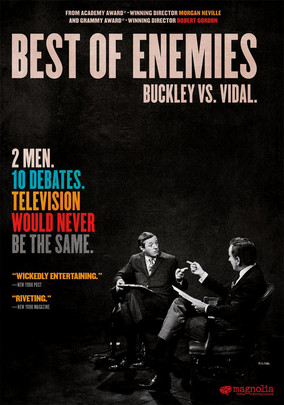
Best of Enemies-2015

Best of Enemies-2015

Director Morgan Neville, Robert Gordon

Starring William F. Buckley Jr., Gore Vidal

Scott’s Review #467

80038199

Reviewed August 19, 2016

Grade: B

Best of Enemies is a 2015 documentary that transports the viewer back to the 1960s, specifically to 1968, during the Republican and Democratic presidential primaries.

I found the documentary to be a nice little history lesson for me as 1968 was before my time and the timing of my viewing (2016) was perfect as at the time of this review we are in the midst of an intense presidential race.

This is an adequate slice of political debate and rivalry with differing ideologies among the central figures.

At that time, ABC Primetime News was a floundering network, that needed something to attract viewers and compete with competitors, the much higher-rated CBS and NBC.

This was a time when audiences had merely three networks of news offerings to choose from.

The documentary references this fact as the power of the medium of television in 1968 was quite intense and still new. I looked back fondly on the limited choices of networks then, compared to oodles of offerings now. Still, everyone watched the same programming, which elicited better conversations the next day it could be argued.

ABC concocted a scheme to bring together two bitter rivals, ultra-conservative, William F. Buckley, and ultra-liberal, Gore Vidal. The pair, obviously of differing opinions, reportedly despised each other, and the possibilities were electric.

I found the documentary very genuine. 1968 was before reality television and mock feuds to garner ratings ever existed.

Their heated debates are now legendary and there was an authenticity to them.

The documentary is told in a structured way. Buckley and Vidal faced off during ten primaries, five for the Republican primary in Florida, and five for the Democratic primary in Chicago.

Other than their blowups, the conversations crackled with intelligence, both men passionate, and well-educated in their views.

Best of Enemies also gives an overview of Vidal and Buckley and how they each had come to achieve their respective fame. Interviews with family members, colleagues, and friends are interspersed in the documentary among the constant barbs between the two as the debates ravaged on.

A moment during the final democratic debate that would cement the loathing between Vidal and Buckley for decades to come.

Continuing to debate with a snarky, condescending tone by both, tensions came to a head as Vidal referenced Buckley as a Nazi, and Buckley, in turn, called Vidal a queer and threatened to sock him in the mouth.

The hatred in the eyes of both men is legendary as their rivalry knew no boundaries. The fact that this all took place on live television (before tape delay censors) made it all the more shocking.

Strangely, the documentary uses narrated voices by Kelsey Grammar and John Lithgow for Buckley and Vidal, respectively, for a few segments. I found this rather unnecessary and even distracting. The voices surmised what each felt at the time and did not work.

This is a documentary showing the real birth of political pundits (now a dime a dozen) and the realism that television was at that time- still rather novel.

Today it is filled with outrageous people and those looking for their ten seconds of fame.

Best of Enemies (2015) shows us the authenticity of television in the early days and sadly, reminds us what it has now become.

Independent Spirit Award Nominations: Best Documentary Feature