Category Archives: Douglas Sirk

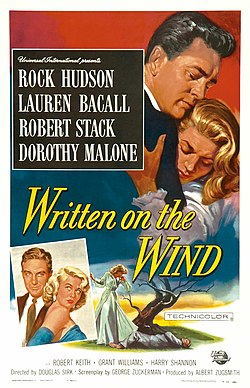
Written on the Wind-1956

Written on the Wind-1956

Director Douglas Sirk

Starring Rock Hudson, Lauren Bacall, Robert Stack

Scott’s Review #1,529
Reviewed April 20, 2026

Grade: A-

The terms ‘melodrama’ and ‘soap opera’ unfortunately come with a negative connotation, conjuring up disparaging adjectives like sappy or overwrought. Mix in poor acting, and you’ve got yourself a bad film.

But director Douglas Sirk, well known in the 1950s for his Hollywood melodramas like All That Heaven Allows (1955), Imitation of Life (1959), and Written on the Wind (1956), crafts beautiful visual effects amid powerful performances and compelling storylines.

Casting A-list movie stars only adds to the credibility.

Written on the Wind stars Rock Hudson and Lauren Bacall as complicated characters on the cusp of a relationship, but hindered by other selfish characters determined to achieve their own romantic desires.

Hudson starred in an impressive six Douglas Sirk films while Bacall’s career was beginning to wane, leading her to accept the role.

The action makes stops in New York City and Miami before settling in oil-rich Texas, where a central dysfunctional family dynasty led by Jasper Hadley (Robert Keith) is the main focus.

Hadley’s alcoholic son, Kyle (Robert Stack), is in love with Lucy (Bacall), whom he woos and marries. At the same time, Kyle’s scheming, self-destructive sister, Marylee (Dorothy Malone), has her sights set on Kyle’s childhood best friend, the dashing Mitch (Hudson), who longs for romance with Lucy.

The foursome banter, lust after, and become involved in dramatic situations, which lead to secrets and eventually death. Subjects like alcoholism, unrequited love, miscarriage, murder, and a court trial are explored.

While the situations may sound like nothing more than a sudsy afternoon daytime drama, the acting and rich writing more than raise the film above mediocrity.

The juicy sequences alone will entice the rabid viewer.

The exceptional chemistry between Hudson and Bacall is a winning formula, and viewers easily root for them to be together, and they immediately seem destined to be.  Their scenes smolder with passion and determination, but both characters are too righteous and benevolent to let anything happen.

After all, Lucy is married to Kyle, and learns she is pregnant, though she remains terribly unfulfilled.

It’s easy to like Mitch and Lucy, especially when they’re contrasted with unsympathetic characters like Kyle and Marylee. Rich and spoiled, Kyle is a lustful playboy, a womanizer, and terribly insecure and jealous.

Marylee is a boozy nymphomaniac who is callous and never satisfied.

Kyle and Marylee are not explored as much as they might have been with a longer running time, so they have hints of being one-dimensional. But both actors’ powerful performances leave audiences mesmerized by their characters.

Marylee nearly steals the show with her fiery bedroom negligee dance to a hi-fi blaring “Temptation,” while another character dies tragically a floor below.

You might say we ‘love to hate’ both characters.

Since Sirk and Hudson were both gay, though not publicly at that time (1956), keen viewers can notice hidden clues about what situations Hudson might have been facing in real life.

We can see how Hudson would have had attractive women like Marylee fawning over him and practically begging him to bed them. Unable to be receptive to their advances, instead, he would feel guilty and lonely.

Besides wonderful writing, Sirk’s direction is inspiring. The opening sequence features a clever ‘the beginning is the ending ‘ approach that many filmmakers borrowed over the years in their cinematic works.

The audience immediately sees Kyle stagger outside the palatial mansion, brandishing a gun and finally collapsing. While the wind whistles, a desk calendar is shown with the pages quickly turning to eighteen months prior when the story really begins.

This opening scene will be recreated at the end of the film, making for instant attention.

Other spicy add-ons, like fine furniture throughout the estate, a grand dinner beginning with a fruit-cocktail appetizer, more than a few sophisticated martinis served, and modern sports cars being driven, lend a robust flair of wealth and glamour to the production.

A sequence was even patterned after a flashy Manhattan nightclub named 21 Club.

For a trip into a world of wealthy yet tortured characters, Written on the Wind (1956) is top-notch. Some cliches can be forgiven, as melodrama was hardly done any better than this film.

Oscar Nominations: 1 win-Best Supporting Actor-Robert Stack, Best Supporting Actress-Dorothy Malone (won), Best Song-‘Written on the Wind.’
Imitation of Life-1959

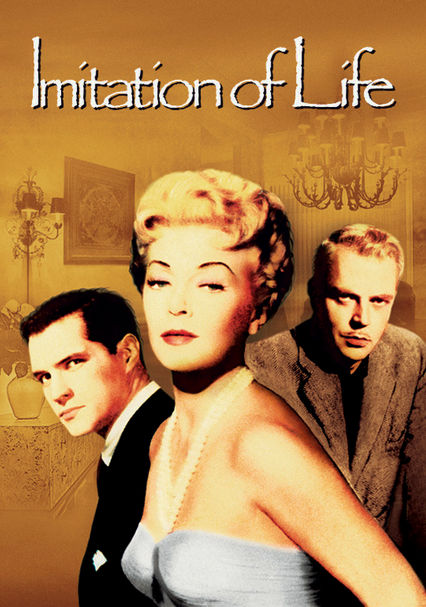
Imitation of Life-1959

Director Douglas Sirk

Starring Lana Turner, Juanita Moore

Scott’s Review #918

Reviewed July 9, 2019

Grade: A-

The original film production, made in 1934, is based on a 1933 novel by Fannie Hurst. Imitation of Life (1959) is a relevant dissection of race relations, class systems, and gender roles, all of which still feel timely decades later.

The film is a fresh, progressive effort that sometimes teeters too much into soap opera land but is an important story to be exposed to.

The dynamics between the central characters in deliciously raw scenes are the most significant part of the film.

Lora Meredith (Lana Turner) is a widowed, stylish New York woman with dreams of becoming a Broadway star. One day, she meets a lovely black woman, Annie Johnson (Moore), on the beach, and the women become fast friends, each having a daughter around the same age.

The women decide to move in together for financial reasons and to further Lora’s chances for success in the entertainment industry. Lora begins a casual romance with handsome Steve Archer (John Gavin).

Eleven years pass, and Lora is now a big star, living in a luxurious New York house and flocking to film locales in Italy. Annie continues to live with her, serving as her housekeeper and confidante.

The girls are now teenagers with issues of their own. Susie (Sandra Dee) has developed feelings for her mother’s boyfriend, while Sarah Jane (Susan Kohner), of mixed-race ethnicity, is ashamed of her black heritage and frequently can pass for white.

The trials and tribulations of all are played out throughout the film.

Imitation of Life has two key distinctions and focuses on each separately. Since the time of the story is said to be 1947 and the picture was released in 1959, before the Civil Rights movement of the 1960s, the racial story is very poignant and truthful and the main draw.

Sarah Jane is embarrassed to be black, and her eventual abandonment of both her life in New York and of her mother can be deemed reprehensible if not for the times. Her regrets come too little too late, but Kohner nonetheless infuses much sympathy into her complex role.

The second central aspect of Imitation of Life is more mainstream and dramatic, easily more accessible to the public than the former. This is why some misunderstood or even dismissed the film as melodramatic.

Lora is glamorous, well-dressed, always stylish, and poised, and soon, Susie grows jealous and resentful of Lora’s achievements and the attention she receives from men at every turn.

This invokes a female rivalry with pure 1950s Hollywood glitz. It seems manipulative and naughty, using bright colors, dazzling costumes, and flair to promote excess drama.

As tremendous as Kohner is, Juanita Moore knocks it out of the park and does the best acting job out of all the principal performers. Her frequent dramatic scenes are filled with emotional bombast without the actress ever going over the top.

Instead, she keeps her composure, earning her well-earned Best Actress Oscar nomination for no other scene than the heartbreaking mother/daughter showdown in a California hotel room.

When Moore’s Annie is mistaken for Sarah Jane’s maid instead of her mother, the pain and worry can be seen as she realizes she has lost what she knew of her daughter for good. She returns to New York an older woman with a broken heart and spirit, both defeated and deflated.

The last sequence is challenging to watch as tragic results and a coldness encompass the film.

The prevalence of more than one suitor for Lora and the implication that she could have up to three, including her agent Allen and playwright David, while Annie has none, is absorbing.

This point is slightly bothersome, and a missed opportunity—or at least the potential for one—as a male companion for Annie might have changed her life forever.

The film is faithful to the novel, but how wonderful it is to imagine Annie being treated to a more admirable life while finding true love.

Imitation of Life (1959) is a film treasure with subtle and not-so-subtle nuances and bold, powerful story-telling enveloping the entire experience.

Although the film suffers from a sometimes too sudsy mass appeal approach and too much focus on melodrama, it nonetheless does not abandon its social issues theme, especially given the harsh treatment of minorities during this period.

No other film deals with the psychological turmoil of mixed race like Imitation of Life does.

Oscar Nominations: Best Supporting Actress-Susan Kohner, Juanita Moore

All That Heaven Allows-1955

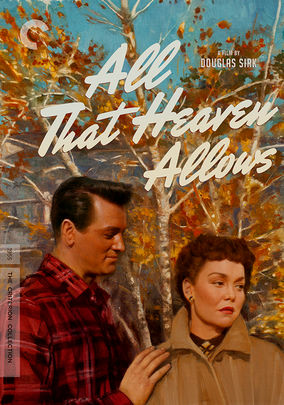
All That Heaven Allows-1955

Director Douglas Sirk

Starring Rock Hudson, Jane Wyman

Scott’s Review #159

60020660

Reviewed August 26, 2014

Grade: B+

All That Heaven Allows (1955) is a perfect-looking film. Director Douglas Sirk famously dressed his films in a contemporary, stylish fashion. As evidenced by the story in this film, his movies traditionally contain a social aspect.

Affluent socialite Cary falls in love with handsome young gardener Ron, and they face discrimination in a town where status is everything and gossip is rampant.

I love the chemistry between Jane Wyman (Cary) and Rock Hudson (Ron). The small town in New England is so perfect looking- sets, cinematography, that it fits the subject matter perfectly- most of the townspeople live these seemingly perfect lives and look down on anyone with a different outlook or way of living.

There is a feeling oozing from these people that contrasts perfectly with Ron’s open-mindedness and freedom and the conflict Cary faces.

On the one hand, she is passionate about Ron and wants to live with him; on the other, she is unsure if she wants to give up a comfortable, affluent life with perks like a social club and a beautiful house.

The chemistry between the leads is really what makes this film unique.

All That Heaven Allows (1955) influenced one of my favorite films, the masterpiece Far from Heaven (2002), which substituted the age factor for race.