Imitation of Life-1959
Director Douglas Sirk
Starring Lana Turner
Scott’s Review #918
Reviewed July 9, 2019
Grade: A-
The original film production, made in 1934, is based on a 1933 novel by Fannie Hurst. Imitation of Life (1959) is a relevant dissection of race relations, class systems, and gender roles, all of which still feel timely decades later.
The film is a fresh, progressive effort that sometimes teeters too much into soap opera land but is an important story to be exposed to.
The dynamics between the central characters in deliciously raw scenes are the most significant part of the film.
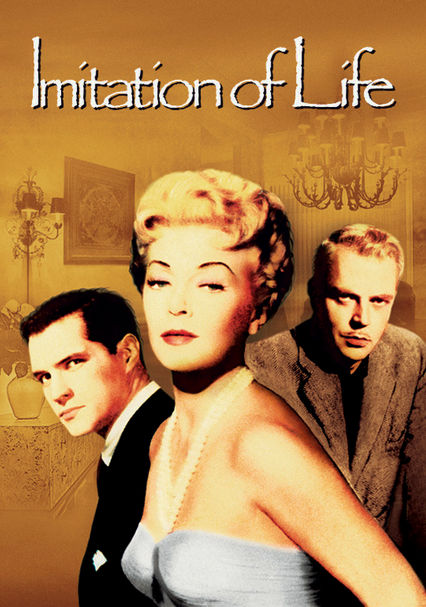
Lora Meredith (Lana Turner) is a widowed, stylish New York woman with dreams of becoming a Broadway star.
One day, she meets a lovely black woman, Annie Johnson (Moore), on the beach, and the women become fast friends, each having a daughter around the same age.
The women decide to move in together for financial reasons and to further Lora’s chances for success in the entertainment industry. Lora begins a casual romance with handsome Steve Archer (John Gavin).
Eleven years pass, and Lora is now a big star, living in a luxurious New York house and flocking to film locales in Italy. Annie continues to live with her, serving as her housekeeper and confidante.
The girls are now teenagers with issues of their own. Susie (Sandra Dee) has developed feelings for her mother’s boyfriend, while Sarah Jane (Susan Kohner), of mixed-race ethnicity, is ashamed of her black heritage and frequently can pass for white.
The trials and tribulations of all are played out throughout the film.
Imitation of Life has two key distinctions and focuses on each separately. Since the story is set in 1947 and the film was released in 1959, before the Civil Rights movement of the 1960s, the racial story is poignant and truthful and the main draw.
Sarah Jane is embarrassed to be black, and her eventual abandonment of both her life in New York and her mother can be deemed reprehensible if not for the times. Her regrets come too little too late, but Kohner nonetheless infuses much sympathy into her complex role.
The second central aspect of Imitation of Life is more mainstream and dramatic, easily more accessible to the public than the former. This is why some misunderstood or even dismissed the film as melodramatic.
Lora is glamorous, well-dressed, always stylish, and poised, and soon, Susie grows jealous and resentful of Lora’s achievements and the attention she receives from men at every turn.
This invokes a female rivalry with pure 1950s Hollywood glitz. It seems manipulative and naughty, using bright colors, dazzling costumes, and flair to promote excess drama.
As tremendous as Kohner is, Juanita Moore knocks it out of the park and does the best acting job out of all the principal performers. Her frequent dramatic scenes are filled with emotional bombast without the actress ever going over the top.
Instead, she keeps her composure, earning her well-earned Best Actress Oscar nomination for no other scene than the heartbreaking mother/daughter showdown in a California hotel room.
When Moore’s Annie is mistaken for Sarah Jane’s maid instead of her mother, the pain and worry are clear as she realizes she has lost what she knew of her daughter for good. She returns to New York an older woman with a broken heart and spirit, both defeated and deflated.
The last sequence is challenging to watch as tragic results and a coldness encompass the film.
The prevalence of more than one suitor for Lora and the implication that she could have up to three, including her agent Allen and playwright David, while Annie has none, is absorbing.
This point is slightly bothersome, and a missed opportunity—or at least the potential for one—as a male companion for Annie might have changed her life forever.
The film is faithful to the novel, but how wonderful it is to imagine Annie being treated to a more admirable life while finding true love.
Imitation of Life (1959) is a film treasure with subtle and not-so-subtle nuances and bold, powerful storytelling enveloping the entire experience.
Although the film suffers from a sometimes too-suds-like mass-appeal approach and too much focus on melodrama, it nonetheless does not abandon its social-issues theme, especially given the harsh treatment of minorities during this period.
No other film deals with the psychological turmoil of mixed race like Imitation of Life does.
Oscar Nominations: Best Supporting Actress-Susan Kohner, Juanita Moore
Golden Globe Nominations: 1 win-Best Performance by an Actress in a Supporting Role in any Motion Picture-Susan Kohner (won), Juanita Moore
