Category Archives: Beau Starr

Goodfellas-1990

Goodfellas-1990

Director Martin Scorsese

Starring Ray Liotta, Robert De Niro, Joe Pesci

Top 250 Films #46

Scott’s Review #349

70002022

Reviewed January 9, 2016

Grade: A

Director Martin Scorsese adapts Goodfellas, a crime-mob film, from Nicholas Pileggi’s 1986 nonfiction book. Pileggi helped Scorsese write the screenplay.

The film is more matter-of-fact in its telling than the purely dramatic The Godfather, with added wit and humor, and excellent editing.

Featuring powerful acting by Ray Liotta, Robert De Niro, and Joe Pesci, it is a memorable classic mob film that can be enjoyed via repeated viewings.

Largely ad-libbed, the film is rich in good dialogue and contains one of the highest totals of curse words in film history.

The film is told from the first-person narrative of the lead character, Henry Hill.

Henry, now in the Witness Protection Program, recounts his years affiliated with the mob from 1955 to 1980.

We meet Henry as a youngster in Brooklyn, New York. He is half-Italian, half-Sicilian. He idolizes the “wise guys” on the streets and intends to one day join their ranks.

From there, the film describes the trials and tribulations of Henry’s group of miscreants. Henry meets and falls in love with Karen (Lorraine Bracco), and their tumultuous love story is explored through tender moments and affairs.

What I love most about Goodfellas is the love of the characters and the sense that you are part of the action. The film is a highly stylized family drama- gritty nonetheless, but the viewer feels like they are part of things and a family member- milestones are celebrated, and meals are shared.

We see Henry grow from a teenage gullible boy who idolizes the neighborhood men to being part of the group.

The other characters, such as vicious and volatile Tommy DeVito (Pesci) and Jimmy “The Gent” Conway (De Niro), are aged and mature.

Bracco’s character is interesting. Unlike most of the female characters in The Godfather films, she is not content to merely sit on the sidelines and look past her husband’s shenanigans and torrid affairs with floozies.

She is a more modern, determined woman, and Bracco plays her with intelligence and a calm demeanor. She wants to be Henry’s equal instead of just some trophy wife.

Pesci deservedly won the Best Supporting Actor Oscar for his role; he is brutal and filthy but a mesmerizing character.

During a memorable scene, his character Tommy jokingly teases Henry, but when Henry responds in a way that displeases Tommy, the scene grows tense, and Tommy becomes increasingly disturbing.

His famous line “What am I a clown- do I amuse you?” is both clever and haunting in its repercussions.

I adore the soundtrack that Scorsese chose for the film—spanning decades, he chooses songs true to the times, such as “Layla” (1970) or “Remember (Walking in the Sand)” (1964), which are just perfect.

Worth noting is that when a scene plays, sometimes the song is mixed in with the narrative so that it enhances the scene altogether—becoming a part of it rather than simply background music.

If one is looking for the perfect mob film, one that contains music, wit, charm, and fantastic writing, Goodfellas is among the best.

I prefer The Godfather and The Godfather II, but while Goodfellas has similarities to these films, it is also completely different and stands on its own merits.

Oscar Nominations: 1 win-Best Picture, Best Director-Martin Scorsese, Best Supporting Actor-Joe Pesci (won), Best Supporting Actress-Lorraine Bracco, Best Screenplay Based on Material from Another Medium, Best Film Editing
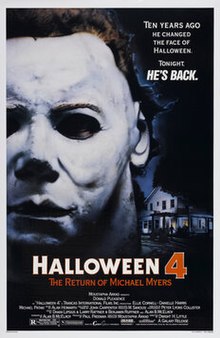
Halloween 4: The Return of Michael Meyers-1988

Halloween 4: The Return of Michael Myers-1988

Director Dwight H. Little

Starring Donald Pleasence, Ellie Cornell

Scott’s Review #1,312

Reviewed October 27, 2022

Grade: B

Give me a good slasher flick any day, and I’m a pretty happy guy.

Especially if it’s one from the Halloween franchise (my favorite series other than Friday the 13th, naturally), and viewed around the demonic holiday is the perfect flavor.

There is so much atmosphere to embrace with pumpkins, masks, and trick-or-treaters nestled seemingly safe in a small town ripe for the picking by a knife-wielding maniac.

By 1988, though, the slasher genre had severely waned, feeling redundant amid watered-down sequels and copycat patterns, resulting in a stale crop of films.

Halloween 4: The Return of Michael Myers (1988) is an okay film and a worthy entry to the franchise. It is most notable for correcting what many fans considered a terrible mistake.

Halloween III: Season of the Witch (1982) omitted maniacal Michael Myers entirely, which made many fans seethe with rage, so Part 4 corrects this miss by adding his name to the title card.

John Carpenter and Debra Hill, the main contributors to the original Halloween (1978), were not involved, so executive producer Moustapha Akkad went for a conventional, safe route, creating a standard slice-em-and-dice-em affair.

The allegedly comatose Michael Myers (George P. Wilbur) is being transferred from one hospital to another. Still, he wakes up when the ambulance crew chatters about his surviving niece, Jamie (Danielle Harris).

Out for fresh blood, he slaughters his attendants and sets out to find his one living relative, who is being cared for by a kind and resourceful foster sister named Rachel (Ellie Cornell).

Meanwhile, the ever-cautious Dr. Loomis (Donald Pleasence) remains on the killer’s path, intent on destroying the monster once and for all.

The overall tone of Halloween 4: The Return of Michael Myers is by-the-numbers, offering an experience that would satisfy only fans of the franchise and would not dare ruffle any feathers or attract new fanatics.

Even the premise of Myers escaping a hospital and targeting a family member is identical to the original film and its sequel. The familiar Haddonfield Hospital and Smith’s Grove Sanitarium return like good friends not seen for years.

There are no points given for originality, but that’s not necessarily a bad thing. After all, Halloween III tried to reinvent the wheel and was largely derided for its efforts.

I liked the film, and I like Part 4 for different reasons.

Myers is front and center with his pointy butcher knife and hulking frame, and that’s pleasing and comforting. The mask is a bit paler and his height shorter, but it’s the same Michael we all know and love.

Missing is Jamie Lee Curtis as Laurie Strode, presumed dead, but the return of Pleasence is a major win, as he takes center stage and has more screen time than he ever has as Loomis. Scarred and looking older and more withered, he is even more determined to best Myers.

In a neat little twist, Michael looks to pass his killing baton to his niece as she attempts to butcher her stepmom, similar to what Michael did to his sister many years earlier.

Borrowing heavily from its predecessors, Halloween 4: The Return of Michael Myers (1988) is satisfying but not revolutionary.

There are enough nods to history combined with a new batch of teenagers to make ground and continue the legacy.