Tag Archives: John Carl Buechler

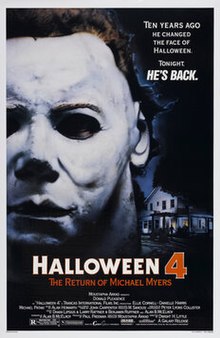
Halloween 4: The Return of Michael Meyers-1988

Halloween 4: The Return of Michael Myers-1988

Director Dwight H. Little

Starring Donald Pleasence, Ellie Cornell

Scott’s Review #1,312
Reviewed October 27, 2022

Grade: B

Give me a good slasher flick any day, and I’m a pretty happy guy.

Especially if it’s one from the Halloween franchise (my favorite series other than Friday the 13th, naturally), and viewed around the demonic holiday is the perfect flavor.

There is so much atmosphere to embrace with pumpkins, masks, and trick-or-treaters nestled seemingly safe in a small town ripe for the picking by a knife-wielding maniac.

By 1988, though, the slasher genre had severely waned, feeling redundant amid watered-down sequels and copycat patterns, resulting in a stale crop of films.

Halloween 4: The Return of Michael Myers (1988) is an okay film and a worthy entry to the franchise. It is most notable for correcting what many fans considered a terrible mistake.

Halloween III: Season of the Witch (1982) omitted maniacal Michael Myers entirely, which made many fans seethe with rage, so Part 4 corrects this miss by adding his name to the title card.

John Carpenter and Debra Hill, the main contributors to the original Halloween (1978), were not involved, so executive producer Moustapha Akkad went for a conventional, safe route, creating a standard slice-em-and-dice-em affair.

The allegedly comatose Michael Myers (George P. Wilbur) is being transferred from one hospital to another. Still, he wakes up when the ambulance crew chatters about his surviving niece, Jamie (Danielle Harris).

Out for fresh blood, he slaughters his attendants and sets out to find his one living relative, who is being cared for by a kind and resourceful foster sister named Rachel (Ellie Cornell).

Meanwhile, the ever-cautious Dr. Loomis (Donald Pleasence) remains on the killer’s path, intent on destroying the monster once and for all.

The overall tone of Halloween 4: The Return of Michael Myers is by-the-numbers, offering an experience that would satisfy only fans of the franchise and would not dare ruffle any feathers or attract new fanatics.

Even the premise of Myers escaping a hospital and targeting a family member is identical to the original film and its sequel. The familiar Haddonfield Hospital and Smith’s Grove Sanitarium return like good friends not seen for years.

There are no points given for originality, but that’s not necessarily a bad thing. After all, Halloween III tried to reinvent the wheel and was largely derided for its efforts.

I liked the film, and I like Part 4 for different reasons.

Myers is front and center with his pointy butcher knife and hulking frame, and that’s pleasing and comforting. The mask is a bit paler and his height shorter, but it’s the same Michael we all know and love.

Missing is Jamie Lee Curtis as Laurie Strode, presumed dead, but the return of Pleasence is a major win, as he takes center stage and has more screen time than he ever has as Loomis. Scarred and looking older and more withered, he is even more determined to best Myers.

In a neat little twist, Michael looks to pass his killing baton to his niece as she attempts to butcher her stepmom, similar to what Michael did to his sister many years earlier.

Borrowing heavily from its predecessors, Halloween 4: The Return of Michael Myers (1988) is satisfying but not revolutionary.

There are enough nods to history combined with a new batch of teenagers to make ground and continue the legacy.

A Nightmare on Elm Street 4: The Dream Master-1988

A Nightmare on Elm Street 4: The Dream Master-1988

Director Renny Harlin

Starring Robert Englund, Lisa Wilcox

Scott’s Review #1,030

Reviewed June 8, 2020

Grade: B-

By 1988, a tepid year in cinema, and with the slasher genre nearly dead on arrival, the release of A Nightmare on Elm Street 4: The Dream Master (1988) had the cards stacked against it.

The franchise feels tired and out of gas by this point, so more comedy and humorous lines were added, along with a return to a similar concept from A Nightmare on Elm Street 3: Dream Warriors (1987): the dream sequences.

The film is so-so, with not much that makes it stand out compared to the superior first three offerings.

Thankfully, Robert Englund is the mainstay and main attraction.

A year after the events of the previous film, Kristen (Tuesday Knight) and her friends have been released from the stifling Westin Hills sanitarium, putting the horrific events behind them.

Their attempts to resume normal teenage activities, like attending class and partying, are thwarted by Freddy Krueger (Englund), who begins infiltrating Kristen’s dreams.

As usual, a fresh batch of teenagers is along for the ride as they struggle to stay awake by watching Music Television (MTV) and revisiting the lavish junkyard featured in the previous installment.

The redundancy of another franchise film using the tired “one year later” to begin events anew is feeling like a cliché.

The main character, Kristen, played by a different actress, does not help the film; she only makes it inconsistent.

The fact that actress Patricia Arquette had little interest in returning for around two more films in the role is not the film’s fault, but a brand-new character, instead of a recast, might not have been a bad idea.

Recasting prominent roles may work in daytime soap operas but not in the movies.

A Nightmare on Elm Street 4: The Dream Master, while quite similar to its predecessor, Dream Warriors, so much so that they could easily be watched in tandem, has some positive qualities.

I love the MTV angle, the music network channel overtaking nearly every United States teenager’s living room or bedroom throughout the 1980s.

If the filmmakers wanted to get teenagers who might not necessarily watch horror films, this was a perfect marketing tool. The target audience is perfectly aligned, and the film feels fresh and relevant for its time.

The drawback to the above point is that making a film that is timely means that decades later, its risk is being referred to as “of its time”, and sadly, that is what has happened with Dream Master.

Nobody will scramble to watch this installment when other better chapters are out there. There may hardly be a reason to watch this one against you unless a Nightmare marathon is on the docket.

The junkyard set and the creepy church set are very good, so the film does well from a visual perspective.

Englund is Freddy, and his familiarity cannot be dismissed, but the actor seems to be phoning in his performance by this point in the franchise.

Finally receiving top billing, as he should, he shares his familiar witty remarks and playfully taunts his victims like a cat would before pouncing on a mouse.

The actor adds even more humor to his one-liners, but this sacrifices the horrific moments, of which there are not many. A successful horror/comedy fusion is a delicate balance, and there is not enough meat on the bone.

Entertaining at best, A Nightmare on Elm Street 4: The Dream Master (1988) is not well remembered, nor should it be. A dated affair, with emotionless teenage actors needing acting lessons and surely never to be heard from again, rounds out the cast, led by Robert Englund.

The film is a letdown because it is too much like Dream Warrior and overly predictable.

Friday the 13th: Part VII: The New Blood-1988

Friday the 13th: Part VII: The New Blood-1988

Director John Carl Buechler

Starring Lar Park Lincoln, Kevin Spirtas

Scott’s Review #551

Reviewed December 19, 2016

Grade: B-

The seventh installment of the legendary Friday the 13th franchise is enjoyable, yet predictable.

Props must be awarded to the creators for at least attempting a novel idea- this time, the “final girl” is not the damsel in distress type, but rather, gives as good as she gets.

Friday the 13th: Part VII: The New Blood (1988) is a decent offering in the horror genre and better than some of its companion films.

The main heroine is a telekinetic girl named  Tina Shepard (Lar Park Lincoln). Via flashbacks, we learn that Tina’s father had alcoholism and abused her mother.

When Tina’s telekinesis was unlocked ten years earlier, Tina caused her father’s drowning death, conveniently at Camp Crystal Lake.

Tina has harbored deep regret ever since and is now treated by Doctor Crews (Terry Kiser). The duo- along with her mother- decides to stay at the lake where a group of partying kids takes up residence next door.

None of them has any idea who Jason Voorhees is.

The beginning and end are ridiculous even by horror standards, as the action is way over the top and too convoluted to go into, but everything else is fine.

The cast seems a bit larger than in other chapters, which is great because that means more kills. Unfortunately, many of the kills have been edited to make an R rating. (I try to watch NR horror films- no edits).

My favorite kill by far is the “sleeping bag” kill. Awesome!!

Unfortunately, the DVD version of this film is severely edited from the theatrical version.

Also, Jason looks like a true monster in this one, and that is to be applauded. Stuntman Kane Hodder would begin a successful stint as the killer, and he looks the part.

Friday the 13th: Part VII: The New Blood (1988) is a fun popcorn horror flick.