Tag Archives: Alfred Hitchcock

Lifeboat-1944

Lifeboat-1944

Director Alfred Hitchcock

Starring Tallulah Bankhead, William Bendix

Scott’s Review #1,020
Reviewed May 6, 2020

Grade: A-

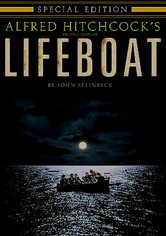
Alfred Hitchcock, well-known for big, bouncy, suspenseful productions, creates a stripped-down, intimate story of adventures while adrift on a survival boat, leaving plenty of tension and peril.

Lifeboat (1944), now teetering on extinction from memory save for fans of the director, deserves appreciation and respect for the brilliant direction and outstanding cinematography alone.

The film was met with controversy and some derision for sympathetic depictions of a German U-boat captain (Walter Slezak) amid the horrors of World War II.

Events begin in the middle of calm Atlantic Oceanic waters after a cruel battle results in a German U-boat and a British/American ship sinking each other, leaving fewer than a dozen civilians and service members to survive in one Lifeboat.

The haughty, glamorous columnist Connie Porter (Tallulah Bankhead), clad in the finest fur coat, is irritated by a run in her stocking, a travesty in her mind.

She is slowly joined by other survivors, including a young British woman with a dead baby, a steward, a U.S. Army nurse (Mary Anderson), a wealthy entrepreneur, and other people from most walks of life.

Lifeboat plays out like a more cerebral version of a disaster film. Think- a brilliant man’s version of The Poseidon Adventure (1972), said with love since it’s one of my favorite films. But with Lifeboat, darkness and a sense of sadness are missing from the 1970s’s more lightweight disaster films.

The black-and-white camerawork helps tremendously, as do the mist, the rain, and the intense beating sun. The weather elements play an essential role, as do the characters themselves.

Speaking of characters, the individuals are plentiful and diverse, ranging from British, American, Black, German, wealthy, and working-class to eventually dead and alive with a gruesome leg amputation taking place mid-stream.

Each is well-written and exhibits fear, bravery, and suspicion of the other’s motivations. The German captain communicates with Connie in his native tongue, causing confusion among the other survivors.

Events would hardly be complete without a good melodramatic romance, and it is a treat to see two formulate. Connie and handsome John (John Hodiak) share a love/hate relationship, clearly from opposite backgrounds, while the more stable Alice and Stanley (Hume Cronyn) even decide to marry!

Genteel Alice reveals a marriage and an affair to Stanley, uncovering the layers and complexity of the character.

My favorite character is Connie, and Bankhead is a pure delight in the bitchy, no-nonsense role. She enshrouds the camera from the first scene.

Reminiscing about Bette Davis, the actress has a similar composure, stance, and trademark cigarette but slowly reveals her insecurities and desperation.

What fun she is to watch!

A tender and poignant scene occurs at the end of the film and is lovely to witness, especially given the tumultuous time of the mid-1940s. A drifting young German soldier attempts to board and shoot at the survivors but is apprehended.

Disputes occur, but instead of shooting or casting the lad overboard to drown, he is saved and presumably provided food and water. Does he inquire why they don’t kill him? The message is powerful and anti-war.

The direction methods are brilliant, and they look as realistic as possible in 1940s cinema, where CGI was decades away. Hitchcock had me fooled as I bought lock, stock, and barrel that the Lifeboat was in the middle of rough and murky waters instead of a Hollywood studio tub.

The creative method of gathering so many characters into one shot wonderfully and effectively provides a claustrophobic feel, as the lack of food and drinking water causes hysteria and emotion.

The one-set approach is marvelous and perfect for the film’s specific storyline.

After decades of underexposure and playing second or third fiddle to other Hitchcock masterpieces, Lifeboat (1944) is finally getting some notice and acclaim. The trend continues here, as the film contains enough frights and perils to keep anyone guessing which characters will sink and which will swim.

Although it may not be the best watch on a cruise ship or other watery surfaces, the escapade will delight fans of classic black-and-white thrill cinema.

Oscar Nominations: Best Director- Alfred Hitchcock, Best Original Story, Best Cinematography, Black-and-White

I Confess-1953

I Confess-1953

Director Alfred Hitchcock

Starring Montgomery Clift, Anne Baxter

Scott’s Review #1,007

Reviewed April 2, 2020

Grade: A-

I Confess (1953) is an early effort by the brilliant Alfred Hitchcock with a decidedly religious slant but keeps the suspense and thrills commonplace like his other films.

The picture is not one of his best-remembered works but one of his least-remembered projects. This is unwarranted because the film contains all the standard elements known to the director, creating an entertaining and enthralling effort.

Montgomery Clift and Anne Baxter are featured as big Hollywood stars of the day.

Although he was not a fan of exterior shoots where he couldn’t control the elements, filming was done mainly on location in Quebec City. Numerous shots of the city landscape and interiors of its churches and other emblematic buildings, such as the Château Frontenac, were heavily featured.

This factor adds to the enjoyment as French sophistication and culture are added, and the accents provide a European influence, which is especially powerful during the final act.

A handsome Catholic priest, Father Michael Logan (Clift), wants nothing more than to be a good priest, but his calling is made complicated after someone confesses a murder to him, and he’s subsequently blamed for the death.

A World War II veteran, he harbors secrets told in the back story as a strong connection to another character comes to light. An easy way to clear his name is to reveal exactly what he knows, but doing so would break his vows as a clergyman and alienate members of his community who trust he will keep their steamy secrets very private.

Ruth Grandfort (Baxter) is a respected member of society, married to her husband Pierre (Roger Dann), a member of the Quebec legislature. They live comfortably in a lavish house with servants and regularly throw cosmopolitan parties befitting people of their stature.

Amid martinis and festive party games, Ruth keeps not one secret but two and is being blackmailed for her shenanigans. Her connection to Father Michael slowly bubbles to the surface.

Christian viewers will neither be offended nor completely embraced either. Hitchcock does not mock religion but makes sure of the conflict and demons that can encircle even a pious or righteous man.

As far back as the 1940s, Rebecca was toying with viewers and frequently adding an LGBTQ uncertainty; this can be said of I Confess.

Assumed to be in love, Father Michael offers little romantic passion or zest towards Ruth, and the connection seems one-sided. Could his descent into the Catholic Church be a front to cover up his sexuality?

Only Hitchcock will know the answer.

Eagle-eyed Hitchcock fans will undoubtedly discover similarities to his other works.

In the very first scene, an unknown man is strangled to death, collapsing to the floor. This is reminiscent of the 1948 masterpiece, Rope (1948), when an identical sequence occurs. The audience knows nothing about the stranger- yet.

In both films, even after death, the character becomes integral to the plot twists and turns in store. The tremendous use of shadows and lighting is on careful display, mirroring the look of the soon-to-come The Wrong Man (1956).

While not the cream of the crop among Hitchcock’s best film entries or even a top ten offering, I Confess (1953) deserves a viewing or two on its own merits.

Clift and Baxter have excellent chemistry and mystique, and the plot is enough to keep audiences well-occupied.

The final twenty minutes provide cat-and-mouse revelry and a shocking death, perfect for a dramatic climax to a film oozing with Hitchcock’s finest traits.

Hitchcock/Truffaut-2015

Hitchcock/Truffaut -2015

Director Kent Jones

Starring Wes Anderson, Martin Scorsese, David Fincher

Scott’s Review #933

Reviewed August 21, 2019

Grade: B+

A documentary about film and film-making is a worthy watch for any rabid lover of cinema, and when the subject at hand is Alfred Hitchcock, any fan must certainly chomp.

I remember Hitchcock/Truffaut (2015) appearing at my local independent theater at the time of release but missed my chance to see it.

The misstep having been undone, the work is fine, and the result is an abundance of riches, serving as a fly on the wall for those wishing to listen to two geniuses speak, or merely observe the clips of great films and revel in the creativity.

Already possessing a hefty knowledge of Hitchcock does not dull my perspective, nor do I take for granted the appreciation served.

For an entry-level fan of the director or French film director, Francois Truffaut, the title must be added to one’s “to see” list.

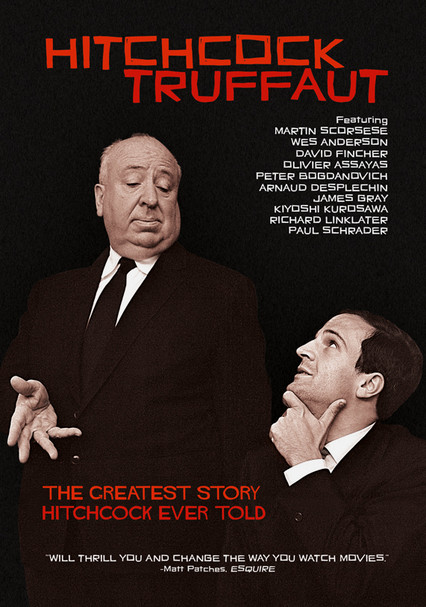
The documentary serves as inspiration and fulfillment for cinema lovers. Billed as side-by-side directors in the title, the documentary treats Hitchcock as the teacher and Truffaut as the student, especially given the age difference between the two men.

Truffaut interviewed Hitchcock in 1962 during a lengthy week-long discussion in a windowless Hollywood office, where the former soaked up the latter’s knowledge and points of view like a sponge.

Truffaut was already a well-regarded filmmaker at age thirty-two, with gems such as The 400 Blows (1959) already under his belt.

Truffaut then wrote a book about the conversations with Hitchcock, and director Kent Jones brings it to life in documentary form, telling his audience why the book had a tremendous impact on cinema while teaching the audience a thing or two about the movies.

The production analyzes film-making from technique to style to clothing, actors, and in between. The main crux is the technique Hitchcock used to create tension and suspense, manipulating the audience every step of the way.

A plethora of his films are featured which is a personal joy to see, most importantly the documentary is clever enough to build to Hitchcock’s most memorable sequence of all, the shower sequence in Psycho (1960), the director’s most recent film, and now, easily his most notorious.

Hollywood titans such as Martin Scorsese, David Fincher, Wes Anderson, and Richard Linklater, arguably geniuses, explain the influence that Hitchcock provided them.

Listening to these formidable directors whimsically praise and dissect Hitchcock’s analysis and explain how he led to their blossoming is a wonderful aspect.

Hitchcock/Truffaut (2015) is a treat for die-hard fans of Hitchcock or Truffaut- or both.

Conversations and interviews with other famous directors show the heavy influence, love, and appreciation for an ingenious suspense director and an equally unique French New Wave director.

A thirty-two-year age difference separated the two men, but they appear as natural as close colleagues.

Great minds do think alike.

Family Plot-1976

Family Plot-1976

Director Alfred Hitchcock

Starring Bruce Dern, Karen Black

Scott’s Review #99

60020560

Reviewed July 9, 2014

Grade: B

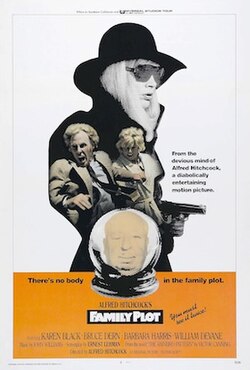
Family Plot is sadly Alfred Hitchcock’s final film, made in 1976.

It is certainly not one of his greats, but not bad either, and a fitting way for a viewer to conclude his career.

The film is a jewel caper and has a vastly different feel from many of his other, earlier films. It has a slick quality to it and is reminiscent of a 1970s television movie, which is not a knock.

It simply feels more television-like than film, which likely could be because the film stars notable television stars, William Devane and Katherine Helman.

It also features some big film stars of the time- Karen Black, Bruce Dern, and Barbara Harris.

The film is a departure from other Hitchcock films in that it is a macabre comedy. It is a tongue-in-cheek story of a fake psychic (Harris) and her boyfriend (Dern) who become involved in a search for a missing heir, a jewel heist, and a murder.

All of the characters intersect as the film moves along and it contains some nice Hitchcock elements- the speeding car with no brakes down a hilly road is pure Hitchcock.

The film, for me, has a slightly melancholy feel as sadly, it is the great Hitchcock’s final farewell.