Category Archives: Kirsten Dunst

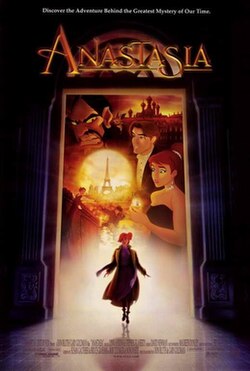
Anastasia-1997

Anastasia-1997

Director Don Bluth, Gary Goldman

Voices Meg Ryan, John Cusack

Scott’s Review #1,530
Reviewed April 27, 2026

Grade: B

Anastasia (1997) is an animated film that explores emperors, duchesses, and the Romanov royal family of Russia, offering an important early-twentieth-century history lesson.

Surprisingly, not a Disney film, it’s the first release from Fox Animation Studios, resulting in an overall decent effort. It has potency but lacks the magic of other darling animated creations of the past.

An evil and vengeful wizard named Rasputin (Christopher Lloyd) casts a curse on the royal family as a dazzling ball commences in 1916, and young Anastasia disappears as their palace is overrun by killers, leaving most of the family dead.

She and her grandmother, whom she eventually is separated from when the Dowager Empress Marie (Angela Lansbury) flees on a train, are saved by a mysterious servant boy who whisks them to a secret room.

Years later, the Grand Duchess offers a reward for Anastasia’s return, but finally gives up amid a legion of imitators and attempted schemers, leaving her flustered and hopeless.

Two Russians, Dimitri (John Cusack) and Vlad (Kelsey Grammer), initially plan to pawn off a phony discovered through auditions, but are shocked to learn that an orphan girl named Anya (Meg Ryan) is the real Anastasia.

Dimitri, who has fallen in love with Anya, is torn between his feelings and a potentially lucrative payday.

The film’s wintry backdrop is visually exquisite, with snow, lights, and the glitz and glamour associated with Paris, setting the story in Saint Petersburg and launching the action amid fabulous costumes and palace trimmings at the ball.

A dangerous train ride from Saint Petersburg to the east, winding up in Paris, is also a high point of the film.

The central characters, Anya, Dimitri, and Vlad, escape terrible fates that the evil Rasputin is plotting against them. They slink from first class to the luggage car to finally leap from the train itself in a daring escape.

They then stowaway on a ship bound for Paris.

The trio’s adventures make the film enjoyable and edge-of-your-seat at times.

Another highlight is a compelling sequence in which Rasputin gets Anya to sleepwalk to the edge of the ship, attempting to make her jump to her death. She sees her dead siblings in a sunny pool of warmth as they invite her to dive in and join them.

The glowing, hallucinogenic interplay of summer sun and winter-driving rain aboard the ship is both majestic and frightening. It also shows the connection between her and her siblings, as well as feelings of loss.

I wasn’t entralled with the characters of Rasputin or the hapless Bartok (Hank Azaria), a minuscule albino bat sidekick, who eventually ‘turns good’.

Rasputin, stuck in a mysterious limbo until he kills off the remaining Romanov (Anya), is portrayed as cartoonish and over-the-top. His threats become redundant, as does his one-note nature.

The characters’ situation is complicated by a weird situation in which, because of foiled attempts on the lives of Dimitri, Vlad, and Anya, they are forced to return to the ‘real world’ and kill Anya there.

It makes little sense, feels juvenile, and the characters were wisely omitted from the stage version.

The musical numbers are charming, but they do not knock it out of the park. Tepidly nominated for an Oscar nomination, “Journey to the Past” is okay, but nothing memorable either.

What works best is the romance between Anya and Dimitri, who have tremendous chemistry. Since he is immediately smitten with her, it is interesting to see how the film handles the eventual revelation of his villainy and his subsequent redemption.

Since it’s clear the film will have a ‘happily ever after’ ending, the anticipation of a final showdown reduces some of the predictability.

The reunion between Anya and her grandmother is touching and sentimental without being too mushy. Even in an animated film, powerful performances can be achieved, and the characters can touch their audience as much as a live-action film.

An entertaining film with heart and a intellectually stimulating backdrop, it has enough to recommend to children and adults alike. I could have done with a better villain or perhaps no villain at all, which makes Anastasia (1997) feel more juvenile and less sophisticated than it should have been.

Oscar Nominations: Best Original Musical or Comedy Score, Best Original Song-“Journey to the Past”
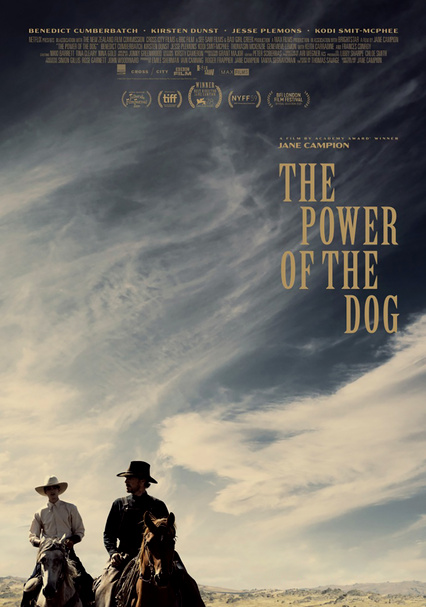
 

The Power of the Dog-2021

The Power of the Dog-2021

Director Jane Campion

Starring Benedict Cumberbatch, Kirsten Dunst, Jesse Plemons

Top 250 Films #134

Scott’s Review #1,199

Reviewed November 21, 2021

Grade: A

Benedict Cumberbatch delivers a harrowing and brutally honest performance in The Power of the Dog (2021), a thought-provoking and layered film by Jane Campion. Parts western, gothic, and drama, Cumberbatch leads the charge, but all players associated with the film knock it out of the park.

If the superior acting is not enough, the eerie subtext and gorgeous cinematography firmly place the viewer in 1925 Montana, where a vast and open range serves as the primary setting. Characters are riddled with secrets, and the fun lies in peeling back the layers to reveal their motives and true desires.

There are enough bare male butts to titillate most viewers, and Cumberbatch himself did not use the aid of a body double. He stated he wanted to be as raw and vulnerable as his character, the dastardly and cruel Phil Burbank.

Campion, who hasn’t made a film in over a decade, is back with a vengeance, paying homage to Ang Lee and his movie Brokeback Mountain (2006).

From the first moment on screen, we know something is mesmerizing about Phil. He is handsome and severe, an alpha male if there ever was one, and attributes his savvy to his deceased father figure, Bronco Henry. His relationship with this man is key to the whole story.

Along with his brother George (Jesse Plemons), the Burbank brothers are wealthy ranchers. One day, at the Red Mill restaurant on their way to market, the brothers meet Rose (Kirsten Dunst), the widowed proprietress, and her impressionable and effeminate son Peter (Kodi Smit-McPhee).

Phil behaves cruelly to Rose and Peter, but George becomes enamored with Rose and they marry, much to Phil’s chagrin. Now all living together, Phil taunts Peter and terrorizes Rose, but slowly begins to take the boy under his wing.

But what are his true intentions, and what will Peter do to save his mother from a complete breakdown?

The acting is so brilliant that I immediately became immersed in their lives. Particularly fascinating is Phil, but Rose, George, and Peter are all substantial characters. All the characters intertwine and have special relationships with each other, and all the principal actors are central to our fascination with them.

Rose may be Dunst’s best role yet, and Plemons is terrific as the kind and steady George. Smit-McPhee, unknown to me, is a revelation as the androgynous young intellectual.

There are enough homoerotic scenes to make the viewer question Phil’s sexuality. His secret stash of strong man magazines and his long gazes at nude male sunbathers may be enough to unlock the key. Still, when he rubs a handkerchief belonging to Bronco all over his body, the relationship between the two men oozes to the surface.

Campion has a lot of guts in taking on the male-driven western genre, and she brilliantly succeeds. Forgetting the storyline for a moment, the ravishing and oftentimes lonely landscape makes the film gorgeous to look at, especially on the big screen.

Plenty of long shots of the mountainous regions will inevitably captivate viewers and transport them to a bygone era.

The Power of the Dog was shot in New Zealand, but I was completely fooled into thinking Montana was the real filming location.

I adored seeing the costumes, whether it be Rose in a housedress or more distinguished characters like the governor and his wife dressed for a dinner party. All costumes appear authentic, peppered with a touch of glamour amidst the dirtiness of the range. Even the grubby ranch hands look great.

Discussions will certainly erupt once the film ends, and isn’t that the point of great films? The Power of the Dog (2021) takes the tried-and-true Western genre and infuses it with psychological depth.

Thanks to Campion and the team, she masterfully uses no gimmicks to draw the viewer into the world of the characters, instead offering authenticity and edge-of-your-seat drama.

Oscar Nominations: 1 win-Best Picture, Best Director-Jane Campion (won), Best Actor-Benedict Cumberbatch, Best Supporting Actor-Kodi Smit-McPhee, Jesse Plemons, Best Supporting Actress-Kirsten Dunst, Best Adapted Screenplay, Best Film Editing, Best Cinematography, Best Production Design, Best Original Score, Best Sound

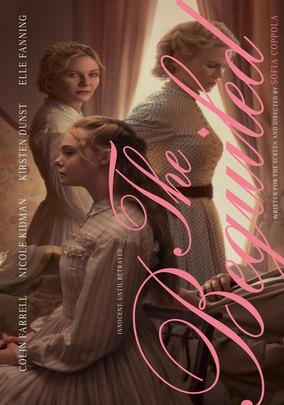
The Beguiled-2017

The Beguiled-2017

Director Sofia Coppola

Starring Nicole Kidman, Colin Farrell, Kirsten Dunst

Scott’s Review #659

Reviewed July 4, 2017

Grade: A-

A remake of the 1971 film (also adapted from an earlier novel) starring Clint Eastwood, The Beguiled is a 2017 release directed by Sofia Coppola (Lost in Translation, 2003), a director ready to burst onto the front lines.

Coppola carefully chooses her films, but each differs from the others, and The Beguiled is no different. A piece fraught with atmosphere and tension, Coppola does wonders from a directing standpoint.

The story has tons of unchartered potential and drags at times, but overall, The Beguiled is a hit if nothing more than to look at in wonderment.

The film gets off to a moody start as we follow a young girl, eerily humming as she picks mushrooms, along a deserted southern road. It is Civil War times (1864), and the setting is a mostly deserted all-girls boarding school in south Virginia.

The girl (Amy) is startled when she discovers an injured, handsome Union Army soldier, Corporal John McBurney (Farrell). Sympathetic, Amy helps the soldier back to the school, led by the headmistress, Martha Farnsworth (Kidman).

Slowly, the females in the school become enamored with John, developing rivalries to gain the upper hand in his affections.

There is something sinister and wickedly foreboding about almost every scene, as we shrink at the thought that something terrible will happen at any moment—sometimes it does, and sometimes it does not.

Almost like a horror film would, the camera angles are such that something or someone is bound to leap out and grab a character suddenly.

The colors are muted and almost pastel, and fog commonly floats through the exterior scenes.

Coppola does a fantastic job of portraying a deserted southern landscape. The film’s lighting is also intriguing, as lit candles enhance the dimness.

The final dinner scene (poison mushrooms, anyone?) is gloomy and Shakespearean.

Beyond the look of the film, The Beguiled is well-acted. With heavyweights like Farrell, Kidman, and frequent Coppola star, Kirsten Dunst, as the vulnerable and unhappy teacher, Miss Morrow, the acting is stellar and believable.

The audience is unsure if John is manipulating the women for his gain or if he has developed feelings for any (or all) of them.

With hormones raging, the lovesick teen, Alicia (Elle Fanning), sets her sights on John almost from the beginning, sneaking out of musical lessons to kiss an unconscious John goodnight.

While compelling, the story is relatively slow-moving, leaving the reader with infinite possibilities when the conclusion finally happens. Other than the tart Alicia, Miss Morrow and Miss Farnsworth could have reached endless romantic potential.

I was left wondering throughout the film when a romance would develop between Martha and John, but only towards the end was this ever addressed and barely skirted over. Stoic Martha slowly began to let her guard down as they took charge.

The film could have added some further romantic complications and beefed up the very short running time of ninety-three minutes.

As Nicole Kidman is one of my favorite film stars of all time (she can tell a story by facial expressions alone), she has wisely begun to choose fantastic supporting roles as she ages in Hollywood (2016’s Lion immediately comes to mind).

Dunst has aged gracefully into a middle-aged actress chomping at the bit for meaty roles, and Colin Farrell is as ruggedly handsome as ever, sprouting a dark and bushy beard for most of the role.

The acting in The Beguiled is fantastic.

The Beguiled is a film to watch if only to escape to the joys of superb, atmospheric filmmaking and to appreciate the outstanding talents of one of the few prominent female directors of today (hopefully, the mega success of 2017’s female-directed Wonder Woman will begin to change this).

The story has a few issues, but The Beguiled (2017) is worth the money.

Hidden Figures-2016

Hidden Figures-2016

Director Theodore Melfi

Starring Taraji P. Henson, Janelle Monae, Octavia Spencer

Scott’s Review #619

Reviewed February 26, 2017

Grade: A-

Hidden Figures (2016) is a mainstream, “Hollywood” style film produced, written, and acted very well.

The film tells the story of three female African American mathematicians who faced many struggles and were somewhat overlooked in the early 1960s.

The women achieved historical success and allowed John Glenn to orbit planet Earth.

From a film perspective, the story is feel-good but not contrived. It feels quite fresh and features an excellent ensemble cast with good chemistry.

I enjoyed this film immensely.

Blessed with good smarts, Dorothy Vaughan (Spencer), Mary Jackson (Monae), and Katherine Johnson (Henson) were fortunate enough to work for the Langley Research Center – in 1961.

In those days, segregation still existed, and the women worked as temporary workers and used separate “colored” bathrooms and were largely excluded from the white workers.

The three women are best friends and drive to work together- each has an individual specialty, and the film focuses on each woman’s story.

The more prominent role and main story are about Katherine. Since the Russians had already achieved success in outer space, the race was on for the United States to follow suit. Katherine is assigned as a “computer” in the Space Task Group, led by Al Harrison (Kevin Costner).

Initially, Katherine is dismissed by her colleagues but eventually is accepted due to her smarts.

In subplots, Dorothy struggles to be given a Supervisory position. Mary aspires to be the first female engineer despite needing to enter an all-white school to take the necessary classes.

My favorite of the three performances is Taraji P. Henson.

The actress impresses with her spunky, well-mannered portrayal, specifically her fantastic scene when she has had enough of the segregation and difficulty performing her job.

She loses it in front of the entire team and rails against them- expecting to lose her job, instead, her boss Al, (a fantastic nice-guy role for Costner), sees her point and declares NASA will see no distinction of color.

Henson is the lead actress in the film and carries it well.

The chemistry between the three actresses makes Hidden Figures work so well and appear believable. The women always have each other’s backs and are friends outside of work, attending church and picnics together.

The film is wise to feature women’s lives outside of their professions.

A nice side story of single mother Katherine (her husband, who has died) meeting and being courted in lovely fashion by handsome National Guard member Jim Johnson (Mahershala Ali) is a sweet story, genuinely told.

The two also have nice chemistry together.

The film’s finale, as the attempted launch of John Glenn is met with problems, is compelling. Due to their genius of Katherine, she must save the day as Glenn trusts only her judgment and calculations of the ever-so-important numbers.

The scene is a “just desserts” moment for Katherine as the country rallies patriotically behind the events.

Hidden Figures plays it safe, and the actual struggles of the real women undoubtedly had darker and meaner situations, as the discrimination they faced had to have been more intense.

Still, the film strives to downplay some of the grit in favor of light-hearted, crowd-pleasing fare, but I fell for it hook, line, and sinker and enjoyed the film ride that I was given.

Oscar Nominations: Best Picture, Best Supporting Actress-Octavia Spencer, Best Adapted Screenplay

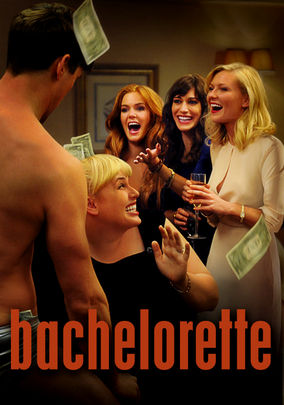
Bachelorette-2012

Bachelorette-2012

Director Leslye Headland

Starring Kirsten Dunst, Isla Fisher

Scott’s Review #22

70227645

Reviewed June 17, 2014

Grade: D

I’m not sure how to pinpoint exactly what is wrong with Bachelorette (2012) except for just about everything.

It tries to be a Bridesmaids (2011) meets Hangover (2009) copycat but fails miserably. What made those films entertaining was that they were funny.

This film attempts many jokes and falls flat almost every time. The set-ups are there, but there is no follow-through.

Almost every character is unlikable and hateful to everyone else and there is nobody to root for.

Worse yet, the film is bland. Dumb comedies are not my favorite genre, but this was lackluster.

I adore Kirsten Dunst, but sadly she picked a dud she’s likely soon to forget. Isla Fisher seems to always be in films like this and the male actors (James Marsden, Adam Scott) have little to do.

The talented cast is wasted and Bachelorette (2012) is not worth seeing.