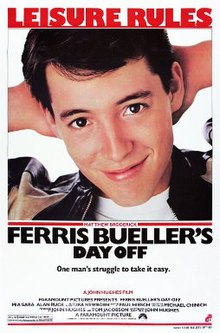
Ferris Bueller’s Day Off-1986
Director John Hughes
Starring Matthew Broderick, Alan Ruck
Scott’s Review #1,396
Reviewed September 7, 2023
Grade: B
Ferris Bueller’s Day Off (1986) is one of the best-known films in John Hughes’s collection of 1980s teen coming-of-age comedies.
On par with The Breakfast Club (1985) and Pretty in Pink (1986) in name recognition memory banks, especially for teenagers growing up in this decade.
Iconic moments like Ben Stein’s teacher’s monotone attendance roll call, the repeated phrase ‘Bueller’, and the term ‘Save Ferris’, which became the name of an alternative rock band, are legendary.
The film has its moments of creativity, and Matthew Broderick’s portrayal of the title character was charming and star-making.
Watching the film, though, decades later, the slapstick feels overwhelming to the drama, and there isn’t much angst like in other Hughes films.
There isn’t much deeper meaning beyond one day to skip school and go on an adventure.
This makes Ferris Bueller’s Day Off fun and lighthearted, but silly compared to more mature Hughes efforts. The film is about being young, free, and having fun, but not much more, and the hijinks between the students and the authority figures sometimes feel tired.
Ferris Bueller (Broderick) is brilliant at skipping school and getting away with it despite being an intelligent student. He causes the high school principal, Rooney (Jeffrey Jones), much irritation and ultimately pursues him to catch Ferris in the act.
The young man plans one final outing before graduation with his best pal Cameron (Alan Ruck) and his girlfriend Sloane (Mia Sara). They ‘borrow’ Cam’s father’s expensive Ferrari and journey through the streets of Chicago.
Ferris’s sister, Jeanie (Jennifer Grey), seethes with rage at her brother’s antics while their successful but dimwitted parents, Katie (Cindy Pickett) and Tom (Lyman Ward), remain clueless.
The film’s strengths are the frequent shots of Chicago and of Broderick himself, which elevate it above mediocrity decades after its initial release.
Broderick followed in the footsteps of contemporaries like Michael J. Fox and Emilio Estevez as the cool, likable all-American boy next door. His performance makes the film better than it might have been, and the fun is watching him outwit rivals like the principal and other villains he encounters.
Hughes creates a nice ‘day in the life’ style that follows the characters from early morning until evening, which keeps the events contained well.
A high point of the film, and where it picks up steam, comes when the gang reaches Chicago. We suspect the teenagers, while they skip school via fibs, merely have a case of ‘senioritis’ and are otherwise superior students. This is confirmed by the sophisticated and intellectually stimulating places they visit.
They have lunch at a swanky French restaurant and visit the world-renowned Art Institute of Chicago for good old-fashioned culture. Not to appear too snobby, they hobnob with blue-collar folks at an afternoon Cubs baseball game.
Where Ferris Bueller’s Day Off feels dated is with the ditziness of Ferris’s parents. The teen easily bamboozles his parents with his feigned illness, and when his father notices Ferris in a nearby taxi cab, he shrugs it off as his imagination.
The most laughable instance of the parents’ cluelessness is when mom Katie, in the passenger seat, appears not to notice her son running in front of their car when sister Jeanie slams on the brakes. She instead scolds Jeanie for driving recklessly.
These and other setups involving the over-the-top principal feel more like cliches than genuine laugh-out-loud moments. But this was common in 1980s comedies.
Ferris Bueller’s Day Off (1986) feels fresh in some parts but dated in others, making the experience humorous but hardly legendary.
Whereas The Breakfast Club holds up very well, this film doesn’t hold up as well.