Tag Archives: Patrick Allen

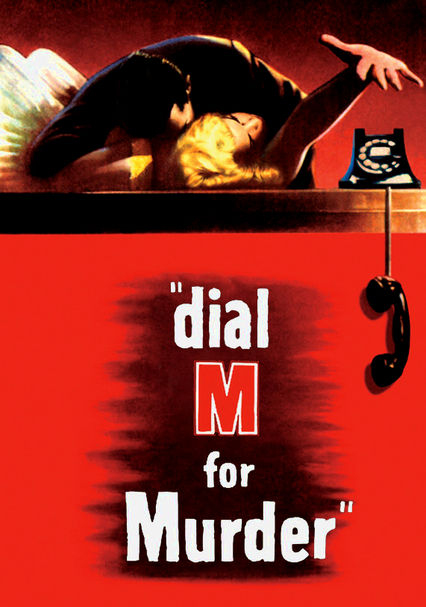
Dial M for Murder-1954

Dial M for Murder-1954

Director Alfred Hitchcock

Starring Ray Milland, Grace Kelly

Top 250 Films #120

Scott’s Review #995
Reviewed February 28, 2020

Grade: A

A fabulous offering by stylistic director Alfred Hitchcock, Dial M for Murder (1954) arrived on the scene when the cinematic genius was at the height of his success in the United States, following his success in England.

The late 1950s and early 1960s revealed his best offerings, but this is no slouch. The film mixes thrills, double-crosses, and murder in a way only Hitchcock can —perfectly.

It is fast-paced and shot almost like a play, using primarily one set. It is based on the Broadway hit, which came first.

An English former tennis champion, Tony Wendice (Ray Milland), hatches a scheme to kill his wealthy but unfaithful wife, Margot (Grace Kelly), who’s embroiled in a liaison with handsome writer Mark Halliday (Robert Cummings).

When Tony’s plans go awry, he attempts the second act of deceit, but events spin out of control when Margot, Mark, and a sly Scotland Yard inspector (John Williams) begin putting the pieces together.

The film is popular because of its conventional, pure Hitchcock story. The viewer immediately knows who the killer is and his motivations—his hunger for wealth and jealousy of another man.

The most fun is when hiccups begin to form, and Tony must fly by the seat of his pants to cover his tracks and think of another way to seal Margot’s fate. If he cannot murder her, why can’t he send her to prison?

Milland is perfect in the role with eye shifts and head turns.

Set pieces, such as a key and a handbag, add zest to the film. The plot gets juicier and juicier when it is revealed that there are multiple keys. The flat where Tony and Margot reside is beautifully designed with state-of-the-art furniture and decorations, making the set a character.

Lavish curtains and French doors are utilized during the late-night attempted murder scene, which is thrilling to witness, leaving the viewer with heart palpitations.

The brilliance is that the viewer does not intend to hate Tony, at least not this viewer. While he is not likable, his motivations can be somewhat understood. Conversely, Margot and Mark are not heroes; their shenanigans come back to haunt them.

I dare say that Grace Kelly has had better roles in Hitchcock films. To Catch a Thief (1955) immediately comes to mind. Margot is not a particularly strong character and is relatively weak.

Dial M for Murder has commonalities with two other Hitchcock gems. As with Strangers on a Train (1951), a tennis star is utilized as a significant character, and twisted strangulation is the game. Also, a tit-for-tat technique is used.

Like the underappreciated Rope (1948), the one-take sequence style and the film’s potential as a stage play are noticeable traits. Those films are good ones to be in the same company with.

The final thirty minutes pass at breakneck speed as we wonder what will happen next. The cat-and-mouse activities are delightful and remind us that the film is essential and stripped down compared to his later films.

One set, good actors, and a full-throttle story do wonders to satisfy a fan. The camera movements and techniques are key to the entire film, as a shot here or there is timed with flawless precision. Hitchcock used 3-D filming, which was inventive for the time.

Although perhaps not as famous as Hitchcock’s delights like Psycho (1960), Vertigo (1958), or North by Northwest (1959), Dial M for Murder (1954) serves as much more than a warm-up act for those classics.

This film is one to remember with a fast pace, twists and turns, and good British sensibilities. Its setting is a stylish London flat, and the sophistication is suitable.
Never Take Sweets from a Stranger-1960

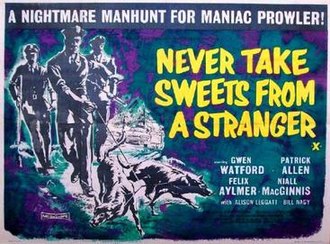
Never Take Sweets from a Stranger-1960

Director Cyril Frankel

Starring Patrick Allen, Gwen Watford

Scott’s Review #900

Reviewed May 17, 2019

Grade: A

Never Take Sweets from a Stranger (modified to Never Take Candy from a Stranger in the US for marketing purposes) is a 1960 British film directed by Cyril Frankel and released by Hammer Film Productions.

The film contains brilliant cinematography and cerebral quality, and it is pretty daring for the time it was made. It combines a story of pedophilia with manipulations of the legal system, allowing those to get away with this most heinous crime because of their status.

Despite the production company name being marketed as a horror film, the film is more left-of-center than a traditional horror film.

The locale is a small, sleepy lakefront Canadian town that seems like an everyday US town. The Carter family (Peter, Sally, and their 9-year-old daughter Jean) has just moved there to give Peter a fantastic job opportunity as the school principal.

Jean confides to her parents that while playing in the woods, she and her friend Lucille went into the house of an elderly man. The man asked them to remove their clothes and dance naked for him in return for some candy, which they did.

Peter and Sally are appalled and decide to file a complaint. The elderly man is one of the wealthiest and most influential in the town, the respected Clarence Olderberry, Sr.

Jean’s experience is downplayed, and the town largely shuns the Carter family. As a trial against Olderberry commences, Jean is ridiculed on the stand and her story ripped to shreds by attorneys.

After Olderberry is acquitted, he pursues Jean and Lucille in the woods, eventually catching the girls during a harrowing lakefront chase and murdering Lucille. Jean escapes, and the truth is revealed to the shocked and devastated town.

Although the cast of Never Take Sweets from a Stranger is not a household name, each performs well.

As the parents, Patrick Allen and Gwen Watford are well-cast and believable. They are upstanding strangers in the town, wanting to protect their daughter without smothering.

As old man Olderberry, Felix Aylmer plays the role not as menacing but by providing glimpses of pain and sympathy. The audience is unclear whether the man has dementia or Alzheimer’s disease, perhaps not even knowing what he has done.

The black-and-white cinematography is gorgeous, surreal, and tremendously effective.

With ghostly tones, the film gets off to a mysterious and prominent start as we see Jean and Lucille casually playing in the woods, startled to glance up at a menacing mansion (perfect for a Hammer production) to see elderly Olderberry leering at them with binoculars.

The lakefront sequences and the chase through the woods are among the best at providing superior camera angles.

As Lucille talks Jean into entering Oldberry’s house, we presume she has done this before. She knows Oldberry will provide the girls with candy, but does she understand this comes at a price?

Immediately, there is a shred of doubt about the children’s innocence—ever so quickly. The film’s decision and Oldberry’s representation are pivotal in casting even the slightest doubt on the motivations or decisions of the main characters.

Comparisons to the brilliant The Night of the Hunter (1955) are rapid. Themes of child abuse, young children in front and center roles, a creepy lake with a prominent boat, and macabre adults are prevalent, at least to some degree, in both films.

Additionally, both films were shunned at the time of release, misunderstood, and later rediscovered, subsequently seen as treasures of brilliant filmmaking.  Measuring both films as tragedies is also apparent; each results in pain and sadness for the children involved.

Never Take Sweets from a Stranger (1960) was released decades ago. It took years for its brilliance to be recognized and appreciated, as it added admirable and thought-provoking nuances to the viewer.

The subtle qualities make this film a world of its own. Sadly, the best movies are often overlooked, marinating the flavorful juices rather than a sudden bombastic reaction.

1960, the world was not ready for this film, but it is remembered as a brave, disturbing, and relevant film offering.