Polyester-1981
Director John Waters
Starring Divine, Tab Hunter, Edith Massey
Scott’s Review #1,527
Reviewed April 6, 2026
Grade: A-
Polyester (1981) is the film that brought raunchy director John Waters to the mainstream, some well-deserved respectability, and what better timing than the 1980s, a time of conservatism.
To many, the film is vile, outlandish, raunchy, and numerous other adjectives, steering many viewers away from even seeing it. But compared to his earlier works of filth, such as Pink Flamingos (1972) and Female Trouble (1974), Polyester is quite tame and accessible.
In fact, the film is one of New Line Cinema’s earliest releases.
I see Polyester as a bridge between his early 1970s works and the sentimentality of his later works.
Waters’ stalwarts like Divine, Edith Massey, Mink Stole, and others return to the fold to wreak havoc on virgin film goers who may not be familiar with his dark comic situations.
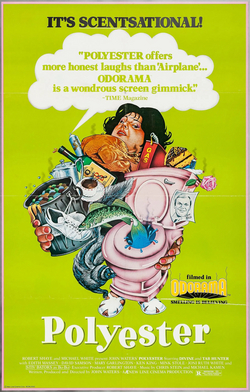
An attention-grabbing gimmick called Odorama, in which moviegoers can smell what they are viewing on-screen using special scratch-and-sniff cards, is a unique add-on to the film.
Scents like roses, pizza, and farts are a few examples.
In the story, a frustrated middle-class housewife, Francine Fishpaw (Divine), tries to maintain her sanity while managing her dysfunctional household. Her husband, Elmer (David Samson), the owner of a controversial adult theater, is sleeping with his secretary, Sandra (Mink Stole).
Meanwhile, her delinquent teen son, Dexter (Ken King), and pregnant teen daughter, Lulu (Mary Garlington), have problems of their own.
But when Francine meets handsome and wealthy Todd Tomorrow (Tab Hunter), the owner of a theater specializing in art films, her life takes a positive turn.
The biggest change from Waters’ previous works, which were always set in his hometown of Baltimore, is that the setting is a more upscale suburban neighborhood rather than the rank slums of downtown.
The Fishpaws reside in a powder blue house with a paved driveway and shutters. While not a mansion, it’s respectable, and they forge a decent lifestyle. Francine dreams away the days while dutifully cooking and cleaning for her husband and fixing his evening cocktail, while enduring jokes about her weight.
The story is told from Francine’s perspective, and she is joined by her best friend and former maid, Cuddles (Massey), who is now wealthy after an enormous sum of money was left to her by a former client.
The ladies chat over fattening cake, discussing Francine’s numerous problems and her scheme to catch her philandering husband in the act of cheating.
Francine’s pale blue phone rings constantly with one nuisance after another.
The film is a satire of suburban life in the early 1980s, involving topics such as divorce, abortion, adultery, alcoholism, racial stereotypes, foot fetishism, and the religious right.
Naturally, in wacky form.
My favorite sequence comes when a religious right group prances around Francine’s house protesting Elmer’s pornographic theatre. When one woman smacks Francine, she proudly proclaims, ‘That’s from Jesus.
Later, when on a shopping trip to try on dresses with Cuddles, a hungover Francine pukes in her handbag to the horror of a stuffy saleswoman.
It makes a mockery of religion, particularly Catholicism, as when wicked nuns enter the story in relation to a pregnant Lu-Lu. Shown as ridiculous, they are able to ‘reform’ Lu-Lu into the straight and narrow.
Polyester is filled with terrific moments tamer than Pink Flamingos and Female Trouble, but nonetheless laugh-out-loud and raucous.
For those curious about a John Waters film, left of center from the normal yet important Hairspray (1988), but still nicely subversive, Polyester (1981) is a great choice.