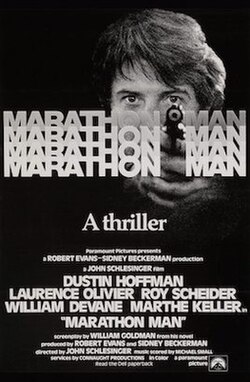
Marathon Man-1976
Director John Schlesinger
Starring Dustin Hoffman
Scott’s Review #1,359
Reviewed April 29, 2023
Grade: A-
Writer William Goldman was involved in two politically charged, taut thrillers released in 1976 that you can easily watch back-to-back.
Fast-paced, rapidly edited, action-packed offerings are on the menu.
The Academy Award-winning All the President’s Men (1976) and Marathon Man (1976) are highly recommended, as they are in the same vein.
They are part of why I love 1970s cinema so much. Freedom and rich character development, combined with a singular vision, are admirable traits.
John Schlesinger, famous for Midnight Cowboy (1969) and other films, directs.
Goldman wrote both films, and each stars Dustin Hoffman, so the similarities are endless. And yet, each has its own identity.
In Marathon Man, Thomas “Babe” Levy (Hoffman) is a Columbia graduate student and long-distance runner, residing in New York City. His older brother, Doc (Roy Scheider), is a government agent chasing down a Nazi war criminal named Szell (Laurence Olivier).
Babe doesn’t learn about Doc’s career until a tragic event draws him into a plot involving stolen gems and sadistic madmen. Even his girlfriend, Elsa (Marthe Keller), becomes a suspect as everything Babe believes is suddenly turned upside down.
At over two hours, there is not a slow moment in the film.
We meet Babe as he runs through New York City, so the audience learns that his obsession with running may be linked to his need to escape something.
This proves to be true when we learn the brothers’ father committed suicide after being investigated during the Joseph McCarthy era, when civilians were suspected and accused of being communists.
So, the backstory made me sympathize with Babe and Doc and fleshed them out as characters. Hoffman and Scheider are superb and show the nuances in the brothers’ personalities. Doc is sophisticated, and Babe is common, though highly intelligent.
The musical score, by Michael Small, deserves mention. Oftentimes in film, the score serves as more or less ‘background music’ and can go unnoticed.
This is not the case in Marathon Man, and I noticed the music-enhancing sequences several times, especially when peril was involved.
I was pleased to learn that the iconic Laurence Olivier plays the villain, Szell. He is believable as a vicious German Nazi who specializes in a unique brand of dental work.
First blonde, then bald, the role’s physical demands are on full display. He also calmly performs torturous tactics using dental tools.
Marathon Man is made up of a series of scenes that will either enthrall, make the audience squirm, or, in some cases, both.
Speaking of dental work, any viewer with a phobia or dislike of going to the dentist may want to fast-forward past the sequence in which Babe is forced to endure stylized poking and prodding.
Szell and his henchmen are convinced that Babe knows more than he is letting on and are determined to make him reveal all.
Early on, a terrifying road-rage scene in Manhattan is as good as it gets and reveals the plot’s gist. Nazis, anti-semitism, and a fiery gasoline truck encompass a speedy and argumentative car chase scene.
The sequence is heart-racing, nail-biting, and revealing.
Others flesh out the film like a quiet lunch at a lovely French restaurant. Doc takes Babe and Elsa out where they dine on lavish courses of creamy, sophisticated cuisine and wine.
The richness of the food and culture enhances the earlier scenes set in Paris.
The final thirty minutes of Marathon Man are the best part. A series of shootouts in the suburban rural farmland and foot chases in downtown Manhattan culminate in a showdown between Babe and Szell near a water tank in Central Park.
A strong appeal for viewers is the scene-by-scene New York City action, as many exteriors were shot there.
The plot of Marathon Man (1976) is sometimes too complicated, and not all events add up satisfactorily. The who’s who and realism are a tough sell, but it hardly matters.
The film entertains and is a high-energy thrill ride, and that is more than enough for me.
Oscar Nominations: Best Supporting Actor-Laurence Olivier
Golden Globe Nominations: 1 win-Best Actor-Drama-Dustin Hoffman, Best Director-John Schlesinger, Best Supporting Actor-Laurence Olivier (won), Best Supporting Actress-Marthe Keller, Best Screenplay